confused Resistor in paralled

Thread Starter

sangpo

Joined Aug 17, 2013
91
Dear all,


When a resistor is connected in parallel, for me it looks that one end/leg of resistor is connected to positive line and other end/leg of resistor is connected to negative line. which for me it is short-circuit.

Just for experiment, i have connected 12DC volt to a mortar and it spins well. I tried to connect a resistor in series (with positive line) and a motor spins in reduced speed.

I have removed that resistor in in series and same was connected in parallel ie. one end to positive and other to negative line. Then motor doesn't spin. I am thinking the reason for not spining is due to short circuit.

I request you to kindly throw light on following

1. whether resistor in paralled connnection is short-circuit or not
2. why resistors are connected in paralled
3. Why my moter does not run when I connect resistor in paralled./is my way of connecting resistor in paralled is wrong?

Thank you all
sangpo
 

studiot

Joined Nov 9, 2007
4,998
When a resistor is connected in parallel, for me it looks that one end/leg of resistor is connected to positive line and other end/leg of resistor is connected to negative line. which for me it is short-circuit.
This is not a short circuit.
A short circuit occurs when you connect two points by zero resistance eg a wire.
We say those two points are shorted or short-circuited together. (Don't try it with your power supply.)


You have correctly described connecting a resistor in parallel.

You should think of parallel connection as like plugging in your stereo, a table lamp and your pc to the mains.
They are all connected in parallel across the mains supply.

Experiment is good (do not experiment with the mains) but you did not report the value of you resistor so it is difficult to comment on it?
 

Thread Starter

sangpo

Joined Aug 17, 2013
91
Thank you (Studiot)for your explanation and especially for cautionary advice.. I have understood that if resistors connected paralled is not shorted, unless the value is zero. Am I right la? The value of resistor is approximately 100 ohms. I have tried with both higher and lower value of resistor in parallel. But the result is same (motor do not spin)
 

studiot

Joined Nov 9, 2007
4,998
Your power supply is clearly not strong enough to maintain 12 volts across both the resistor (which draws 0.12 amps) and the motor at the same time.

Have you any means to measure voltage or current ?
 

Thread Starter

sangpo

Joined Aug 17, 2013
91
I have a digital multimeter. The input is 13VDc and motor is rated 12 volt ( not mention ampere) I have tried with only one resistor(in series and parallel) for experiment.
Thank you studiot
 

Thread Starter

sangpo

Joined Aug 17, 2013
91
The reason why resistors are connected in series is to limit the current. But why do we connect them in parallel?
 
Last edited:

WBahn

Joined Mar 31, 2012
32,871
Some ideas:

1) Put the resistor in series with the motor and measure the voltage across the resistor. From that, calculate the total current draw and report that result.

2) Configure the DMM as an ammeter and put it in series with just the motor (no resistor) and report what current it says the motor is drawing and report the result.

3) Put just the resistor across the power supply (no motor) and measure the voltage across the resistor and report the result.

My suspicion is the same as studiot's, that your power supply can't support the current that the resistor needs while maintaining close to full voltage across it. So my guess is that test #1 will find that the voltage across the resistor is fairly small, perhaps just a few volts, that test #2 will find that the motor only draws a few dozen milliamps or so, and that test #3 will find that the supply voltage is pulled down to just a few volts when loaded by the resistor.

Repeat your experiment with a considerbly larger resistor, say 10kΩ. You will likely find in this case that the motor barely turns, if at all, when in series but that there very little effect when in parallel.
 
Last edited:

WBahn

Joined Mar 31, 2012
32,871
The reason why resistors are connected in series is to limit the current. But why do we connect them in parallel?
We don't always put them in series to limit current. The specific reason why any component is used the way it is depends very strongly on the specific circuit and what the intent is. It's very hard to provide any kind of decent answer to such a broad question without some kind of defining context.
 

studiot

Joined Nov 9, 2007
4,998
We don't always put them in series to limit current. The specific reason why any component is used the way it is depends very strongly on the specific circuit and what the intent is. It's very hard to provide any kind of decent answer to such a broad question without some kind of defining context.
However this is a good experiment to learn quite a lot about circuits from.

So perform the tests WBahn suggests, I was leading up to something like this.

We can discuss what you are observing, a little at a time.
 

Thread Starter

sangpo

Joined Aug 17, 2013
91
Thank you Wbahn for ur valuable suggestions. I will do experimenter this evening as suggested. But during my experiment I have used only 100 ohms ( which I think this has less resistance than 10Kohm) and this 100 ohms should drop less voltage than 10K ohms.
So if I experiment with 10 kilo ohms, then isn't there be more voltage drop thereby still motor doesn't turn? Please advaice me where Im going wrong
 

WBahn

Joined Mar 31, 2012
32,871
Thank you Wbahn for ur valuable suggestions. I will do experimenter this evening as suggested. But during my experiment I have used only 100 ohms ( which I think this has less resistance than 10Kohm) and this 100 ohms should drop less voltage than 10K ohms.
So if I experiment with 10 kilo ohms, then isn't there be more voltage drop thereby still motor doesn't turn? Please advaice me where Im going wrong
Uh... yeah. 100Ω has about 1% of the resistance that 10kΩ (which is the same as 10,000Ω) does.

You are trying to think in terms of a mistaken notion that the voltage drop across a resistor is purely a function of the resistance. It isn't. The voltage drop across a resistor is related to the current through the resistor by Ohm's Law, namely that

V = I*R

When you connect two things in series, you force them to have the same current but you split the voltage between them. When you connect them in parallel, you force them to have the same voltage but split the current between them.
 

studiot

Joined Nov 9, 2007
4,998
If you have some larger resistors:

Start with the largest you have, connect it in parallel across the 12v and the motor and test to see the effect.

Then do it for a smaller resistor and then a smaller one......

I suggest 1,000,000Ω, 100,000Ω, 10,000Ω, 1,000Ω

Measure the actual volts the psu (power supply unit) is giving out each time.

Each post we can introduce a little more terminology / abbreviation / unit. Note the omega symbol at the end for ohms. You will find this to the right of the text box in the full input text editor in the forum.
 

Thread Starter

sangpo

Joined Aug 17, 2013
91
Thank you Wbahn. very much for your suggestion and advice and explanation. It helps one like me ( who is new to to electronic) U have provide lot of information
Thanks a lot
sangpo
 

Thread Starter

sangpo

Joined Aug 17, 2013
91
As suggested by Wbahn. I carried out the folowing experiemment.

1. I have put the resistor 2Kohms in series( i dont have 10K ohm) with motar. The motar do not spin. Votage is 13VDC (input is 14 VDC.) Aternatively I have tried with 100 ohms resistor the same way. This time motar spins. Votage is found to be 8.5 VDC.

As per Ohms Law: the current is 13/2kohm=.0065 A and 8.5/100=.085A=85mA
2. with 2 k ohms. the current measured is 2.4 mA. But motar stops spinning when tesing AMpere. Is it oK if it stop spining mortar when checking ampere? With 100 Ohms resistor. the ampere is 0.6mA. Motar stops here also when checking ampere.
3. With resistor 100ohms the volt measured is 13.5 Vdc and with 2 k ohms it is 7.3 Vdc

Please kindly go through my experimental findings

Sangpo
 

WBahn

Joined Mar 31, 2012
32,871
As suggested by Wbahn. I carried out the folowing experiemment.
What I told you to do:

1) Put the resistor in series with the motor and measure the voltage across the resistor. From that, calculate the total current draw and report that result.
What you reported:

1. I have put the resistor 2Kohms in series( i dont have 10K ohm) with motar. The motar do not spin. Votage is 13VDC (input is 14 VDC.) Aternatively I have tried with 100 ohms resistor the same way. This time motar spins. Votage is found to be 8.5 VDC.

As per Ohms Law: the current is 13/2kohm=.0065 A and 8.5/100=.085A=85mA
So this is 13V across the resistor, which would indicate about 6.5mA. With the 100Ω resistor you have 8.5V across the resistor giving about 85mA.

Since the motor didn't turn with the 2kΩ resistor, the remaining 1V was taken up in the resistance of the motor winding which, at 6.5mA, would imply that the winding is roughly 15Ω. At 85mA, that would mean that the winding resistance is dropping about 1.3V leaving about 4.2V to be dropped as back-emf from the turning motor.

Next:

2) Configure the DMM as an ammeter and put it in series with just the motor (no resistor) and report what current it says the motor is drawing and report the result.

2. with 2 k ohms. the current measured is 2.4 mA. But motar stops spinning when tesing AMpere. Is it oK if it stop spining mortar when checking ampere? With 100 Ohms resistor. the ampere is 0.6mA. Motar stops here also when checking ampere.
This isn't making much sense. Is it an autoranging DMM? If so, perhaps the motor back-emf is confusing the autoranging circuitry. Try forcing into a fixed range.

But I still don't understand your measurements above. Are you saying that with the meter, the resistor, and the motor all in series the current draw was 2.4mA with the 2kΩ resistor but only 0.6mA with the 100Ω resistor?

Could you sketch exactly how you had things connected?

Also, what I had wanted you to do was to measure the motor current with NO resistor in the circuit, just the meter.

Next:

3) Put just the resistor across the power supply (no motor) and measure the voltage across the resistor and report the result.

3. With resistor 100ohms the volt measured is 13.5 Vdc and with 2 k ohms it is 7.3 Vdc
This also makes no sense. Are you SURE you didn't get the resistors swapped?

What are you using for your voltage supply?
 

Thread Starter

sangpo

Joined Aug 17, 2013
91
Your advise No2: Configure the DMM as an ammeter and put it in series with just the motor (no resistor) and report what current it says the motor is drawing and report the result.

I dont know how to write schematic drawing. So I have measured the current in the following way(may be I haven't measure the current the right way)

1. I have connected the 2k ohms in series (ie across the positive line(red wire) of power that connect one terminal of a motor)
2. I have set/inserted red probe of multimeter into 20Am and black in common. With running/spinning the motor, then I have placed the red prob of multimeetr to the postive wire which connect terminal of motar after joint of resistor. And other black probe of multimeter to other terminal of mortar.

Your suggestion No3:: Put just the resistor across the power supply (no motor) and measure the voltage across the resistor and report the result.
How I have done: I have connected one end of resistor to positive line(red wire( and other end of resistor to negative line(black wire). No motor was connected. To measure volt. I have placed the red probe of meter to positive line and black probe of meter to negative.

Sorry, my english is bad.

Thank you
 

WBahn

Joined Mar 31, 2012
32,871
Your advise No2: Configure the DMM as an ammeter and put it in series with just the motor (no resistor) and report what current it says the motor is drawing and report the result.

I dont know how to write schematic drawing.
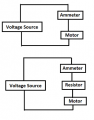
So use Paint. It doesn't have to be fancy. Consider the attached figure.


So I have measured the current in the following way(may be I haven't measure the current the right way)

1. I have connected the 2k ohms in series (ie across the positive line(red wire) of power that connect one terminal of a motor)
Notice that the instructions I gave said NO RESISTOR! Put the resistors off to the side and don't touch them for this test. Also, a resistor has TWO terminals. Your description tells me that one terminal is connected to the red wire that connects the power to the motor. Where is the other terminal connected?

Use the top figure above for this test.

2. I have set/inserted red probe of multimeter into 20Am and black in common. With running/spinning the motor, then I have placed the red prob of multimeetr to the postive wire which connect terminal of motar after joint of resistor. And other black probe of multimeter to other terminal of mortar.
It sounds like you are shorting out the motor with the meter, which is why it stops working. You need to connect an ammeter in series with the circuit so that the current that you are measuring has no choice but to go through BOTH the meter AND what you are measuring the current through.

Your suggestion No3:: Put just the resistor across the power supply (no motor) and measure the voltage across the resistor and report the result.
How I have done: I have connected one end of resistor to positive line(red wire( and other end of resistor to negative line(black wire). No motor was connected. To measure volt. I have placed the red probe of meter to positive line and black probe of meter to negative.
This sounds fine, but are you SURE that the voltage value you reported for when the 2kΩ resistor was across the supply really was when the 2kΩ resistor was across the supply? How are you determining what the resistor value is? Measuring it with the meter? Reading the color bands? If the latter, what ARE the color bands?

And, again, what is it that you are using for a power supply?
 

Attachments

Thread Starter

sangpo

Joined Aug 17, 2013
91
Thanks a lot Wbahn. This is with regard to my experiment as per advise No2. I have connected the resistor between povsitive line (red wire) ie one terminal of resistor to one end of red wire and other terminal of resistor to end of red wire. I have check what you have suggested in your suggestion no 2. So i have re-checked/experiment done to check what current motor draw. It measured 0.25mA. With 100ohms resistor in series. the current the motar draw is 0.22mA. But with resistor of 2Kohms. motar doesnot spin as same as I have reported for the first time. I have followed the right way to measure current as advised by you. now with right way to check curent. motor do not stops. Thanks now I have leaned how to check ampere. Did I do better?

I am sorry for the mistake i have done, but i have learn a lot. Sorry for the trouble
Thank you La
Sangpo
 

WBahn

Joined Mar 31, 2012
32,871
Not too much trouble. I'm glad to help.

What kind of motor is this? Seems odd for a motor to draw so little current, even under no load conditions. But maybe not.

What kind of value do you get if you use your DMM to directly measure the resistance of the motor's winding?
 
Top