when you grow your experience then you will notice that all the circuits out there are not readily through-tested and verified for every possible combination of parts available. As in fact - majority of the circuits are the copies or modified copies of the copies or modified copies already out there before , so some may have their original parts and connections significantly changed since the next user didn't use the ®parts and modified the circuit for the ones it got . . . what however is the worse case is when originally a simplified , theoretical circuit changed it's context to a highly functional one /!\/!\/!\
_______________
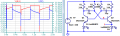
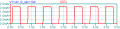
This "fade-OFF" effect presents in original TS's circuit too.
Transistors are in active region, because for saturation Beta of transistors should be much more than R_b / R_c (>>10k / 220 or >>500).
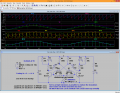
See how changes behavior of circuit with lower value of R_b:
________________
other than that ↑ the circuit in question ↑ only looks as "a simple one" -- i have been attempting to make sense of it every now and then - in conjunction of different target purposes - and learned , that you can tune it in several occasions to meet your needs . . . but there seems to be no universal setup that would work at all weather . . . . . . the thing can be made to consume nano-amps only - but in general it still takes a lot of more power than some simple DTL gate (it might be more noise proof - but there is actually very few reasons to prefer it to any low voltage logic family commercially avail - the only good benefit is that if you can't go shopping - you can do most any trick with it . . . https://www.quora.com/How-do-flip-flops-work-with-transistors , etc. ...)
If the battery voltage sags (decreases) under load, the circuit operation changes. The constant-on LED and either of the switched LEDs add up to a constant 50 mA load on the battery, not counting the energy used by the timing capacitors.
it's worth to work out the answer to your question because such will reveal the information what you sometimes cannot predict/expect
i don't have the transistor models nor your wall supply nor the batteries - i may test out the answer for something similar - but it won't be it then
what i can tell you is that the transistor and the transistor may have a big difference ← which may be one of the causes -- for your power range you can try the 2N3904 only it starts to heat up above 43mA and gets really hot above 56mA continuous/average collector current
it may occur that when some simulation shows the circuit operates at a wide range of biasing currents (with all possible base resistor values form 100Ω to a M-Ohm) -- then the actual case is that (depending on circuit) it may work at low range say 150Ω to 300Ω (in one mode) - then it does not start up with intermediate values . . . and yet works again from 2kΩ to 4.3kΩ (in another mode) ← the values and range widths are also supply dependent
there might be a case that to start up the circuit requires a fresh powerful battery - but when it already works it can work from almost empty one - if tuned "precisely" (optimally to work with lower voltages)
there might be a case that - in contrary to prev. case - the circuit wont start up with high power supply but requires one that reacts more to power draw . . .
A simple fix may be to first reduce the LED current a bit by changing the collector resistors from 220 ohms to 470 ohms. Then add a capacitor across the battery, possibly about 100mFD at 25 volts or so. Then it may work well with the 9 volt battery. Or is max brightness from the white LEDs very important, such as in a bike headlight?
Also, since this comment addresses several posts, it is possible for both outputs to be on in some flipflop circuits. Not normal, but possible.
Circuit with good timing stability.
Works from 9V (fresh) to 4V (discharged) battery.
Duracell 9V 310 mAh Alkaline battery will work
more than 9 hours continuously.
β => 30 [R6 / R7]
The circuit in post #28 is very different in two aspects: First, the LED drivers are separate from the driver flipflop circuit and run at a much lower collector current, since the collector load resistors are 10K ohms instead of 220 ohms. Second, the flipflop portion is running on a regulated voltage, because the D1 LED is serving as a shunt type voltage regulator. Thus the voltage is always close to 3.3 volts. So while it is a good and stable circuit, it is also very different from the original one. Even the RC time constant components are much different, the capacitance being lower and the resistance being much larger.

 Facebook
 Google
 GitHub
 Linkedin