complementary relaxation oscillator

Thread Starter

xljin2014

Joined Nov 11, 2014
120
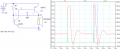
We are interested in violet marked region, where collector voltage V(3) starts drop:

View attachment 296121

Let us see on base Ib(Q2) and capacitor I(C1) currents under microscope:

View attachment 296122
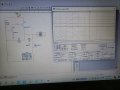
IMG_20230614_113235.jpghere is my multisim simulation. no oscillation. q2 collector is always about 3v. and q1 base is always about 0.7v. I guess it's from speaker. because when I use resistor. it oscillate well. and when I use inductance. it oscillate differently.
 

Danko

Joined Nov 22, 2017
2,169
here is my multisim simulation. no oscillation. q2 collector is always about 3v. and q1 base is always about 0.7v. I guess it's from speaker. because when I use resistor. it oscillate well. and when I use inductance. it oscillate differently.
Slightly changed circuit works with all your loads.
Use diode parallel to inductive load else transistors will breakdown by hundreds volt spikes.

1686726278715.png

1686726420123.png

1686726561497.png

1686728058803.png
 
Last edited:

Danko

Joined Nov 22, 2017
2,169
what simulation software do you use?I think multisim's speaker is not so well for simulation.
thx.
It is free simulation software LTspice XVII.
Download from: https://www.analog.com/en/design-center/design-tools-and-calculators/ltspice-simulator.html
Additional library by @Bordodynov (where speaker model is): http://bordodynov.ltwiki.org/.

ADDED:
XLV1 is not speaker model, but it is LabVIEW instrument. Read manual here:
https://knowledge.ni.com/KnowledgeArticleDetails?id=kA03q000000YI4sCAG&l=ru-KZ
 
Last edited:

Bordodynov

Joined May 20, 2015
3,431
In LTspice it is possible to record the signal obtained in the simulation in WAV format. The resulting WAV can be played back on the computer. But you have to make this file from a signal that is less than 1 V in amplitude. The signal must be made without a constant component.
 

Thread Starter

xljin2014

Joined Nov 11, 2014
120
We are interested in violet marked region, where collector voltage V(3) starts drop:

View attachment 296121

Let us see on base Ib(Q2) and capacitor I(C1) currents under microscope:

View attachment 296122
here is what I leaned,have a look:
first. let's put off c1, to see what is the stable state:let voltage of q2 to be Vo. then vo=((vcc-vbe1)/r1)*beta1*beta2*rload. let r1>>r2,we could let Vo less than vcc.it's better to let q2 to be in amplify area.
now put c1 on. as all know s. vcc charge c1 through r1 and load. as q1 base voltage goes to about 0.6v. q1 start on. and this makes q2 on. q2 on with load makes q2 collector voltage goes up. this feedback to q1 base through c1. which makes q1 conduct more. by this posative feedback. q1 base will be 0.7v. q2 collector will go to nearly vcc.

points come now:will q2collector voltage go high? stay there? or go down? as I have shown above. amplify region is the stable state. so q2 collector will go down. and there's road: right plate of c1--load--source--r1--left plate of c1.and as q2 collector voltage go down. c1 couple it to q1 base. which makes q2 base go up. which makes q2 current go down. so Vo go down more. this is still a positive feedback. Vo will go to zero. q1base -(vcc-0.7).

now vcc will charge C1 again. cycle.
 

Danko

Joined Nov 22, 2017
2,169
here is what I leaned,have a look:
first. let's put off c1, to see what is the stable state:let voltage of q2 to be Vo. then vo=((vcc-vbe1)/r1)*beta1*beta2*rload. let r1>>r2,we could let Vo less than vcc.it's better to let q2 to be in amplify area.
now put c1 on. as all know s. vcc charge c1 through r1 and load. as q1 base voltage goes to about 0.6v. q1 start on. and this makes q2 on. q2 on with load makes q2 collector voltage goes up. this feedback to q1 base through c1. which makes q1 conduct more. by this posative feedback. q1 base will be 0.7v. q2 collector will go to nearly vcc.

points come now:will q2collector voltage go high? stay there? or go down? as I have shown above. amplify region is the stable state. so q2 collector will go down. and there's road: right plate of c1--load--source--r1--left plate of c1.and as q2 collector voltage go down. c1 couple it to q1 base. which makes q2 base go up. which makes q2 current go down. so Vo go down more. this is still a positive feedback. Vo will go to zero. q1base -(vcc-0.7).

now vcc will charge C1 again. cycle.
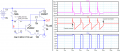
Below is demo:
1686910932322.png
 

Danko

Joined Nov 22, 2017
2,169
see VB. it goes rapidly high. means positive feedback.then goes down exponentially(?). then goes down rapidly. then goes up linearly.
1. Capacitor C1 is charging through diode B-E of Q1,
so curve of voltage on base Q1 is defined by AV characteristic
of forward biased diode B-E of Q1.
2. Discharging curve is almost linear, because
discharging current through resistor R1 is almost constant .
 
Last edited:
Top