complementary relaxation oscillator

Thread Starter

xljin2014

Joined Nov 11, 2014
120
1. Capacitor C1 is charging through diode B-E of Q1,
so curve of voltage on base Q1 is defined by AV characteristic
of forward biased diode B-E of Q1.
here is what I learned and my question:

after node 1,2 are connected . there seems have positive feedback that makes VB and vout to go near 3v. (maybe this is the only way). then have this current road: left hand of c1---q1 Base---r2---power supply---q2 emitter---q2 collector---c1 right hand. (maybe this is the only choice).
my question is: when will VB and vout start positive feedback after VB exponential curve?

thx first.
 

Danko

Joined Nov 22, 2017
2,169
after node 1,2 are connected . there seems have positive feedback that makes VB and vout to go near 3v. (maybe this is the only way). then have this current road: left hand of c1---q1 Base---r2---power supply---q2 emitter---q2 collector---c1 right hand. (maybe this is the only choice).
my question is: when will VB and vout start positive feedback after VB exponential curve?
β(Q1) depends on level of input signal.
β(Q2) depends on level of saturation.
Dynamic attenuation in feedback chain depends on signal level changes speed.
etc...
Therefore overall gain changes continuously in time.
When overall gain becomes 1+, system switches its state.
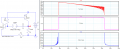
On picture, with help of 1MHz probe signal, you can see how overall gain changes in time:

1687110672553.png
 
Last edited:

MisterBill2

Joined Jan 23, 2018
27,547
It is junk because it depends on the battery internal resistance and state of charge, and because it depends on the exact transistor characteristics. That means that multiple copies may not all perform in a similar way, and with different battery characteristics it may not function at all.
 

Thread Starter

xljin2014

Joined Nov 11, 2014
120
β(Q1) depends on level of input signal.
β(Q2) depends on level of saturation.
Dynamic attenuation in feedback chain depends on signal level changes speed.
etc...
Therefore overall gain changes continuously in time.
When overall gain becomes 1+, system switches its state.
On picture, with help of 1MHz probe signal, you can see how overall gain changes in time:

View attachment 296627
thx.
it's first time I heard this: when overall gain to be 1+, system switches it's state.is it the point that q1 base and q2 collector go down sharp?
don't know about the pic.what is top of pulse? full pulse?bottom of pulse?how the vout curve?

another thing:when q2 collector voltage go down. there can be positive feedback. q2 collector voltage goes down. couple d by c1, q1 base voltage go down. q1collector current goes down. q2 collector current goes down.vout goes down. it is said this will make vout goes to ground. and q1base below 0v. the problem is : when q1base lower than say 0.4v. it stops. the positive feedback can't work. my answer is like this:the rload pull down vout. and q1base go down by c1's coupling. is it right?

thx first..
 
Last edited:

Danko

Joined Nov 22, 2017
2,169
when q2 collector voltage go down. there can be positive feedback. q2 collector voltage goes down. couple d by c1, q1 base voltage go down. q1collector current goes down. q2 collector current goes down.vout goes down. it is said this will make vout goes to ground. and q1base below 0v. the problem is : when q1base lower than say 0.4v. it stops. the positive feedback can't work. my answer is like this:the rload pull down vout. and q1base go down by c1's coupling. is it right?
Good.

it's first time I heard this: when overall gain to be 1+, system switches it's state.is it the point that q1 base and q2 collector go down sharp?
don't know about the pic.what is top of pulse? full pulse?bottom of pulse?how the vout curve?
Do not pay attention to post #42.
My English level is zero, so it is really difficult for understanding.
 
Top