complementary relaxation oscillator

Thread Starter

xljin2014

Joined Nov 11, 2014
120
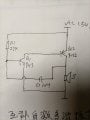
IMG_20230514_194647.jpghi,friends.
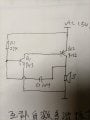
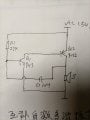
this is a complementary relaxation oscillator.
here is what I can understand: at first, vcc charge c1 through r1 and speaker(s) , so the voltage of left hand of c1, also the base of q1,start s to go up, to about 0.5v, q1starts to conduct, this makes q2 to conduct too.and voltage of collector of q2 goes high. this positively feedback to base of q1, to make q1 and q2 conduct fully.
my question is, what comes next? will c1discharge?how? through what route?
thx
 

DickCappels

Joined Aug 21, 2008
10,661
It is an adaptation of the circuit to use and inductor in place of the speaker and it utilizes the voltage spike when the transistor switches off to get a high enough voltage to light the LED, neither of which the earlier circuits did.
 

Thread Starter

xljin2014

Joined Nov 11, 2014
120
This circuit has been around longer and me (and that is a long time). It popped up again in a U.S. Patent in 2003. It is pretty well explained in the patent, attached.
thank you. but I found it is not same exactly with my circuit, and the patent is not explaining how it is oscillating. help...
 

Bordodynov

Joined May 20, 2015
3,430
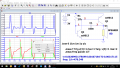
Yes, this is the LTspice simulator file.
I applied a speaker, and it has a complicated equivalent circuit. So to analyze this circuit is not enough skills of a student. Especially it is a non-linear circuit. Simplified, we can consider that it is a non-inverting amplifier. The first stage with common emitter with gain equal to one is the first inverting stage. The second stage is also a common emitter circuit, loaded on the load with an inductive impedance. The capacitor introduces positive feedback.
 

Danko

Joined Nov 22, 2017
2,136
how does c1 charged and discharged? thx.
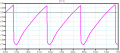
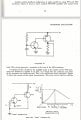
See how capacitor C1 is charging-discharging (@Bordodynov's simulation in post #8):
1684644699266.png
ADDED:
at first, vcc charge c1 through r1 and speaker(s) , so the voltage of left hand of c1, also the base of q1,start s to go up, to about 0.5v, q1starts to conduct, this makes q2 to conduct too.and voltage of collector of q2 goes high. this positively feedback to base of q1, to make q1 and q2 conduct fully.
my question is, what comes next?
Important! Current through R1 should be only partially turning ON transistor Q2.

So, In your explanation Q2 is fully turned ON while current through C1 is enough for it.
But C1 current fast decreases in process of charging and collector current of Q2 starts to decrease too.
Voltage on speaker decreases, fully charged capacitor starts to discharge through R1 and speaker,
direction of C1 current reverses, polarity of Q1 base voltage reverses, Q1 and Q2 become turned OFF.
Capacitor C1 discharges during long time by R1 current, provide pause between generated current pulses.

In your case resistance of R1 27k is a little small, therefore circuit does not work when load is resistor 8 Ω,
but speaker generates sine, which negative part helps to turn Q1 and Q2 OFF.

Links:
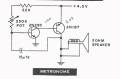
Circuit of metronome
https://forum.allaboutcircuits.com/threads/simple-tone-oscillator-22mf-capacitor.95028/#post-703007
 
Last edited:

Thread Starter

xljin2014

Joined Nov 11, 2014
120
IMG_20230514_194647.jpg

thx Danko.
now I'm thinking about this: when Q2 starts to conduct and it's collector voltage goes to high peak by positive feedback, will the collector peak voltage goes high?stay there? or go down? and why?
thx first.
 
Last edited:

Danko

Joined Nov 22, 2017
2,136
when Q2 starts to conduct and it's collector voltage goes to high peak by positive feedback, will the collector peak voltage goes high?stay there? or go down? and why?
thx first.
Positive feedback is carried out through capacitor.
While capacitor is charging from Q2 collector peak voltage, Q2 still conduct.
When capacitor is charged, current through capacitor and base Q1 dramatically drops, Q1 collector current and base Q2 current are drop too,
Q2 collector voltage begin decrease and, thanks to positive feedback, Q2 collector voltage goes down very fast.
 

AnalogKid

Joined Aug 1, 2013
12,049
This circuit has been around longer and me (and that is a long time).
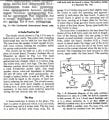
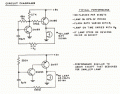
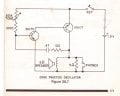
GE Transistor Manual, 7th Edition, 1964, Experimenters Circuits: Code Practice Oscillator, Metronome

GE Transistor Manual, 6th Edition, 1962, Experimenters Circuits: Code Practice Oscillator

GE Transistor Manual, 2nd Edition, 1956 (?), Circuit Diagrams: Metronome, Light Flasher

Wow, that's O.L.D.

These are images from the 1956 edition. Note that one of the flasher circuits has the base current limiting resistor, but that circuit is not in succeeding editions. In the Metronome circuit the speaker is shorted out; they did fix that in later editions.

Thanks to Bertus for the WRH source way back when, a gift that keeps on giving.

https://worldradiohistory.com/BOOKSHELF-ARH/Bookshelf-GE.htm

ak

Metronome-1957.gif Flashers-1957.gif
 
Last edited:

DickCappels

Joined Aug 21, 2008
10,661
@Mrcips, this is the circuit that I bought pre-built at Sunnyvale Electronics (TV Repair supply shop) at about 1962 at the terrific price of 55¢. Good find.
 
Top