Commonly used acronyms and synonyms in electronics

Janis59

Joined Aug 21, 2017
1,893
choke = inductor, coil, inductance, inductive reactance
condenser = capacitor, condenator, cap.
valve = tube, vacum lamp, radio-lamp
trace = track (PCB), wire, lead, path
klaxon = horn, beeper, sounder, buzzer
μP =microprocessor, ARM
CMOS = CMOP
SMPS = impulse power supply
vacuum chamber = vacuum camera (!)
camera = photo apparate
 

Ya’akov

Joined Jan 27, 2019
10,259
Here are some (very partial list) terms, including ones that have general use but are also heard among people working with magic pixies (see below). All of these have some folksy or humorous quality, but are actually used to communicate important ideas. Engineers and other technical folks seem to like to have fun.

Pronunciations are American English and provided for acronyms and for initialisms when there is a particular way of saying them.

WAG n. /wæɡ/ acronym
Wild Assed Guess; a surmise
SWAG n. /swæɡ/ acronym
Scientific
Wild Assed Guess; A surmise by an expert

FUBAR adj. /fu bar/ acronym
F[oul*]ed Up Beyond [Repair | Recognition]; American GI slang probably from WWII. Today often connotes human error has interfered with proper operation of a device); related to:
SNAFU adjective. /'snæfu/ acronym
Situation Normal, All F[oul]ed Up

*both terms above are usually heard in situations where politeness is not at a premium and an alternative pronunciation of "fouled" should be expected.

RTFM imperative, initialism
"Read The F[ine] Manual" Advice given to a person asking someone else to think for them when documentation is readily available. Possibly not so polite, depending on who is saying it, and to whom.

ID10T Error n. /ɪd10ti ˈɛrər/ A way to discuss or label human error as the cause of a problem in front of the causing human. Spoken as "eye dee 10 tee error"

Magic Smoke n.
The secret material used to make all electronic components work. If allowed to escape it is almost impossible to put back inside.
Magic Pixies n.
Whatever it is that moves through the wires of an electrical circuit, or seems to, often causing magic smoke. Most people who "know" what magic pixies are would call then electrons (source of the name "electricity") but it turns out that magic pixies may not be the responsible agents. Do we need a new term, possibly "magic wind"?

Smurf Tube n. (N. America, Electrical Trade)
1690194451383.png
Flexible, non-metallic conduit used for low and no voltage wiring (fiber optic cable). Usually corrugated in appearance though not like vacuum cleaner hose rather with grooves. Originally and often in blue color where it got the name but now generally available in many colors.

Ground Lifter n. (N. America)
1690194239924.png
A device commonly sold in hardware stores designed to render otherwise safe electrical appliances potentially deadly, and used because of improper or out of date wiring. It is usually called a "three prong adapter", and can be used safely if the including ground wire or lug is connected to a bonded outlet or box (almost never the case).

When called a "ground lifter" it is being used explicitly to render the safety ground of a device useless in order to "isolate" it from either ground loop induced hum in audio gear or an undesirable path to ground for test gear. It is a very cheap substitute for an isolation transformer, that is, unless it cost you your life.

DC to Daylight adj.
Denotes ultrawide bandwidth, suggesting a device is usable at frequencies in this range. It is poetic, and if you look at it too hard, it stops making any sense. So, don't look too hard, just enjoy it.


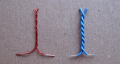
Gimmick n. (also "Gimmick Capacitor")
1690195150646.png
A capacitor made from a pair of insulated wires twisted together. Usually found as a way to trim a circuit. The gimmick is made too long, then progressively "trimmed" (cut off in length) until the best value is found. Well known among old school circuit builders and in some specialty disciplines but often a revelation to neophytes and those who don't generally need such a thing.

Kludge n.|v.
A quick or compromised construction or repair usually the result of improvisation with parts on hand. But sometimes caused by ignorance, this is, the lack of relevant knowledge on hand. A kludge is usually, but not always, intended to be temporary but the most common lifetime is until it stops working.

The pronunciation of kludge is a matter of debate. Some folks insist (correctly) it is with with the u sounding like the oo in "moon". Others will insist (incorrectly) with their last breath the u is pronounced like the u in duck. The author takes no position on this controversy other than to note the correct way to say it.

Hack n.|v.
A hack is a quick and clever fix. Unlike the kludge, the hack can be an innovative solution that will be repeated. The source of hacker (one who hacks) in the context of building devices, when used natively it it considered a term of praise.

This usage is said to originate in the 1950s among members of the MIT Model Railroad Club which was a refuge for people who loved to build complicated devices and took this out on model railroad layouts. In particular creating very complicated signaling systems based on electromechanical relays, and capable of logical operations to have pulled off a "good hack" was something that would provoke discussion and imitation.

This is the same group that embraced digital computers as soon as they were available. This is not a coincidence, of course.

There are a couple of notional etymologies for this usage. One is the idea of a primitive furniture builder who uses an axe to create furniture of unlikely quality. Another is related to an earlier usage as in "hack golfer" denoting a bad player (presumably who "hacked away" with the club rather than taking elegant swings). There is no good evidence for either of these, though.

"Hacker" is now seen as a synonym for "cybercriminal". This makes many real hackers quite angry. Attempts to make a distinction by labeling those who do damage as "crackers" almost worked, but didn't. Hackers pride themselves on doing no damage and leaving no trace, they may do things that are techically illegal because to the way the law is written, but they distinguish the illegal from immoral. The theory is if you've done no harm, and not even left a trace, there is no reason for that to be illegal.

Those people who write the laws either don't care about the distinction of don't understand it, which means that since Operation Sundevil it's been dangerous to be a hacker on your own terms. We seem to have settled on the distinction of white hat vs. black hat hackers, which is a very organic and probably appropriate thing. It's not the using of tools but how you use them that matters.
 

MisterBill2

Joined Jan 23, 2018
27,679
One more rather confusing term I have come across only in this forum is "MCB", used to imply Miniature Circuit Breaker.
Common usage for MCB is to mean MAIN Circuit Breaker. Defining a device by it's physical size instead of it's application is an effective way to cause confusion among those folks used to the more common use of terms.
It is even worse than referring to a computer program listing as a "sketch", which is rather illiterate.
 

Ian0

Joined Aug 7, 2020
13,158
One more rather confusing term I have come across only in this forum is "MCB", used to imply Miniature Circuit Breaker.
Common usage for MCB is to mean MAIN Circuit Breaker. Defining a device by it's physical size instead of it's application is an effective way to cause confusion among those folks used to the more common use of terms.
It is even worse than referring to a computer program listing as a "sketch", which is rather illiterate.
MCB is always ”Miniature circuit breaker” here. (Though, if what is normally called a MCB is “miniature” it makes me wonder how big a normal sized one would be)
 

MisterBill2

Joined Jan 23, 2018
27,679
MCB is always ”Miniature circuit breaker” here. (Though, if what is normally called a MCB is “miniature” it makes me wonder how big a normal sized one would be)
As MCB is taken to describe the branch circuit breakers, then How then is the main circuit breaker referenced? As the BIG circuit breaker??? That is where the uncertainty is made.
And that is why the early response was based on the poor choice of descriptors.
In the USA there is one entrance connection breaker to protect the wires to the panel, and then many branch circuits.
Quite often, but not always, every breaker is physically the same size. And in no case are the branch breakers called "miniature", because none of them ARE miniature. Referencing to function, Main or Branch, makes vastly more sense.
 

Ian0

Joined Aug 7, 2020
13,158
As MCB is taken to describe the branch circuit breakers, then How then is the main circuit breaker referenced? As the BIG circuit breaker??? That is where the uncertainty is made.
It’s always a fuse, in its own box, next to the meter, generally where the neutral is bonded to earth on a TN-C-S system. In the “consumer unit” (hate the term, because it is entirely meaningless) the incoming supply has a double pole (Live and neutral) isolator.
Three phase supplies have three fuses.
 

MisterBill2

Joined Jan 23, 2018
27,679
It’s always a fuse, in its own box, next to the meter, generally where the neutral is bonded to earth on a TN-C-S system. In the “consumer unit” (hate the term, because it is entirely meaningless) the incoming supply has a double pole (Live and neutral) isolator.
Three phase supplies have three fuses.
Interesting! I did, for a while, live in a part of the country where all of the circuit protection was located hard-by the meter box. That included the main and the branches, all in one enclosure, fairly weatherproof. That was the standard for Residential locations. (a much better term than "consumer") Businesses and apartment buildings had the same requirements, up to some size, after which the rules were a bit different.
The downside was that it made it convenient for any bad actor to disrupt one's power. The second occurrence was prevented by the addition of a cheap padlock, which the fire department agreed they could easily cut.
 

djsfantasi

Joined Apr 11, 2010
9,237
It is even worse than referring to a computer program listing as a "sketch", which is rather illiterate.
Not necessarily. Remember the original market for Arduinos? It was to non-computer literate artists. In that context, “sketch” is an excellent term to refer to a computer program, to which artists might have negative connotations.
 

Ian0

Joined Aug 7, 2020
13,158
Interesting! I did, for a while, live in a part of the country where all of the circuit protection was located hard-by the meter box. That included the main and the branches, all in one enclosure, fairly weatherproof. That was the standard for Residential locations. (a much better term than "consumer") Businesses and apartment buildings had the same requirements, up to some size, after which the rules were a bit different.
The downside was that it made it convenient for any bad actor to disrupt one's power. The second occurrence was prevented by the addition of a cheap padlock, which the fire department agreed they could easily cut.
The "mains fuse" is (hypothetically) only replaceable by the electricity company (who will lecture you on electrical safety if you manage to blow it) and the fuseholder is fastened shut by a steel cable with a lead seal. So if you want to do some unauthorised work on the fuse box, you have to remove the seal. At some later date you will be interrogated by the electricity company as to why the seal is missing and you can offer a lame excuse such as "Dunno mate, I never look in there" or "it was like that when I bought the house" or you can cut the cable at the furthest distance from the seal then tuck the cut ends in round the back so that it looks intact. Now that they have farmed out meter reading to some data collection company who doesn't give a damn, that's all in the past.
 

MisterBill2

Joined Jan 23, 2018
27,679
Given that it is safer to work on electrical wiring with the voltage off, it makes no sense for the electrical utility to not allow folks to disconnect the mains feed ahead of the distribution panel. Replacing the panel or installing additional circuits are two honest actions that are definitely safer with the power off. And no way can that equate to bypassing the metering.

I did need to disconnect the segnebt between the utility drop cable and my meter panel in order to replace it. That was a bit tense, by the way. The utility person had used crimp on splices for the connection, which was unfortunate. The installation previously had used good copper split-bolt connections that can be used repeatedly, and installed with common tools.
Of course, I did use my wooden ladder to do that project. Being totally insulated from ground reduces the shock hazard quite a lot.
 

Ian0

Joined Aug 7, 2020
13,158
Given that it is safer to work on electrical wiring with the voltage off, it makes no sense for the electrical utility to not allow folks to disconnect the mains feed ahead of the distribution panel. Replacing the panel or installing additional circuits are two honest actions that are definitely safer with the power off. And no way can that equate to bypassing the metering.

I did need to disconnect the segnebt between the utility drop cable and my meter panel in order to replace it. That was a bit tense, by the way. The utility person had used crimp on splices for the connection, which was unfortunate. The installation previously had used good copper split-bolt connections that can be used repeatedly, and installed with common tools.
Of course, I did use my wooden ladder to do that project. Being totally insulated from ground reduces the shock hazard quite a lot.
Hope you did it on a nice dry day!
 

MisterBill2

Joined Jan 23, 2018
27,679
Hope you did it on a nice dry day!
Certainly I did the work on a quite totally dry day, using a very dry hardwood ladder to avoid any ground connection possibility.
I may be a bit crazy at times, but I fully understand the hazard mechanisms and do my best to avoid them. Not stupid at all. A Big Difference there.
 

radiohead

Joined May 28, 2009
514
Inspired by @Ian0 in another thread I have started this list of words that have same or similar meanings.
You can add to this list as you please. This could be particularly useful for non-English speaking audience.

choke = inductor
condenser = capacitor
valve = tube
tension = voltage
puff = picofarad
rectifier = diode
trace = track (PCB)
alternator = generator
scope = 'scope = oscilloscope
wall-wart = adapter = power converter
klaxon = horn
loudspeaker = audio transducer
buzzer = piezoelectric transducer (buzzer is usually an active transducer)
electret = mic = microphone (electret is a condenser microphone with built-in FET amplifier that requires external power)
pot = potentiometer (a.k.a. potential divider, voltage divider, rheostat, volume control, level control, variable resistor)
trimpot = trimmable pot

TEC = thermo-electric cooler= Peltier device
μP =microprocessor
μC = microcomputer
MCU = microcomputer unit
BJT = bipolar junction transistor
CMOS =complementary metal-oxide-semiconductor (pronounced sea-moss)
FET = field-effect transistor
MOSFET = metal-oxide-semiconductor FET (pronounced moss-fet)
SMD = surface mount device
SMT = surface mount technology
ESD = electro-static discharge
PSU = power supply unit
SMPS = switched mode power supply
UPS = uninterruptible power supply
ASCII = American Standard Code for Information Interchange (pronounced as-kee)
UART = universal asynchronous receiver/transmitter
USB = universal serial bus
SPI = serial peripheral interface
I2C = inter-integrated circuit (pronounced eye-squared-sea)
MISO = master-in slave-out
MOSI = master-out slave-in

Edit:
The intent is not to make this a glossary of electrical/electronics/programming/computer terms because this will turn out to be a thousand pages long. I will append the interesting and useful submissions to this list. Then this should become a "sticky".
buy one of Ugly's electronic / electrical reference books
 

MaxHeadRoom

Joined Jul 18, 2013
30,692
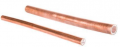
Not too many are familiar with Pyrotanex cable or even ever worked with it.
Tubular Copper with conductors embedded in a insulating fireproof mineral '
Used in fire proof required situations, alarms, sprinklers etc

1692981935189.png
1692982343754.png
 
Last edited:

Ian0

Joined Aug 7, 2020
13,158
Not too many are familiar with Pyrotanex cable or even ever worked with it.
Tubular Copper with conductors embedded in a insulating fireproof mineral '
Used in fire proof required situations, alarms, sprinklers etc

View attachment 301231
View attachment 301233
Known generally just as "pyro" - and called "mineral insulated cable" in the catalogues - electricians who know how to work with it are a dying breed.
Occasionally when replacing a central battery system, we come across an emergency lighting circuit wired with it.
 
Top