Facebook
 Google
 GitHub
 Linkedin
Hello gentlemen ;
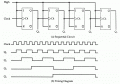
I've started working/learning new materials on digital logic devices and there's something getting me perplexed , when I've three digital devices connected sequentially to each other like this way: 1 2 3 which every number imply the order of the device, 1- is the first device ..etc . the devices are single cycle clock.
I didn't understand why the second device needs two clocks to get started and the third device needs three clock to get started? what's perplexing that the first clock enters to the first device so the first device will be operated .. and that clock will continue to the other device - the second one- and the second one will be operated .. and will also continue to the third device so the third device will be operated .. so how actually the second device needs two clocks to be operated ? the same with third device needs three clocks to be operated .. ? may please anyone illustrate me the concept of applying clocks on digital circuit and how it works when I've sequential digital devices?
In addition, if I send many clocks to the sequential device (( 1 2 3 )) so after three clocks the three I will get the required output .. but if I have many clocks what happened to the circuit ? will the output be periodic and repeated itself every three clocks?
thanks in advance.
I've started working/learning new materials on digital logic devices and there's something getting me perplexed , when I've three digital devices connected sequentially to each other like this way: 1 2 3 which every number imply the order of the device, 1- is the first device ..etc . the devices are single cycle clock.
I didn't understand why the second device needs two clocks to get started and the third device needs three clock to get started? what's perplexing that the first clock enters to the first device so the first device will be operated .. and that clock will continue to the other device - the second one- and the second one will be operated .. and will also continue to the third device so the third device will be operated .. so how actually the second device needs two clocks to be operated ? the same with third device needs three clocks to be operated .. ? may please anyone illustrate me the concept of applying clocks on digital circuit and how it works when I've sequential digital devices?
In addition, if I send many clocks to the sequential device (( 1 2 3 )) so after three clocks the three I will get the required output .. but if I have many clocks what happened to the circuit ? will the output be periodic and repeated itself every three clocks?
thanks in advance.