Facebook
 Google
 GitHub
 Linkedin

(Dangerous mains voltages this is posted for interest only please note it is for incandescent lamps ONLY)
I used to have a clock that slowly turned a sidelamp on to simulate dawn. I had two of them in the end. This is the manual for it:
https://www.manualslib.com/products/Sunrise-System-Srs-100-10886901.html
When the second one died I discovered they weren't made any more and had been generically superseded by clocks with built in lights, which I didn't really want. And anyway, I didn't want a third one because the infernal thing buzzed at 50Hz something awful.
So I made one using a cheap USB-powered digital clock and a load of old CMOS components. I'm sure you could do all of this much better with a microcontroller, but that's what the SRS-100 did, and it meant everything was in the same box and buzzed. By having a USB-powered clock, 50Hz mains was only connected after the alarm went off. It buzzes a bit, but by then it's dawn.
I used a PWM circuit by Ton Giesberg from an old Elektor and an even older audible alarm circuit which won Tim Tanner an Electronics Today International competition in 1983 - I'd been wanting use that circuit for nearly forty years. Page 71 of https://www.worldradiohistory.com/UK/Electronics-Today-UK/80s/Electronics-Today-1983-02.pdf
I'm sure this appears to have numerous unnecessary diodes and overcomplications but it was all breadboarded over several months and it works for me. The alarm starts to increase the luminosity of an incandescent lamp over thirty minutes and then it gradually dims away. The audible alarm starts after ten minutes or so, or after nearly twenty minutes using the 'weekend' switch. The lamp is never massively bright but that suits my morning state very well. There are two push buttons, one to stop the audible alarm, and one which massively increases the rate of change of luminosity (effectively an off switch).
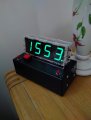
I've been using this for a couple of years now. The original green LED clock failed and I have a white LED one now, but the circuit still works.
I used to have a clock that slowly turned a sidelamp on to simulate dawn. I had two of them in the end. This is the manual for it:
https://www.manualslib.com/products/Sunrise-System-Srs-100-10886901.html
When the second one died I discovered they weren't made any more and had been generically superseded by clocks with built in lights, which I didn't really want. And anyway, I didn't want a third one because the infernal thing buzzed at 50Hz something awful.
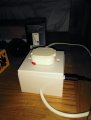
So I made one using a cheap USB-powered digital clock and a load of old CMOS components. I'm sure you could do all of this much better with a microcontroller, but that's what the SRS-100 did, and it meant everything was in the same box and buzzed. By having a USB-powered clock, 50Hz mains was only connected after the alarm went off. It buzzes a bit, but by then it's dawn.
I used a PWM circuit by Ton Giesberg from an old Elektor and an even older audible alarm circuit which won Tim Tanner an Electronics Today International competition in 1983 - I'd been wanting use that circuit for nearly forty years. Page 71 of https://www.worldradiohistory.com/UK/Electronics-Today-UK/80s/Electronics-Today-1983-02.pdf
I'm sure this appears to have numerous unnecessary diodes and overcomplications but it was all breadboarded over several months and it works for me. The alarm starts to increase the luminosity of an incandescent lamp over thirty minutes and then it gradually dims away. The audible alarm starts after ten minutes or so, or after nearly twenty minutes using the 'weekend' switch. The lamp is never massively bright but that suits my morning state very well. There are two push buttons, one to stop the audible alarm, and one which massively increases the rate of change of luminosity (effectively an off switch).
I've been using this for a couple of years now. The original green LED clock failed and I have a white LED one now, but the circuit still works.
Attachments
-
1.1 MB Views: 23
Last edited: