It does the tone decoding function by using a PLL locked to the input frequency. The VCO output is available on a pin so noisy signal in gives clean stable frequency output. When the input signal is lost the VCO runs at the centre frequency, so the correct frequency is still available. Further, by connecting an LED to the decoder output you have an easy locked/unlocked indication.
It does the tone decoding function by using a PLL locked to the input frequency. The VCO output is available on a pin so noisy signal in gives clean stable frequency output. When the input signal is lost the VCO runs at the centre frequency, so the correct frequency is still available. Further, by connecting an LED to the decoder output you have an easy locked/unlocked indication.
Wally - love the idea. Over 50 years of looking at hum on an unconnected scope and it never sank in. duh.
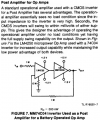
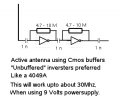
A late thought - a single opamp twin-T filter will get you much better out-of-band rejection with less complexity, but it has to be tuned to either 50 or 60 Hz. Also, you can do all amplifying, filtering, level-detecting, and output driving with a single CD4049 unbuffered hex inverter.
It isn't undefined. An unbuffered gate is a low-rent inverting amplifier. If you are young and stupid you can make an audio preamp complete with an RIAA phono equalizer and Baxandall tone controls.
*defined*? - don't know. It came up in class one day and I ran with it in subsequent lab sessions. I've seen it occasionally in circuits over the years, though not nearly as often nowadays. I remember one that was like a Clapper, and used one gate as the electret mic preamp. It occurs to me now that I could build an entire intercom out of hex inverters...
Well, I guess more specifically, I don't trust my Spice CMOS digital models to accurately model their AC behavior as linear amps, and I don't do a design without simulating it.
Also, since their linear behavior is not specified, it would seem that it could vary significantly from different manufacturers, or even between lots.
But it's an interesting design application of digital gates for doing one-up hobby designs.
A friend of mine lost his shirt on a design for LED jewelry based on using the 'undefined' analog behaviors of some CMOS chips- the first one worked, then they built a shit-ton of them, 70% of them did not work.

 Facebook
 Google
 GitHub
 Linkedin