Class D amp, mosfet driver circuit issues

Thread Starter

deelakademel

Joined Mar 10, 2026
13
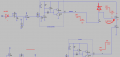
Schematic.
View attachment 365872
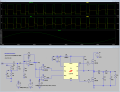
Waveforms
View attachment 365873
See attached SPICE file. There are some problems with it but that is all the time I have right now.
The first one of these I built was in about 1980. It worked but the switching frequency was too low for good audio. Back then we fought to switch above 20khz. Now we are switching at 1mhz.
RonS.
Could you point out where i can optimize my original circuit, to get an output similar to this.
 

ronsimpson

Joined Oct 7, 2019
4,702
Change M1 to P_MOSFET and flip around so S is on the supply and D is on the output.
Make certain that M1 and M2 are never on at the same time. It is OK for both to be off for 100nS or some small time.
Diode is backwards.
1776083448416.png
 

Irving

Joined Jan 30, 2016
5,136
I'd ditch those gate drivers and use a proper driver with shoot through protection.

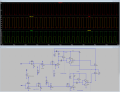
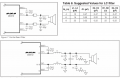
Here's my take on it:
250kHz switching frequency
output flat within 0.5dB 20Hz-20kHz using LCLC output filter, giving reasonable match to 8ohm
output with 10v supply @1kHz is 3.5w into 8ohm at 93% efficiency (losses in M1 and M2 < 100mW each)
output with 24v supply @1kHz is 20w into 8ohm at 95% efficiency (losses in M1 and M2 < 400mW each)

1776100510456.png


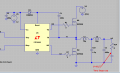
If you insist on using that driver circuit then configure it correctly like so:

1776105182349.png
 

Attachments

Last edited:

Thread Starter

deelakademel

Joined Mar 10, 2026
13
I'd ditch those gate drivers and use a proper driver with shoot through protection.

Here's my take on it:
250kHz switching frequency
output flat within 0.5dB 20Hz-20kHz using LCLC output filter, giving reasonable match to 8ohm
output with 10v supply @1kHz is 3.5w into 8ohm at 93% efficiency (losses in M1 and M2 < 100mW each)
output with 24v supply @1kHz is 20w into 8ohm at 95% efficiency (losses in M1 and M2 < 400mW each)

View attachment 365916


If you insist on using that driver circuit then configure it correctly like so:

View attachment 365921
This was very helpful. Thanks a lot.
 

MisterBill2

Joined Jan 23, 2018
27,584
MANY better quality amplifiers use a split-polarity Dc supply with the mid-point used as the common. It makes a lot of sense and it avoids the need for thatseries capacitor in the speaker connection.
 

ronsimpson

Joined Oct 7, 2019
4,702
split-polarity Dc supply with the mid-point used as the common.
Example.
1776481394503.png
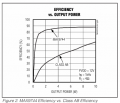
Efficiency
1776481299038.png
MAX9744.pdf
♦Wide 4.5V to 14V Power-Supply Voltage Range ♦Filterless Spread-Spectrum Modulation Lowers Radiated RF Emissions from Speaker Cables ♦20W Stereo Output (4Ω, VDD= 12V, THD+N = 10%) ♦ Integrated Volume Control (I2C or Analog) ♦Low 0.04% THD+N ♦High 75dB PSRR ♦High 93% Efficiency ♦ Integrated Click-and-Pop Suppression ♦Low-Power Shutdown Mode ♦Short-Circuit and Thermal-Overload Protection ♦Available in a 44-Pin Thin QFN-EP (7mm x 7mm x 0.8mm)
 

MisterBill2

Joined Jan 23, 2018
27,584
Notice that the critical SERIES capacitor is not apart of the output circuit. The filter capacitor locations are far less demanding, although they arestill important. In addition, the capacitance values required, and also the physical size, are several orders of magnitude less. So there certainly is a big benefit available with using a split polarity power configuration.
There are other advantages as well, I am certain. But the benefits I described here are easy to see.
 

Irving

Joined Jan 30, 2016
5,136
The filter capacitor and inductor values are important in respect of the flatness of the filter and the roll-off which is made easier by the high switching frequency of the PWM.

The big issue with series capacitance is the large value required to not badly impact on the low frequency performance of the amp. It also requires a low ESR to avoid high losses at higher wattages.
 

MisterBill2

Joined Jan 23, 2018
27,584
The filter capacitor and inductor values are important in respect of the flatness of the filter and the roll-off which is made easier by the high switching frequency of the PWM.

The big issue with series capacitance is the large value required to not badly impact on the low frequency performance of the amp. It also requires a low ESR to avoid high losses at higher wattages.
In addition to those requirements, is the large size of that capacitor, especially if there is much amplifier power to be coupled to thee speakers. THAT is a good reason to consider an amplifier circuit that uses an output transformer.
 

MisterBill2

Joined Jan 23, 2018
27,584
I have a few that have output transformers. None of them are current or even "close to new"! There are a few "HIFI" Receive/amplifiers that do not have output transformers at all. Those are the most current. But I recall that they do have bi-polar DC supplies, primarily for the output stages.
 

Irving

Joined Jan 30, 2016
5,136
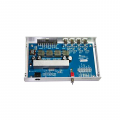
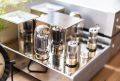
The last time I worked on a power audio amplifier with a transformer it looked like this. See the transformers.
View attachment 366118
[Unashamedly off- topic]
That, my friends, is work of art. Takes me back 50y to my late teens with memories of my 250w twin-4CX250b push-pull 144MHz RF amp with polished brass case and cooling towers. Sadly I no longer have any photos of it, lost in the mists of time, just memories.
 

MisterBill2

Joined Jan 23, 2018
27,584
Yeah, sorry about that, but "they don't make 'em like that any more" :D :rolleyes:
Certainly that is mostly correct! Every new generation of active devices tends to lead to designs of new circuits, especially for audio amplifiers. I have amplifiers from several generations, at least one able to deliver almost 100 watts to speakers. It uses an array of four power tetrode tubes, type 6L6, which had been around for quite a few years when that amplifer was designed. I biught it when it was replaced by a "modern" amplifer, in 1965. That amplifier weighs about 26 pounds! I also have a few newer and lighter tube type amplifiers, as well as some excellent transistor stereo amplifiers from about 1980, delivering 25 watts per channel, made by MARANTZ. And newer yet amplifiers made by SONY and KENWOOD. Each generation physically smaller and lighter.
CERTAINLY most generations leave behind the ones that"They don't make them like that any more."

The bad news is that some of the more recent amplifiers use integrated modules that are secret designs and only available from one source at quite high prices. So there is a trade-off for certain.
 
Top