Class C ASK Transmitter Questions

Thread Starter

fzizzo21

Joined Feb 16, 2024
4
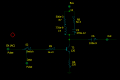
Hello, I have a simulation for a Class C Amp operating at ~8.3MHz that I am happy with the performance of. It is simply doing ASK modulation for a small personal project and the 8.3MHz sine wave modulated by a 10kHz digital data signal appears at the output perfectly. I now want to connect this output to an antenna and transmit, and will plan to make a receiver. For now though, I am a little confused and can't seem to find many resources on how to proceed correctly. I understand that I need to match my amplifier output impedance to 50 ohms, and attach a 50 ohm antenna, but I am a little confused on how to find my output impedance, even in simulation. I have attached the simulation schematic below, where the node Clk is a 8.3MHz square wave, Data is a 10KHz square wave just turning the switch on and off, and Out is just a label. The transistor is just a simple model with beta=120 for estimations sake.

Any help would be much appreciated, or any good resources. This is just for a personal project so I am aware of the fact that this is a pretty low frequency to transmit and might require a large antenna, as it is what my equipment can measure so I will make do.
1730072296196.png
 

MisterBill2

Joined Jan 23, 2018
27,528
Quite an interesting project, it appears. And an unusual frequency selection.Not a common frequency for data or voice, or even remote control. In most issues of "The Radio Amateurs Handbook" there are sections about designing just such matching networks for close-by frequencies. Likewise for creating dipole antennas to be resonant.
It may work well to combine the circuit elements L4 and C5 into a radiating loop arrangement that would improve efficiency and greatly reduce the required antenna size.

But depending on where the TS resides, agencies of the government may take issue with transmission of any noticeable amount of power thru the airwaves.
 

Thread Starter

fzizzo21

Joined Feb 16, 2024
4
Quite an interesting project, it appears. And an unusual frequency selection.Not a common frequency for data or voice, or even remote control. In most issues of "The Radio Amateurs Handbook" there are sections about designing just such matching networks for close-by frequencies. Likewise for creating dipole antennas to be resonant.
It may work well to combine the circuit elements L4 and C5 into a radiating loop arrangement that would improve efficiency and greatly reduce the required antenna size.

But depending on where the TS resides, agencies of the government may take issue with transmission of any noticeable amount of power thru the airwaves.
Thank you, I will check out that book, it seems helpful. As for L4 and C5, they are not the radiating elements as I still need to make an antenna, but should they be made into a loop regardless? I am a little unsure
 

MisterBill2

Joined Jan 23, 2018
27,528
Thank you, I will check out that book, it seems helpful. As for L4 and C5, they are not the radiating elements as I still need to make an antenna, but should they be made into a loop regardless? I am a little unsure
If the radiating elements can be a resonant radiating loop, that can eliminate all of the transmission line losses and avoid all of the impedance matching efforts. The loop diameter can be kept at a convenient size by making the loop more than a single turn, which allows much more convenient packaging.
In addition, as a loop is quite directional, if the (unknown) application is intended to be between fixed points, that can provide an additional benefit.
 
Top