Clarifying Single VS Double Ended Inputs

Thread Starter

Glenn Holland

Joined Dec 26, 2014
703
Here's an article from AAC and I need some clarification about single ended an double ended inputs:

https://www.allaboutcircuits.com/te.../chpt-8/single-ended-differential-amplifiers/

An op-amp has a differential input consisting of two common emitter amplifiers with NPN transistors. Normally, the non-inverting input of the differential pair is grounded and the input signal is applied to the inverting input which is the other amp of the differential pair. Since both transistors are biased 1/2 way ON, the input signal will add to or subtract from the bias point of the transistor for the inverting input. However the since the transistor for the non-inverting input is grounded, it will just stay turned on 1/2 way.

So what is the practical effect of using a single ended or a double ended input?
 

nsaspook

Joined Aug 27, 2009
16,321
Here's an article from AAC and I need some clarification about single ended an double ended inputs:

https://www.allaboutcircuits.com/te.../chpt-8/single-ended-differential-amplifiers/

An op-amp has a differential input consisting of two common emitter amplifiers with NPN transistors. Normally, the non-inverting input of the differential pair is grounded and the input signal is applied to the inverting input which is the other amp of the differential pair. Since both transistors are biased 1/2 way ON, the input signal will add to or subtract from the bias point of the transistor for the inverting input. However the since the transistor for the non-inverting input is grounded, it will just stay turned on 1/2 way.

So what is the practical effect of using a single ended or a double ended input?
The practical effect is usually common mode noise rejection on the double ended input incoming signal while amplifying to a single ended output. I needed to measure microvolt signals from a solar panel array at night. This involved many feet of interconnect wiring. By keeping the signal input differential at the input I was able to use the nulling action of common field energy on differential inputs to eliminate line noise and other signals to a level that the ADC internal filters could handle easily to deliver a 'clean' digital signal for later processing.

https://forum.allaboutcircuits.com/threads/super-moon-shine.100322/#post-896006
 

Thread Starter

Glenn Holland

Joined Dec 26, 2014
703
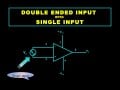
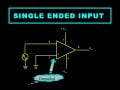
Seems the functional difference between a single ended and double ended input is whether the non-inverting input is grounded.

The single ended input is the most common configuration and the non inverting input varies above or below the grounded non inverting input. The output is an inverted and amplified form of the input.

However, in the double ended configuration, the input varies both the inverting and non inverting input and the output is twice the input.

Single Ended Input W Ground.jpg Single Ended Input WO Ground.jpg
 

ErnieM

Joined Apr 24, 2011
8,415
Any signal, or voltage for that matter, exists between two points. A single ended input amplifies the signal on the input (first point) with respect to ground (the second point). A double ended input amplifies the difference between both signals.

The main advantage of the second double ended scheme is if the double ended signal has noise with respect to ground then this is not part of the difference, and will be attenuated instead of amplified. A single ended input has no such ability.

BTW, the input to an op amp does not work as you think, but that is a seperate complicated topic. For now it is fine to think of an op amp as a black box that does some good things and not worry about what is inside.
 
Top