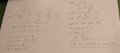
The best thing you can do is get a cheap/used scanner and hook it up to pc, use IrFanView (free) program to edit the image. In the case the solution I posted I did two things: I cropped the image, and I adjusted the "quality" of the image so that the file is smaller ( Save for Web in File menu).
Generally speaking I read somewhere some years ago that for web you want to keep image files under 300 kB. Now, that was long time ago when people still used dial-up, but I still keep to that rule.
The best thing you can do is get a cheap/used scanner and hook it up to pc, use IrFanView (free) program to edit the image. In the case the solution I posted I did two things: I cropped the image, and I adjusted the "quality" of the image so that the file is smaller ( Save for Web in File menu).
Generally speaking I read somewhere some years ago that for web you want to keep image files under 300 kB. Now, that was long time ago when people still used dial-up, but I still keep to that rule.
Except that you should properly track your units. Shteii01 doesn't believe there is any value in doing so. He isn't alone. But people can, do, and have died because someone couldn't be bothered to track their units -- and I was very close to being one of them -- so I tend to take them pretty seriously. And I can't begin to count the number of mistakes, both in academic and industrial settings, that I have found because of a near-religious commitment to doing so.
Except that you should properly track your units. Shteii01 doesn't believe there is any value in doing so. He isn't alone. But people can, do, and have died because someone couldn't be bothered to track their units -- and I was very close to being one of them -- so I tend to take them pretty seriously. And I can't begin to count the number of mistakes, both in academic and industrial settings, that I have found because of a near-religious commitment to doing so.
PsyScorp, answer is correct but maybe because you got lucky?
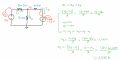
In the first equation, the last term, should be (V3+V2)/R.
In the 4th equation, using your setup it would be V3= (10V+15V)/3 = 8.3V, but you substituted -V2 instead of V2 in your equation so you got the right answer.
Your setup is correct if you defined the polarity of V2 opposite of what is shown in Bahns or the original schematic. Since you didn't make note of that it looks like two wrongs made a right.
Since you are using nodal analysis, you need to use node voltages, which means that the your definitions for V1, V2, and V2 are different than mine, which is perfectly fine, but you need to clearly indicate what they are. You say that V3 is the middle node (on top, I'm assuming), but you don't indicate what either V1 or V2 is nor which node is GND. It looks like you assigned the bottom middle node as GND (which is very reasonable) and chose the top-left node at V1, making it 10 V by inspection.
But what node did you use as V2? You first equation implies that it is the top-right node, but when you put in a value for it you us -15 V. But this would only be true if the GND node was chosen to be the bottom-right node.
Now, you got the right answer because you did something that was perfectly valid, but I don't know that you did so knowingly. You swapped the 15 V source and the bottom right resistor. You can do this because they are in series and nothing will change except the voltage at the node they share.
Well, now you made me doubt of my own convictions! Yes, V1 is the 10V voltage source, so the node is the top left one, and V2 is the right voltage source of 15V, so, as the voltage source is turned upside down, V2 = -15V wrtg... And yes, I swapped the V2 voltage source with the resistor because it is in series. And that way, I would create a similar situation on the right of the circuit as I have in the left side.
And about V2 = -15V, if I measure V2, placing a multmeter red probe on the minus of V2 and the black probe on the opposite side, it will read -15V, right, so that's why I'm using V2 = -15V. This adds up with V1 sign... If I considered V1 to be positive and it has the minus sign turned to the GND node and V2 has it's plus sign turned to GND, then I considered V2 = -15V... And used that value in my expressions.
Having in mind the current directions related to the direction of the path from V3 to GND, I add a minus sign when the directions are opposite like in V1 branch!
and V2 is the right voltage source of 15V, so, as the voltage source is turned upside down, V2 = -15V wrtg...
You contradict yourself: in the first clause you state V2 is the voltage source, in the second you say it is the node voltage. V2 is either the voltage source (whose polarity is identified in the diagram) or it is the node voltage. V2 source is +15V; V2 node voltage is -15V - and only in your rearranged circuit which you did not share in your original post. In your formula you treat it as a node voltage which is fine, but that was not clear in your original post.
The unnecessary rearrangement of the right hand branch does not affect the solution for I, but if the next question were what is the voltage with respect to ground of the negative terminal of the right hand voltage source your answer would be wrong. I don't see why you introduced this complication and potential for confusion and error.
Well, now you made me doubt of my own convictions! Yes, V1 is the 10V voltage source, so the node is the top left one, and V2 is the right voltage source of 15V, so, as the voltage source is turned upside down, V2 = -15V wrtg... And yes, I swapped the V2 voltage source with the resistor because it is in series. And that way, I would create a similar situation on the right of the circuit as I have in the left side.
And about V2 = -15V, if I measure V2, placing a multmeter red probe on the minus of V2 and the black probe on the opposite side, it will read -15V, right, so that's why I'm using V2 = -15V. This adds up with V1 sign... If I considered V1 to be positive and it has the minus sign turned to the GND node and V2 has it's plus sign turned to GND, then I considered V2 = -15V... And used that value in my expressions.
Having in mind the current directions related to the direction of the path from V3 to GND, I add a minus sign when the directions are opposite like in V1 branch!
Your analysis is fine except for a couple of fine points. You say that V2 is the right voltage source of 15 V. But your diagram (and all of your work) indicates that V2 is the voltage on a particular node (the top-right), not the voltage difference across a particular component.
You almost tracked your units, but look at that next to last equation. You have I1 equal to a voltage because you dropped the units on the resistance in the denominator.
Finally, hopefully you can see how providing a diagram of the circuit YOU are actually working with makes communication a LOT better.
Thanks for your advises. But I can't find another mnemonic to perform nodal analysis. And in this case the voltage at the top right node wrtg is the same as the voltage across the right voltage source also wrtg...
Thanks for your advises. But I can't find another mnemonic to perform nodal analysis. And in this case the voltage at the top right node wrtg is the same as the voltage across the right voltage source also wrtg...
But it isn't. The voltage across the right voltage source is +15 V while the voltage at the top right node (of your schematic with the components swapped) is -15 V due to the orientation of the supply.
I don't know what you mean by wanting to find another "mnemonic" to perform the analysis. If you mean finding better labels, that's a simple matter of just choosing different labels for things that are different (regardless of whether they might numerically have the same value). In this case, call the two voltage sources Vs1 and Vs2 and call the node voltages V1, V2, etc. (or Va, Vb, etc.).
The source voltage is the voltage difference between the voltage at the labeled + terminal and the voltage at the labeled - terminal, i.e. V+ minus V-. The voltage of a node is the absolute voltage of a point in the circuit with respect to your chosen reference point, usually a common return or ground. As Bahn said, clearly and separately labeling sources and nodes will reduce confusion and the possibility of conflating the two.

 Facebook
 Google
 GitHub
 Linkedin