Well, we can't help you very much unless you show us the steps you used. My crystal ball just isn't that good.thank you WBahn
i'm still trying to get an answer using the mesh method i've seen in similar problems. i had used the superposition method earlier and came up with 2.6A at which point i think i got lost in the steps.
I have just checked the current flowing through the 5Ω in series with 10V battery in two cases using superposition and your results is correct if R3 is the resistor in series with 10V battery.using superposition this is what i came up with: 10v 15v
R1 R2 R3 R1//R2 R1//R2+R3 TOT R1 R2 R3 R1//R2 R2+R1//R3 TOT
E 2.16v 2.16v 6.67v 3.33v 10v E 5v 10v 5v 5v 15v
I .65a .65a 1.3a 1.3a 1.3a I 1a 2a 1a 2a 2a
R 5Ω 5Ω 5Ω 2.5Ω 7.5Ω R 5Ω 5Ω 5Ω 2.5Ω 7.5Ω
when using these values in the other tables for voltage and current the only time i came up with 2.3A was for the combined currents for the IR3. is this on the right track?
Yes, actually when you calculate current through R3 in each case, R1, R2 (or IR1, IR2) are already taken into account.yeah i'm not very computer savvy when it comes to making tables sorry. but even though the IR3 sum from the 10v and 15v tables add to give me 2.3A don't i have to take into account the IR1, and IR2 sums as well when looking for the 10v emf current?
I give you a different way of getting there.how do i get there?
thank you anhnha i will try to wrap my head around that.Yes, actually when you calculate current through R3 in each case, R1, R2 (or IR1, IR2) are already taken into account.
DGElder sorry for the mess. it was all spaced out and organized when i typed it. when i hit return it clumped together. there was no post preview option.using superposition this is what i came up with: 10v 15v
R1 R2 R3 R1//R2 R1//R2+R3 TOT R1 R2 R3 R1//R2 R2+R1//R3 TOT
E 2.16v 2.16v 6.67v 3.33v 10v E 5v 10v 5v 5v 15v
I .65a .65a 1.3a 1.3a 1.3a I 1a 2a 1a 2a 2a
R 5Ω 5Ω 5Ω 2.5Ω 7.5Ω R 5Ω 5Ω 5Ω 2.5Ω 7.5Ω
Your kidding right? You expect someone to decipher that mess?
thanks dannyf i'll try that too.I give you a different way of getting there.
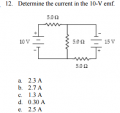
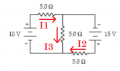
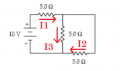
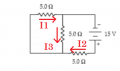
Assuming that the voltage over the middle 5R resistor is V (from top to bottom).
It must be true then that the current through the bottom 5R resistor is (15v + V) / 5;
It must also be true that the current through the top 5R resistor is (10v - V) / 5. This is also the current through the 10v source.
The two current flows opposite of each other and creates a voltage drop of V over the middle 5R resistor so
[(10v - V) / 5 - (15v + V) / 5] * 5 = V.
Or -5 = 3V and V = -1.7v.
The current through the 10v source is (10v - (-1.7v)) / 5 = 2.3a.
Simple math.
Even if it were nicely spaced, I would have no idea how to interpret it.thank you anhnha i will try to wrap my head around that.
DGElder sorry for the mess. it was all spaced out and organized when i typed it. when i hit return it clumped together. there was no post preview option.