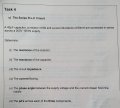
circuit theorems

Thread Starter

Bobby2017

Joined Dec 28, 2019
19
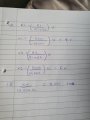
when you say misstated the formula do you mean it should be V(R1/R1+R2)? so the V is at the beginning and not the end?
and am I right with question 1a) 6V and 1b) 1mA ?
 

SamR

Joined Mar 19, 2019
5,487
You have misstated the voltage divider formula. Solve for Vout. Instead of voltage across R1 and R2. You have the right idea.
 

MrChips

Joined Oct 2, 2009
34,807
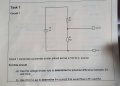
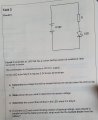
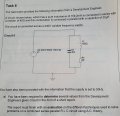
It is unfortunate that the input voltage was labelled as V1. This will lead to confusion.
It would be better to replace the label V1 with Vin so as not to confuse with V1 which is the voltage across R1.
 

MrChips

Joined Oct 2, 2009
34,807
The person that drew those diagrams is really sloppy.
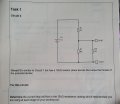
In Task 1, Circuit 2 there are two nodes labelled VOUT. This is very bad notation.

You should point these two errors to your instructor.
 

Thread Starter

Bobby2017

Joined Dec 28, 2019
19
we are "taught" by the same person who drew these diagrams....
its no wonder I cant learn anything in this lesson....
I don't have any idea what to do for any of these questions...
I honestly just about winged the first question.
 

WBahn

Joined Mar 31, 2012
32,823
MOD NOTE:

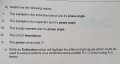
@Bobby2017: You've posted about 36 questions spanning 3 very different problems. The thread is going to become very chaotic as people start talking about different parts of different problems all mingled together. I'm going to edit the original post to remove all but the first problem. When you want to discuss one of the others, post just that problem in a new thread.

Also keep in mind the general expectation that you are expected to show your best attempt at working the problem and we are then expected to help you identify where you are going wrong or what the next step is that you might consider.
 

MrChips

Joined Oct 2, 2009
34,807
There is nothing wrong with the questions, just poor notation in the diagrams.
Apply Ohm's Law and you should be able to do the first 3 problems.
 

WBahn

Joined Mar 31, 2012
32,823
we are "taught" by the same person who drew these diagrams....
its no wonder I cant learn anything in this lesson....
I don't have any idea what to do for any of these questions...
I honestly just about winged the first question.
Is this lesson really trying to teach you everything associated with these four tasks?

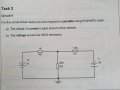
It seems very odd that they would try to teach DC voltage dividers and A.C. circuits involving series-parallel combinations of resistors, capacitors, and inductors in the same lesson.

They have the flavor of a review of material you are already expected to have mastered.

But be that as it may, let's go from where you and see if we can get you were you need to go.

For the first circuit, forget about voltage divider formulas. View it as being just a circuit. If you were asked for the current flowing in the circuit, could you confidently determine that much without "winging it"? Could you do the same if asked to find the voltage across R2?
 

Thread Starter

Bobby2017

Joined Dec 28, 2019
19
Is this lesson really trying to teach you everything associated with these four tasks?

It seems very odd that they would try to teach DC voltage dividers and A.C. circuits involving series-parallel combinations of resistors, capacitors, and inductors in the same lesson.

They have the flavor of a review of material you are already expected to have mastered.

But be that as it may, let's go from where you and see if we can get you were you need to go.

For the first circuit, forget about voltage divider formulas. View it as being just a circuit. If you were asked for the current flowing in the circuit, could you confidently determine that much without "winging it"? Could you do the same if asked to find the voltage across R2?
yes this lesson is trying to teach us all of that. I'm a mechanical student but we have to do a small unit on electricals of which I know absolutely nothing about.
so current flowing in the circuit is I, which is V/R, so 10/10,000=0.001=1mA?
and across R2 10/6000=0.0016=1.6mA?
 

WBahn

Joined Mar 31, 2012
32,823
yes this lesson is trying to teach us all of that. I'm a mechanical student but we have to do a small unit on electricals of which I know absolutely nothing about.
so current flowing in the circuit is I, which is V/R, so 10/10,000=0.001=1mA?
and across R2 10/6000=0.0016=1.6mA?
Your calculation for the circuit current is correct.

Ohm's Law relates the value of a resistance to the voltage across THAT resistance and the current through THAT resistance.

You need to start tracking units properly -- in all your work, including your mechanical work. So you should have

I = V/R = 10 V / 10,000 Ω = 0.001 A = 1 mA

Your attempt at the second problem shows a very common mistake that people make -- they throw some voltage and some resistance at Ohm's Law and hope for a meaningful answer.

Remember, to use Ohm's Law on R2, you need the voltage across R2. But 10 V is NOT that voltage, it is the voltage across the series combination of R1 and R2.

However, you already know the current through R2. Since R1 and R2 are in series, whatever current flows in one must flow in the other and this is the same current that flows in the voltage source (again, because they are in series with it), which you've already determined is 1 mA.

So can you use Ohm's Law, combined with the known resistance of R2 and the known current flowing through R2, to find the voltage across R2?
 

Thread Starter

Bobby2017

Joined Dec 28, 2019
19
Your calculation for the circuit current is correct.

Ohm's Law relates the value of a resistance to the voltage across THAT resistance and the current through THAT resistance.

You need to start tracking units properly -- in all your work, including your mechanical work. So you should have

I = V/R = 10 V / 10,000 Ω = 0.001 A = 1 mA

Your attempt at the second problem shows a very common mistake that people make -- they throw some voltage and some resistance at Ohm's Law and hope for a meaningful answer.

Remember, to use Ohm's Law on R2, you need the voltage across R2. But 10 V is NOT that voltage, it is the voltage across the series combination of R1 and R2.

However, you already know the current through R2. Since R1 and R2 are in series, whatever current flows in one must flow in the other and this is the same current that flows in the voltage source (again, because they are in series with it), which you've already determined is 1 mA.

So can you use Ohm's Law, combined with the known resistance of R2 and the known current flowing through R2, to find the voltage across R2?
so V - IR which is 0.001x6000 = 6V ?
 
Top