Circuit or arduino?

Thread Starter

Rufinus

Joined Apr 29, 2020
305
Hi everyone.

I have a relay NC. Sometimes, this relay will open for a few seconds and close again. In the moment it closes, I need to close a circuit for 0,5 seconds (this time is flexible, is like sending a pulse), for example with other relay. This will be done repeatedly

I don´t know how to make with analog components. I think it shoudn´t be complicated, but I have no clue.

I have very few knowledge about arduino programing, but I think I could do it, Nevertheless, I would preffer to doit in the clasical and analog way

I have looked in the internet but no clue. I have tought using a 555 timer. But I have trouble to make it working in that set up. I mean, I can make it close a circuit for the 0,5 seconds, but I don´t know how do it after the relay open and closes again

Any help?

thank you

best regads
 
Last edited:

Ian0

Joined Aug 7, 2020
13,097
You need a non-retriggerable monostabe, such as the 74HC221.
Connect the NC relay to the input so that it triggers when it closes. Use the output to drive your second relay.

it can be done with a 555, but it needs extra parts.

Contact bounce may also be a problem, and that would make it trigger when the input relay opens as well as when it closes.
 

Ya’akov

Joined Jan 27, 2019
10,226
A time delay relay is a packaged solution and may be a good one for you.

While you could use a microcontroller, an "Arduino" in the ordinary sense is certainly overkill—many times over. However you could use the Arduino ecosystem and its IDE with a simple 8-pin MCU (e.g.: ATTiny13A) and a handful of parts for a cost effective solution.

However, given that you would be starting from zero in terms of knowledge and personal infrastructure, it seems the wrong direction unless you want to treat this as a learning project to get started with MCUs and Arduino. I would say this isn't the best choice for that, though.

The time delay relay can act as a one shot triggered by the energizing of the first really and it will be otherwise just a familiar relay.
 

Irving

Joined Jan 30, 2016
4,996
Even though the description of what you need is unclear, I understand that you have an NC relay and you need to close it and open it automatically at intervals of 0.5seconds or so. This is possible with both arduino/any MCU as well as discrete electronics (what you call clasical and analog). In arduino, you need the board, an NPN transistor, a diode , and your relay. Just write the classical blink code and instead of an LED connect the pin to the base of the BJT. In the case of discrete/analog electronics, the 555 timer is a good starting point. Wire it as an astable multivibrator making sure to set the period to 1 second and the dutycycle to 50%. In this way, the State of the relay will change every 0.5 seconds. If you give more information I can provide clearer explanations.
Not quite, though the TS' description begs a few implementation-specific questions what the TS wants is quite clear to me: generate a 0.5 second pulse whenever the existing NC contacts open then close again (presumably driven by some external process not described here). I provided a 555 solution, and a simpler cost-effective ATtiny solution in post #6.

[Edit] That post vanished quickly ... was it stamped upon from on high?
 

MisterBill2

Joined Jan 23, 2018
27,186
OK, I guess that the interpretation of the requirements is clear enough: Generate a short pulse every time the existing relay is energized. IF it is a DC relay that will be simple: Have the second relay also be a DC relay, connected in parallel with the existing relay but with a capacitor in series. When the voltage is applied to operate that relay, the charging current for the capacitor will operate the added relay until the charging is partly completed. At that point the relay will release. When the original relay is released, the capacitor will discharge thru it's coil, getting ready for the next operation.
 

Irving

Joined Jan 30, 2016
4,996
no, the short pulse is when the contacts close, which is when the 1st relay is de-energised (they are NC contacts). Your capacitor idea is ingenious but doesn't meet the requirement and might be tricky to find the right values. Its possible that the NC contact could operate the 2nd relay via a capacitor as you envisage, but how would you then discharge it? I suppose a resistor in parallel might work, but you could end up missing pulses if it took too long to discharge. Depends on coil resistance and supply volts; you need a big enough C to provide enough pull-in current, but a large enough R not to operate the relay while discharging the C.
 

sghioto

Joined Dec 31, 2017
8,633
Is another relay or any relay actually required?
Wonder if it can all be done electronically.
More info on the existing relay and what this 0.5 second pulse is for would be helpful.
 

MisterBill2

Joined Jan 23, 2018
27,186
LIKE I MENTIONED, the capacitor discharges thru the coil of the other relay. But you are correct that I got the timing wrong. Generating a momentary closure when the other relay drops out will be more involved. That would require a capacitor to charge slowly while the first relay is held on, and then to discharge when that relay drops out. That will require at least one diode and a resistor, in addition to the capacitor.
The scheme can easily be made to work IF the voltage source of the existing relay presents a low resistance when it switches off. Otherwise it requires aat least two diodes, maybe three or four, plus the capacitor and a resistor. And the added relay needs to operate on a fairly low current. There is a chance that I am wrong, I have not done the analysis of each state on paper yet.
 
Last edited:

Thread Starter

Rufinus

Joined Apr 29, 2020
305
Thank you for your help, I´ll try it!

I have recently moved in my job, this is why I didn´t answer, but as soon as I can resume this project I´ll try it
 

Plamen

Joined Mar 29, 2015
111
Hi everyone.

I have a relay NC. Sometimes, this relay will open for a few seconds and close again. In the moment it closes, I need to close a circuit for 0,5 seconds (this time is flexible, is like sending a pulse), for example with other relay. This will be done repeatedly

I don´t know how to make with analog components. I think it shoudn´t be complicated, but I have no clue.

I have very few knowledge about arduino programing, but I think I could do it, Nevertheless, I would preffer to doit in the clasical and analog way

I have looked in the internet but no clue. I have tought using a 555 timer. But I have trouble to make it working in that set up. I mean, I can make it close a circuit for the 0,5 seconds, but I don´t know how do it after the relay open and closes again

Any help?

thank you

best regads
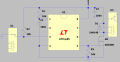
Check the TimerBlox family from AD (former Linear Technology). For instance LTC6993.
They offer online design utility allowing to enter requirements numbers and get specific schematic with all component values.
Unlike other timers, relying on RC networks with substantial part to part variations, the Timer blox family achieves 1% part to part variation with no external timing caps. The parts are in SOT23-6 package and feature very low consumption.
 

Thread Starter

Rufinus

Joined Apr 29, 2020
305
Hello.

I ended using arduino, because I need a sequence. For sure could be done with analogic electronics but is far from my capacity


You can control the duration and the power of the weld, and also the force. The arduino detects I press the pedal, and based in the potentiometer with the dial, moves the linear actuator on the top. This actuator is connected to a big spring and if the movement is short, the spring will take most of the force and Little force will be applied to the weld. If the actuator moves for more time, will compress the spring and it will apply great force to the weld. When the actuator stops, arduino send a pulse to the controler of the welder to send current to the transformer and then, moves backwards the actuator. Too complicated for me doing in analogic.

First try. The duration of the weld is a bit long, but I´m still doing test.

https://youtube.com/shorts/nd6Lx3tyAt8?si=iv5LvQcSRhGUoI_d

Of course everithing is properly grounded
 
Last edited:

MisterBill2

Joined Jan 23, 2018
27,186
The simplest scheme will be to have an additional set of contacts on the relay. If it is actually a power contactor for switching on the weld current then auxiliary contacts should be an option.
 

MaxHeadRoom

Joined Jul 18, 2013
30,562
The way it was often done in the production world, was first, the weld was only enabled when sufficient electrode pressure was sensed, then the weld was precisely controlled by so many AC cycles, dependant on material gauge etc.
To switch the primary with relay, does not give a precise weld duration. !
 
Top