Circuit modification for lead battery desulphator

Thread Starter

Bhante

Joined Dec 15, 2009
64
Correct.

The FET is shorted between gate and drain. Many thanks for your help in the diagnosis.

Next question is why. I have one spare FET, but that will probably blow when I connect it into the circuit.

The circuit gives very profuse sparks about 1cm long when connected, continuously as the connector is moved along the screw before putting on the nut. - Thinking about that, they cannot be 1cm sparks because the gap is very tiny, but 1 cm flashes. I have an inverter connected full-time to the batteries, maybe that is the problem? (Of course, the inverter is not the origin of the sparks, and there are no such sparks when eg a voltmeter is connected, but maybe there is an active interaction between the circuit and the inverter). The original article does mention it can be used with an inverter, but maybe it depends on the inverter.

Another possible (maybe unlikely?) cause has to do with the peculiarities of the states of the two batteries, such that it causes the circuit to give initially higher voltage pulses than the circuit was designed for.

If I have to use the circuit offline that would be unfortunate.

The other question is whether it might be worth changing R2 from 22K to 10K - the rationale would be that this would slightly reduce the charging of C6 and also reduce the on-time of Q1, so it should reduce the magnitude of the pulse.

"That would explain all but c3"
c3? If you mean Question 3, that would surely be explained by a gate-drain short going through the inductors to -24V. (Not sure what route it would take from +24V though - presumably through the 555?)
Probably you mean C5?

"Which version?"
24V version
 
Last edited:

Thread Starter

Bhante

Joined Dec 15, 2009
64
Ah, I see. The modifications were all about getting around the fact that I had the wrong parts. That didn't work out, so when I had a chance to go overseas I got the required parts - i,e, I used the original circuit.
 

ronv

Joined Nov 12, 2008
3,770
Ah, I see. The modifications were all about getting around the fact that I had the wrong parts. That didn't work out, so when I had a chance to go overseas I got the required parts - i,e, I used the original circuit.
Is C4 on the correct side of R5?
 

ronv

Joined Nov 12, 2008
3,770
There is no C4 on this circuit. C4 is on the 12V circuit, I am using the 24V circuit.

I assume you mean C5? C5 is indeed on the correct side of R5 and correctly orientated.
Yes, sorry, C5.
Before you change the FET and hook it back up, we need to make sure the 555 is running. It's possible the FET was stuck in the on position. Then you could explain everything but C5.
 

Thread Starter

Bhante

Joined Dec 15, 2009
64
Oops, I got impetuous last night. I convinced myself it was my inverter that had cause the FET to blow. I installed the other FET and tried it on another 2 batteries not connected to the inverter, just to a charger. It worked for the first mement, with the whining sound clearly indicating an oscillation and vigorous sparking when attached. After 4 seconds the whining stopped, the FET was shorted gate-drain, and the FET (only) was burning hot. I couldn't find any other hot components, just the inductors slightly warm (disconnected pretty quick after the whining stopped).

It looks as though the 555 was oscillating, otherwise why the whining (also with the first one) and the sparking? But good to check what the 555 is doing if there is a way of doing so. For R4 to be hot the first time the current must have crossed the timer through pins 4-3, presumably. How to check it? Disconnect the drain of FET first?
 

Thread Starter

Bhante

Joined Dec 15, 2009
64
The following thought occurs to me: what if the inductors I am using have the wrong inductance values, causing substatially larger voltage spikes than intended - could that be the cause of the destruction of the FETs and overheating of other components?

All the inductors I have are unmarked, and all are of slightly "amateurish" construction. It is always possible for mistakes and mixups to occur. When I bought the new 330uH inductors to replace the under-dimensioned originals I was careful to observe the context - a big tub very clearly marked 330uH, of uniform appearance, similar but noticeably different from other values in other tubs. The original 1000uH inductor is much more questionable though - the original 330uH was obviously contrary to stated specifications, and the same source provided the wrong FET; I had no sight of the tub the 1000uH was taken from, and therefore no way of judging the uniformity and labelling of the source, so serious doubts linger.

Should I consider dismantling the inductors to count windings? How much "unknowable" information about the core material do I need to know to calculate the actual inductance, and to what extent can I get a reliable measure of inductance simply by counting turns? (I have two of each).

Saturation of the cores should not cause excessive spikes since the result of saturation should be reduced spikes - am I right? Maybe saturation could cause excessive DC currents, is that capable of resulting in the observed effects?

Then there is RonV's suggestion above that the 555 might not be running properly and that the FET may be stuck on. How do I check that? Are you suggesting this as an original cause for the destruction of the FET, or as a result of the destruction of the FET?
 

Thread Starter

Bhante

Joined Dec 15, 2009
64
Looks very interesting Bordodynov, but unfortunately I am not sufficiently qualified to evaluate it. Can you comment on why you made the changes you made, what they achieve, and why the changes are necessary? Have you built this circuit? Actually I can well imagine that your reorganised gate input looks a lot more robust, but as I say I am not qualified to judge. Do you have a theory as to why I have problems with the original circuit (which circuit appears to have been well established over the years and multiply reproduced; there might have been changes to the circuit over time but I haven't been able to find any apart from a non-specific reference)?

By the way, in case you haven't read the whole thread, the earlier discussion about alternative circuits was because I had been supplied a wrong FET; in the meantime I got the requisite component from overseas so I used the original circuit (doubts about the inductors notwithstanding).

Why have you changed the diode - isn't that the symbol for a zener??
 
Last edited:

Bordodynov

Joined May 20, 2015
3,431
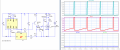
I changed the circuitry for the n-channel transistor. N-channel transistors are more accessible and have lower resistance, all things being equal. In terms of battery currents, this is the same as my scheme. With less transistor resistance, this transistor will have less heat. As proof that my circuit is functioning, I simulated it in LTspice. I did not have a spice-model of your diode and therefore took Schottky's diode (your diode is not a zener).
 

ronv

Joined Nov 12, 2008
3,770
The following thought occurs to me: what if the inductors I am using have the wrong inductance values, causing substatially larger voltage spikes than intended - could that be the cause of the destruction of the FETs and overheating of other components?

All the inductors I have are unmarked, and all are of slightly "amateurish" construction. It is always possible for mistakes and mixups to occur. When I bought the new 330uH inductors to replace the under-dimensioned originals I was careful to observe the context - a big tub very clearly marked 330uH, of uniform appearance, similar but noticeably different from other values in other tubs. The original 1000uH inductor is much more questionable though - the original 330uH was obviously contrary to stated specifications, and the same source provided the wrong FET; I had no sight of the tub the 1000uH was taken from, and therefore no way of judging the uniformity and labelling of the source, so serious doubts linger.

Should I consider dismantling the inductors to count windings? How much "unknowable" information about the core material do I need to know to calculate the actual inductance, and to what extent can I get a reliable measure of inductance simply by counting turns? (I have two of each).

Saturation of the cores should not cause excessive spikes since the result of saturation should be reduced spikes - am I right? Maybe saturation could cause excessive DC currents, is that capable of resulting in the observed effects?

Then there is RonV's suggestion above that the 555 might not be running properly and that the FET may be stuck on. How do I check that? Are you suggesting this as an original cause for the destruction of the FET, or as a result of the destruction of the FET?
Chances are pretty good the 555 is also blown.
What tools do you have available to test?
 

Thread Starter

Bhante

Joined Dec 15, 2009
64
Only a multimeter. Also an ultra-primitive "logic probe" that only consists of a slider-switch and 2 LEDs! (Shows high/low and flashing LED, nothing else). I could change a resistor to get a slower oscillation. Maybe disconnect the FET first ... tie the 555 output high with 1kOhm?
 

ronv

Joined Nov 12, 2008
3,770
Only a multimeter. Also an ultra-primitive "logic probe" that only consists of a slider-switch and 2 LEDs! (Shows high/low and flashing LED, nothing else). I could change a resistor to get a slower oscillation. Maybe disconnect the FET first ... tie the 555 output high with 1kOhm?
We can probably make that work. :)
Disconnect R$ and C3 from the gate of the fet then tie the gate and source together.
You should then be able to connect it safely and use your multimeter to test the voltage out of the regulator.
Then use the LED probe on the output of the 555 to see if it is pulsing.
If all is well we can think about a way to lower the power.
 

Thread Starter

Bhante

Joined Dec 15, 2009
64
Disconnect R$ and C3 from the gate of the fet then tie the gate and source together.
Good, I'll try it. One thing I'm not clear about: does the FET drain have to remain connected to L3 or should I leave that open? Don't forget gate is internally shorted to drain, so if I tie gate high, drain is also shorted to +V. The main thing we are testing is the 555, so I should disconnect the FET I think (it is blown anyway)?
 
Last edited:

Thread Starter

Bhante

Joined Dec 15, 2009
64
Result: 555 is blown (output +V). I have a spare 555. Regulator is giving -11.5V

I have now replaced the 555, put a 22uF in parallel over C2 so that I can see the output on my LED probe, and now on output of 555 I get 1 for about 7.5 seconds and 0 for about 0.3 seconds - which is correct. The FET is completely removed.

Regulator is now giving -11.68 to -11.74V. Should be able to do better than that shouldn't it?
 
Last edited:

ronv

Joined Nov 12, 2008
3,770
Good, I'll try it. One thing I'm not clear about: does the FET drain have to remain connected to L3 or should I leave that open? Don't forget gate is internally shorted to drain, so if I tie gate high, drain is also shorted to +V. The main thing we are testing is the 555, so I should disconnect the FET I think (it is blown anyway)?
Yes. For sure remove the FET if it is still the shorted one.
 

Thread Starter

Bhante

Joined Dec 15, 2009
64
Did you miss my reply here, Ron?

Result: 555 is blown (output +V). I have a spare 555. Regulator is giving -11.5V

I have now replaced the 555, put a 22uF in parallel over C2 so that I can see the output on my LED probe, and now on output of 555 I get 1 for about 7.5 seconds and 0 for about 0.3 seconds - which is correct. The FET is completely removed.

Regulator is now giving -11.68 to -11.74V. Should be able to do better than that shouldn't it?
 
Top