Circuit for car turn signal and brake light signal to share one filament

Thread Starter

joe28704

Joined Feb 11, 2025
7
I'm modifying the turn and brake lights for an older car using a two-element 1157 bulb. The smaller filament in the 1157 bulb is used exclusively for park/running lights; the larger filament is "shared" by the turn signal and the brake signal. In the original old turn signaling switch when a turn is called for and actuated the switch would simultaneously open the brake circuit for that side allowing that large filament (even with brake "on') to flash while the other side would have solid brake light when brakes were applied. My dilemma is the new modern steering column and turn signal circuitry provides TWO separate operating fused circuit wires ( Turn and brake ) going to that one remaining element.
I would like to develop a circuit that will sense a turn signal and at that time open the brake circuit to allow uninterrupted flashing as long as turn signal is on. Once turn signal comes off normal brake light function can resume.
The large element pulls 1.3 Amps.
My only thought on this is to use a NC relay along the brake circuit governed by the turn signal along with a capacitor that would keep the relay energized just slightly longer than the length of the flash ( 1/2 second ?) . Once flashing was no longer active the relay would revert to NC and would allow the brake light to come on when brake was applied.
I would think I would need two of these devices one for each 1157 tail light bulb.
The only place I have to mount these would be near tailight behind bumper/rear fender as there is no room under the hood or in the cabin. They need to be sealed for the elements so maybe solid state relay ?
I'm going to try and research what type and size capacitor to use but I'm sure this issue requires more experience in designing it than the zero I have.
Any guidance will be greatly appreciated
 

LowQCab

Joined Nov 6, 2012
5,101
No suggestions can be made without a
Schematic-Diagram of the Switches in the "new" Steering-Column,
and a Schematic-Diagram of the original Car-Wiring .


Will You be using the original factory wiring in any part of this project ?

Do You have an actual "new" Aftermarket-Custom-Steering-Column ?,
( from an accessory manufacturer such as Flaming-River or Lokar et-al )
OR,
simply a used Column out of a later model Car that came with separate Brake and Turn-Signal Lights ?

How will the Emergency-Flasher-function be handled ?
( new Column Schematic will be required )

Do You intend to add an LED "third / High-Mount Brake-Light" ?

It will probably be easier to add new LED Brake or Turn-Signal-Lights in the rear of the Car.
.
.
.


.
.
.
 

crutschow

Joined Mar 14, 2008
38,423
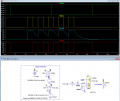
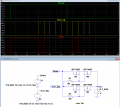
Below is the LTspice sim of a relay circuit as you suggested:
The capacitor keeps the relay pulled in between the turn-signal pulses.
You may have to experiment to get the right capacitor value, depending upon the characteristics of the relay you use.
You, of course, need two of these circuits.

1739488545664.png
 
Last edited:

Thread Starter

joe28704

Joined Feb 11, 2025
7
No suggestions can be made without a
Schematic-Diagram of the Switches in the "new" Steering-Column,
and a Schematic-Diagram of the original Car-Wiring .


Will You be using the original factory wiring in any part of this project ?

Do You have an actual "new" Aftermarket-Custom-Steering-Column ?,
( from an accessory manufacturer such as Flaming-River or Lokar et-al )
OR,
simply a used Column out of a later model Car that came with separate Brake and Turn-Signal Lights ?

How will the Emergency-Flasher-function be handled ?
( new Column Schematic will be required )

Do You intend to add an LED "third / High-Mount Brake-Light" ?

It will probably be easier to add new LED Brake or Turn-Signal-Lights in the rear of the Car.
.
.
.
No suggestions can be made without a
Schematic-Diagram of the Switches in the "new" Steering-Column,
and a Schematic-Diagram of the original Car-Wiring .


Will You be using the original factory wiring in any part of this project ?

Do You have an actual "new" Aftermarket-Custom-Steering-Column ?,
( from an accessory manufacturer such as Flaming-River or Lokar et-al )
OR,
simply a used Column out of a later model Car that came with separate Brake and Turn-Signal Lights ?

How will the Emergency-Flasher-function be handled ?
( new Column Schematic will be required )

Do You intend to add an LED "third / High-Mount Brake-Light" ?

It will probably be easier to add new LED Brake or Turn-Signal-Lights in the rear of the Car.
.
.
.


.
.
.
Thank you for the questions.

No original wiring is being used, ( except the 1157 bulb ) all wiring is from the donor vehicle .( 2004 Yukon XL )

Using donor vehicle steering column and signaling circuits ( attached)

I believe Hazard function is handled by GM Flasher Module #12450284 ( It has ten pins on it . I cannot find schematic for it's internal function). No third light will be used.

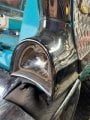
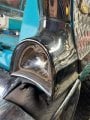
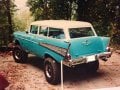
I am exploring adding some kind of LED into the reflector cavity of the taillight housing ,( pictured). It sure would simplify things. There is no room to drill and surface mount a bulb on the "reflector" as there is no room behind it to accept it and it's part of the taillight casting itself. However, a strip of custom-made LED's might tuck in there somehow.

I like the idea of a sealed relay and capacitor mounted on each side behind each taillight housing. But on the other hand, jamming/securing some LED strip in the reflector cavity is also an option if circuitry is too hard to fabricate and install.

Thank you for your thoughts on this.


.
.
.
 

Attachments

Thread Starter

joe28704

Joined Feb 11, 2025
7
Below is the LTspice sim of a relay circuit as you suggested:
The capacitor keeps the relay pulled in between the turn-signal pulses.
You may have to experiment to get the right capacitor value, depending upon the characteristics of the relay you use.
You, of course, need two of these circuits.

View attachment 342489
OK , Thank you. I think I get it.
When turn signal comes in to relay circuit it opens "brake" circuit and closes "Turn sig" for a period of time. Great.
So Turn_Sig going to each taillight respectively will first branch into TWO wires. One branch goes directly to bulb, other branch into relay circuit that receives brake signal and acts on it accordingly.
Now I need to find weatherproofing container and components as each of these two circuits can only be mounted near taillight housing.

I'm also exploring ways to cram(securely) an LED strip into the reflector cavity ( pictured) ,
this may be a reasonable way to get the third "filament" into the tailight.

Thank you for the schematic!

Joe
 

Attachments

crutschow

Joined Mar 14, 2008
38,423
So Turn_Sig going to each taillight respectively will first branch into TWO wires. One branch goes directly to bulb, other branch into relay circuit
No.
Why do you think that?
The only wire going to the bulb is from the Out signal C terminal of the relay contacts.
The Turn_Sig goes to the relay NO terminal and the resistor going to the diode and the relay coil.
 
Last edited:

Thread Starter

joe28704

Joined Feb 11, 2025
7
No.
Why do you think that?
The only wire going to the bulb is from the common terminal of the relay contacts.
The Turn_Sig goes to the relay NO terminal and the resistor going to the diode and the relay coil.
The reason I thought that is the schematic shows two Turn_sig wires.
One on the left going into a resistor, and another one on the right next to the brake signal going into the relay.
My thinking is the turn signal has priority and should at all times flash overriding the brake.
I'll try and view it another way.
Thank you.
 

crutschow

Joined Mar 14, 2008
38,423
The reason I thought that is the schematic shows two Turn_sig wires.
That's two connections for the Turn_sig.
But neither goes directly to the bulb.

The schematic I posted shows connections, not wires.
A wiring diagram, which shows specifically how to connect each wire, is different from a schematic, which does not.
My thinking is the turn signal has priority and should at all times flash overriding the brake.
That's what the circuit does.
See the red trace in my simulation which shows the output to the bulb for the brake-signal (green trace) and the turn-signal (blue trace).
Note that the Out signal is in sync with the turn_signal, even when the brake is on (high).
 
Last edited:

Thread Starter

joe28704

Joined Feb 11, 2025
7
That's two connections for the Turn_sig.
But neither goes directly to the bulb.

The schematic I posted shows connections, not wires.
A wiring diagram, which shows specifically how to connect each wire, is different from a schematic, which does not.
That's what the circuit does.
See the red trace in my simulation which shows the output to the bulb for the brake-signal (green trace) and the turn-signal (blue trace).
Note that the Out signal is in sync with the turn_signal, even when the brake is on (high).
Thank you very much for the schematic of this circuit. I have a very limited knowledge of electronics.
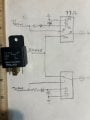
The only readily available relay I could find is the pictured 5 pin (77 Ohm) automotive relay.
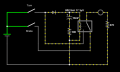
I have redrawn a full diagram based on your schematic.
If I may, I have a couple of questions to ask.
1) Could you tell me if this schematic looks right based on your sketch?
2) What is the purpose of the resistor in the turn signal line? How might I determine its value?
3) the resistance measured across the relay coil is 77 Ohms. Based on this would your 6800 Uf Capacitor still be a good starting point for a turn signal duration of an estimated 1/2 second?
4) Would either a 16-volt or 25-volt rated electrolytic capacitor be OK to use?

If my wiring diagram is good, it looks like I can build and put this circuitry in a small sealed container in the under-hood fuse box, route the brake line into it, and simply run one wire to each rear turn signal.

Thank you very much for any help you may provide me.TurnSchematicChevy.jpg
 

crutschow

Joined Mar 14, 2008
38,423
1) Could you tell me if this schematic looks right based on your sketch?
From my schematic, yes, it looks fine.
2) What is the purpose of the resistor in the turn signal line? How might I determine its value?
It limits the peak capacitor charge current through the diode to prevent zapping it (the diode).
The value is somewhat arbitrary but I show 1 ohm in the schematic (the "1" next to its symbol).
3) the resistance measured across the relay coil is 77 Ohms. Based on this would your 6800 Uf Capacitor still be a good starting point for a turn signal duration of an estimated 1/2 second?
Yes.
I used 70Ω in my simulation.
4) Would either a 16-volt or 25-volt rated electrolytic capacitor be OK to use?
Either would work.
 
Last edited:

crutschow

Joined Mar 14, 2008
38,423
I need a circuit to do this exact thing as described, except that I need to do it with solid-state components (no relays). MOSFETs would be preferred,
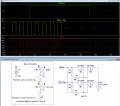
Below is the LTspice sim of a power XOR circuit using four P-MOSFETs to do that:
The two MOSFETs in the back-to-back connection provide blockage of the voltage in either direction when off (gate voltage high), but conduct fully in either direction when on (gate voltage low).
The P-MOSFETs can be just about any with ≥30V rating and <100mΩ on-resistance.
(Note: Be sure and note the correct orientation of the MOSFET source-to-source connections.)

1774752239694.png
 
Last edited:

eetech00

Joined Jun 8, 2013
4,704
Below is the LTspice sim of a power XOR circuit using four P-MOSFETs to do that:
The two MOSFETs in the back-to-back connection allow blockage of the voltage in both directions when off (gate voltage high), but conduct fully in either direction when on (gate voltage low).
The P-MOSFETs can be just about any with ≥30V rating and <100mΩ on-resistance.
(Note: Be sure and note the correct orientation of the MOSFET source-to-source connections.)

View attachment 365286
The car has electro-mechanical switches and flasher (I used to have a 55' Belair hardtop).
How does this circuit behave if the input signals float (when off)?
How does this circuit behave if the flasher is turned on first before braking?
 

crutschow

Joined Mar 14, 2008
38,423
How does this circuit behave if the input signals float (when off)?
Good question.
I added resistors to prevent floating voltages so the MOSFETs will stay off under those conditions.
How does this circuit behave if the flasher is turned on first before braking?
Signal sequence makes no difference (why would it as it's just a logic circuit?).
See below with switches added to simulate mechanical switches:

1774792672107.png
 

sghioto

Joined Dec 31, 2017
8,634
I was under the impression that the bulb was on continuously when activated by either turn or brake switch from the video simulation in post #15, as there is a 10mF cap across the relay coil.
 
Last edited:

crutschow

Joined Mar 14, 2008
38,423
I was under the impression that the bulb was on continuously when activated by either turn or brake switch from the video simulation in post #15, as there is a 10mF cap across the relay coil.
Not, if you are referring to the circuit below, when the relay is actuated by the turn-signal, the bulb is then powered by the turn-signal through the relay contacts:

1774796598834.png
 
Last edited:
Top