Circuit distorting AC signal from CT

Ian0

Joined Aug 7, 2020
13,144
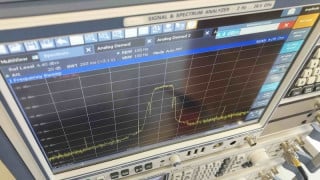
I just went to the lab and scanned one of CoilCraft's CTs. The leakage inductance has nothing to do with low end frequency response. With no primary and no LL, just using the secondary, the 100mH shorts out the resistors at low frequencies. (in this case there is 1 ohm of wire and 100 ohms of burden resistance) 100mH & 101 ohms makes the low end roll off.
View attachment 215914
I used 10 ohm, 100 ohm and 1k for the test. Burden resistor effects low end response.
The high end roll off is a function of C1 and R and has a ring at resonant frequency.
My CT has a Lmag of 6.4H, so the shunt impedance is more like 2k at 50Hz, so whether the burden resistor is 10 ohms or 100 ohms isn't going to make much difference.
However, mine is ferrite cored, so is going to saturate at a lower voltage than one with a laminated core.
I have some different CTs at work designed for 1A output. I can only remember that the manufacturer's name is three letters and that they are brown, which doesn't help Mr. Google find the datasheets; but it seems as though there is a big difference between different CTs and it's difficult to predict the result of varying the burden resistor without the datasheet, or without knowing Lmag and Lleak.
I imagine that the two-terminal types (where the primary wire goes through the middle) are going to behave differently from the four-terminal types which have a proper primary winding of several turns around the core.
 
I did a similar design for a ground-fault CT circuit. The test winding is typically 1/100 #turns of the sense winding. Most CT manufacturers construction is scramble-wound so a lot of unwanted, lop-sided capacitance between windings which makes the design more difficult. I let the test winding normally float yet have transient protection (diode clamps) present. For GFI test you connect and inject an AC square-wave at mains frequency to the test winding, equivalent to the few mA the safety standard requires. I use CMOS gates as a full bridge for this, so +/-3.3Vp available.
I don't think OP knows enough to pull this one off, and the question has been cross-posted all over.
 

MisterBill2

Joined Jan 23, 2018
27,591
I did a similar design for a ground-fault CT circuit. The test winding is typically 1/100 #turns of the sense winding. Most CT manufacturers construction is scramble-wound so a lot of unwanted, lop-sided capacitance between windings which makes the design more difficult. I let the test winding normally float yet have transient protection (diode clamps) present. For GFI test you connect and inject an AC square-wave at mains frequency to the test winding, equivalent to the few mA the safety standard requires. I use CMOS gates as a full bridge for this, so +/-3.3Vp available.
I don't think OP knows enough to pull this one off, and the question has been cross-posted all over.
I knew that I had seen this post before. Right down to the same circuit drawing. IS it somebody trolling this site?Or what??
 
Lately I see alot of people wanting design answers and help, posting all over the Internet. It seems to be for their job.
I'm losing patience when they are vague, demand help and scold people for not giving them the answers, cross-post and then the thread goes necro once they have their answer. There is no spirit of learning the craft, just "gimme the answer".
https://www.eevblog.com/forum/projects/circuit-distorting-ac-signal-from-ct/
https://electronics.stackexchange.com/questions/518594/circuit-distorting-ac-signal-from-ct
 

Ian0

Joined Aug 7, 2020
13,144
I suppose that if they get a huge variety of different suggestions then they still have to think!
And not all the solutions they are given might actually work.
 

MisterBill2

Joined Jan 23, 2018
27,591
I suppose that if they get a huge variety of different suggestions then they still have to think!
And not all the solutions they are given might actually work.
You certainly have THAT right. A whole lot of random input on some posts. I always identify my guesses as based on insufficient information. Of course many requests are from those who really are newbees and don't realize that others are not aware of the things that they are asking about. I am totally not familiar with cheap entertainment products sold on the other side of the world from me. But often I can answer questions once I know what explanation is needed.

But this particular one is really unfortunate.
 

Thread Starter

Blue_Electronx

Joined Jun 10, 2019
112
Sorry for not reporting back. Thanks for all the comments above. The circuit works well, the problem was two things: the bias resistor R31 was too high, so no enough current for a stable voltage reference. The other thing is that I removed the analog switch from L2 test winding, apparently it has some internal diodes clamping the signal and it reflects on L1.
 
Top