Circuit Analysis Help

WBahn

Joined Mar 31, 2012
32,852
I take this seriously. How I went wrong - I'd like to hear where you see errors on my part. I see I got the same basic answer in post 15 and 18. I don't see how you can say "This time you got it right". Post 15 was taken at a lesser accuracy than in 18. I feel I got the right answer both times but I don't see how I accidentally got the right answer.

But I bow to your knowledge and experience, and ask you give details on what you feel I did wrong.
Maybe it's just a case of you switching, for some reason, from making actual calculations to using approximations and me not realizing that you had done so since you gave no indication that you were doing do.

Here is Post #15:

R2 + R3 (Series) = 100Ω
R4/R5 (Parallel) = 20.3Ω
R4/5 (Parallel) + R6 (Series) = 95.3Ω
R2/3 parallel with R4/5/6 = 50Ω
R1 + {R2,3,4,5 & 6 (parallel/series resistors)} = 130Ω.
In the first three lines, you make the effort to actually do the calculations for parallel resistors, reporting the results to three sig figs. No approximations.

So I assumed that your calculation in the fourth line was ALSO done with no approximations, using the results from the prior two lines. But the result you got was not consistent with that -- you got 100 Ω in parallel with 95.3 Ω was 50 Ω. That implies a mistake, since we know that the answer must be strictly less than 50 Ω. If, at this point, you just decided to stop using actual calculations of parallel resistances, as was done in the prior two lines, to just using an approximation, I'd suggest indicating that somehow, such as saying

R2/3 parallel with R4/5/6 = ~50Ω
or
R2/3 parallel with R4/5/6 = 50Ω (approx)
 

Tonyr1084

Joined Sep 24, 2015
9,744
How could I draw this circuit and visualize it in that way?
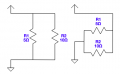
Here's two ways you can redraw your circuit to help you understand what's going on. Both of these circuits are the same as the one you originally posted.
Screenshot 2025-06-30 at 5.59.25 AM.png
Sorry if I got off on a tangent with multiple series/parallel circuits. It was all in an effort to help you understand how parallel resistors can look like a single resistor; and how series resistors can also look like a single resistor.
 

MrAl

Joined Jun 17, 2014
13,707
When two resistors are close to the same size, the parallel combination is close to half their average, which in this case would be 48.825 Ω. The actual combination comes out to 48.798 Ω. Both are 48.8 Ω to three sig-figs.
Hi there,

Two 100 Ohm resistors in parallel obviously comes out to 50 Ohms.
100+100=200
200/4=50

The calculation for the two in this problem that are connected directly in parallel is very interesting...
37 in parallel with 45 comes out to 20.3 Ohms.
Using the average:
37+45=82
82/4=20.5
That's within 1 percent of the exact result.

I think the ideal divider factor is:
k=a+1/a+2
where
'a' is the ratio of R2/R1 where R2>R1.
This was a quick thought though it really needs verification yet.
In the case of 45 and 37 this would lead to a divider factor of 4.038 approximately.
To use the constant divider factor of 4.000 and get within 5 percent I think R2 would have to be limited to a bit over 1.5*R1 but I'd have to check that over again also.
 
Last edited:

WBahn

Joined Mar 31, 2012
32,852
Hi there,

I think you meant to say that when two resistors are close to the same value the parallel combination is close to one-quarter of their average. It's funny I was looking at the possibility of averages fitting into these problems too.

Two 100 Ohm resistors in parallel obviously comes out to 50 Ohms.
100+100=200
200/4=50
Uh... The average of two 100 Ω resistors is 100 Ω. Half that size is 50 Ω.

A quarter of their average would be 25 Ω.
 

MrAl

Joined Jun 17, 2014
13,707
Uh... The average of two 100 Ω resistors is 100 Ω. Half that size is 50 Ω.

A quarter of their average would be 25 Ω.
Oh yes, it's one quarter of their sum not one quarter of their average. The way I did it was slightly different.
Thanks for pointing that out. I'll also correct that post.

The calculation using 'a' should be correct but you can check that too.
It's interesting that we get a value that is close even when the two values are much more different from each other (like 50 percent).
 
Top