Circuit Analysis Help

Thread Starter

cbarb2747

Joined Apr 15, 2025
2
circuit.png


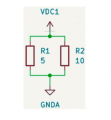
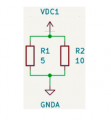
I am having trouble visualizing the circuit and whether the resistors are in parallel or series. Usually a circuit is drawn as a square with a path from+ to - on the power source. How could I draw this circuit and visualize it in that way
 

Attachments

spenkmo

Joined Apr 24, 2025
25
You must first specify two nodes in the circuit and then ask whether the two resistors are in parallel or in series between the two nodes.
 

WBahn

Joined Mar 31, 2012
32,703
View attachment 351767


I am having trouble visualizing the circuit and whether the resistors are in parallel or series. Usually a circuit is drawn as a square with a path from+ to - on the power source. How could I draw this circuit and visualize it in that way
Interpreting that schematic requires that you understand some of the conventions used by people that draw schematics in order to make them more readable -- provided you know the conventions.

In many circuits, there are lots and lots of things connected to certain nodes, such as the connections to both sides of a power supply. So explicitly showing every connection via a line on the schematic can severely clutter things up and make it difficult to follow. So we have "global" nodes that are connected by name. There are a number of common symbols that are used for this, your schematic used two of them. One of them is the triangle connected to a node named "GNDA". Any place else in the schematic that is connected to a global marker (usually the same shape, but doesn't have to be) that uses the label "GNDA" is connected to that same node. Another global node in your schematic is "VDC1".

Somewhere in your schematic there is probably a power source of some kind that is also connected to those same two global nodes. The connections are exactly as if there were wires drawn between similar labels (and, in a real circuit, there would be physical wires connecting them).

With that in mind, ask yourself whether any current that flows in R1 must also flow in R2. If so, they are in series. If not, they are not in series.

Next, ask yourself whether the voltage that appears across R1 must always be the same voltage that appears across R2. If so, they are in parallel. If not, they are not in parallel.

It's important to realize that it is NOT an either/or situation. In general, pick two components in a circuit and they are in neither series nor parallel. However, in one trivial case (can you figure it out), two components can be in both series and parallel. Hint -- think of a flashlight with the switch turned on.
 

sparky 1

Joined Nov 3, 2018
1,218
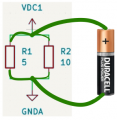
All along the Green wire at the top, the resistance is nearly zero (such as 0.001Ω or less) it is therefore a node. A schematic node has zero resistance.
In geometry two parallel lines never cross by geometry definition and is for solving geometry.

In electronics, resistors not in series and are connected to the same source (Vdc 1 and Gnd A) are said to be in a parallel arrangement,
This is a parallel electrical current flow with two or more resistors. A source began by observing cause and effect by experiments and developing an empiral formula.
Alessandro Volta developed the first continuous DC source called the pile using primitive electrical chemistry.

Refering to RonSimpson's post, showing a conventional battery cell, the resistors are arranged in parallel and not series.
When enough parallel and series arrangements are combined it can be tricky, requiring sufficient electrical math skill and strategy,
 
Last edited:

MrChips

Joined Oct 2, 2009
34,628
1751024226040.png

Without worrying about series or parallel circuits, try to analyze the voltages across each resistor and the current through each resistor.

What is the voltage across R1?
What is the voltage across R2?
What is the current through R1?
What is the current through R2?
What is the combined current from VDC1 to GNDA?
What is the combined or equivalent resistance of R1 and R2?

Now, are R1 and R2 in series or parallel?
 

Tonyr1084

Joined Sep 24, 2015
9,744
Screenshot 2025-06-27 at 9.06.27 AM.png
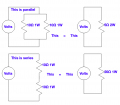
In parallel, the resistors are side by side. But they don't have to be drawn that way. Electrically they are parallel.
In series, the resistors are end to end. They don't have to be drawn that way but electrically speaking one is connected to the other in an end to end manor.
 

spenkmo

Joined Apr 24, 2025
25
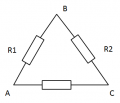
Being in series and parallel should be studied based on the two reference points. In the following example, if we look at A and C, then R1 and R2 are in series. But if the reference points are shifted to A and B, then R1 and R2 are in parallel. Of course in general there is a third case, where R1 and R2 are neither in series nor in parallel; eg at least one is disconnected. Basically when a pair of reference points are chosen, we can apply a voltage source across the two points and ask the question "whether any electron passes through both R1 and R2 when flowing from one reference point to the other (one end of the voltage source to the other)?" If the answer is yes, then R1 and R2 are in series. Otherwise, they are in parallel, or one or both are disconnected. This can be further clarified by asking "whether both R1 and R2 see any current?"
1751038289486.png
 

Tonyr1084

Joined Sep 24, 2015
9,744
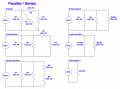
In the "Parallel / Series" circuit below, all five of these circuits are identical. Follow the progression of how to break them down.
First iteration turn R4 - the angled resistor into a parallel resistor, parallel to R1 and essentially R2 & R3.
Second iteration redraw the two series resistors R2 & R3 into a stacked pair, one above the other.
Third iteration combine the two series resistors R2 & R3 into a single resistor (R2/R3)
Fourth iteration combine R1 & R4 into a single 5Ω 2W resistor (R1/R4)
Finally, the Fifth iteration is the final circuit. Using Ohms law we combine the resistances and calculate their values.
Screenshot 2025-06-27 at 9.41.23 AM.png
 
Last edited:

MrAl

Joined Jun 17, 2014
13,667
View attachment 351767


I am having trouble visualizing the circuit and whether the resistors are in parallel or series. Usually a circuit is drawn as a square with a path from+ to - on the power source. How could I draw this circuit and visualize it in that way
Hi,

If you only have exactly 2 elements connected and no source it's hard to say if they are in series or parallel, but here you actually have 3 elements. The voltage source is also connected across the two resistors so that makes it easy to figure out.

If you only had the two resistors and nothing else, it would *usually* be called a parallel circuit anyway because calling it a series circuit would just be a play with theory not anything that could ever happen in real life (within the confines of the theory behind the lumped circuit element model which is most common). There's no current flow with just two resistors and no source of any kind. You do not have to worry about that case though yours has a voltage source in addition to the two resistors.

Here's another possibility...
If you can combine the two resistors into just one resistor using the parallel resistor formula:
RT=R1*R2/(R1+R2)
then they must be in parallel, for most cases except the highly theoretical.
Another way of writing that is:
RT=1/(1/R1+1/R2)
with RT the total combined resistance.
This is also interesting I think because we could never use the formula for two series resistors:
RT=R1+R2
so they can't be said to be in series, in almost all cases except the highly theoretical which would invoke fields or wavelengths and component physical dimensions and positions in 3d space which we usually don't consider in these simpler exercises.
 
Last edited:

ThePanMan

Joined Mar 13, 2020
862
Based on the most conventional consideration the two resistors are in parallel. In Tony's drawing, iteration #1 & 2, R2 & R3 are in series. R1 & R4, as well as the series of R2/R3 are all three of them in parallel. Then when all has been sorted out - what you have is a single resistance as in Tony's last iteration.
 
Last edited:

MrChips

Joined Oct 2, 2009
34,628
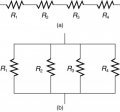
If two resistors are in parallel they must have the same end nodes. The voltage nodes are the same for both resistors. The voltage across each resistor is the same.

If two resistors are in series, they must have the same current flowing from one resistor to the other. The current through one resistor is the same as the current through the other resistor.

Now, can you tell which is series and which is parallel configuration?

1751062470853.jpeg
 

MrChips

Joined Oct 2, 2009
34,628
In this circuit, which resistors are in series and which are in parallel?
Determine the equivalent resistance of the total combination of all resistors R1-R6.
Show your work.
1751062998822.gif
 

Tonyr1084

Joined Sep 24, 2015
9,744
R2 + R3 (Series) = 100Ω
R4/R5 (Parallel) = 20.3Ω
R4/5 (Parallel) + R6 (Series) = 95.3Ω
R2/3 parallel with R4/5/6 = 50Ω
R1 + {R2,3,4,5 & 6 (parallel/series resistors)} = 130Ω.
 

WBahn

Joined Mar 31, 2012
32,703
In this circuit, which resistors are in series and which are in parallel?
Determine the equivalent resistance of the total combination of all resistors R1-R6.
Show your work.
View attachment 351811
A very useful skill, and one that is seldom even mentioned in EE courses anymore, is the ability to estimate solutions. Both to get a rough idea of the answer, but also to put bounds on what the detailed answer has to be in order to catch mistakes.

Here, right off the bat, we know that the total resistance has to be at least 80 Ω, due to R1.

We also know that the rest of the resistors can't equal out to anything more than 100 Ω (R2 + R3), so we have an upper bound of 180 Ω. We can thus make out first estimate as being the midpoint, or 130 Ω. But out bounds are pretty loose at ±50 Ω.

To proceed further and narrow the gap between the upper and lower bounds, we leverage the fact that for two parallel resistances, the effective resistance can be no less than half the smaller and no more than half the larger. Sometimes a tighter bound is obtained by noting that it can be no more than the smaller of the two.

So, looking at R4 and R5, it must be larger than 37 Ω / 2, so call it 18 Ω and smaller than 45 Ω / 2, so call it 23 Ω. That means the bottom branch must be between 83 Ω and 98 Ω. Combining that with the top branch, the smallest that can total out to is half the 83 Ω, so call it 42 Ω, and the largest it can be is half of 100 Ω, or 50 Ω. This gets us to a total resistance that must be between 122 Ω and 130 Ω, so split the difference and call it 126 Ω ± 4 Ω. That's within about 3%, so if these are 5% resistors (or worse), there's probably no need to actually run the full analysis.

But, if we do, we get 128.8 Ω.
 

WBahn

Joined Mar 31, 2012
32,703
R2 + R3 (Series) = 100Ω
R4/R5 (Parallel) = 20.3Ω
R4/5 (Parallel) + R6 (Series) = 95.3Ω
R2/3 parallel with R4/5/6 = 50Ω
R1 + {R2,3,4,5 & 6 (parallel/series resistors)} = 130Ω.
R2/3 parallel with R4/5/6 = 50Ω

This should have put up some red flags, as it is exactly half of R2+R3, which would require that the combination of R4/R5/R6 also be 100 Ω, but the line above shows that it is less than that. So you know that the total of everything (except R1) has to be strictly less than 50 Ω, albeit not by much.

When two resistors are close to the same size, the parallel combination is close to half their average, which in this case would be 48.825 Ω. The actual combination comes out to 48.798 Ω. Both are 48.8 Ω to three sig-figs.
 

Tonyr1084

Joined Sep 24, 2015
9,744
R2 . R3
49+51=100 Ω

......R4......R5......R45
1/(1/37+1/45)=20.3

.R45..R6..R456
20.3+75=95.3

......R23........R456...R23456
1/(1/100+1/95.3=48.8

R1+R23456
80+48.8=128.8Ω

First time through I got 130Ω. Pretty close to having the computer calculate it out at 128.8
the combination of R4/R5/R6 also be 100 Ω
Potato / Patatta, you got 100 I got 95.
So you know that the total of everything (except R1) has to be strictly less than 50 Ω, albeit not by much.
Again, we're in agreement. Less than 50Ω. 48.8Ω is what we get, you and I. (48.798 to be precise)

Did I come up with the wrong answer? (approximations not withstanding)
 

WBahn

Joined Mar 31, 2012
32,703
R2 . R3
49+51=100 Ω

......R4......R5......R45
1/(1/37+1/45)=20.3

.R45..R6..R456
20.3+75=95.3

......R23........R456...R23456
1/(1/100+1/95.3=48.8

R1+R23456
80+48.8=128.8Ω

First time through I got 130Ω. Pretty close to having the computer calculate it out at 128.8
Yes, THIS time you got lucky and the mistake you made only through the final answer off by a small amount.

The point is much more general, however. We need to be in the habit of religiously asking whether our answers, including intermediate results, make sense. If they don't, then we need to stop right there and resolve it before proceeding further. We all make mistakes -- I am surely no exception to that, not by a long shot -- so we need to develop (and then use) routine practices that increase the likelihood that our mistakes will not go uncaught.

Potato / Patatta, you got 100 I got 95.
I got 95.3 Ω, the same as you. I didn't say that I got 100 Ω, I said that, for you to get " R2/3 parallel with R4/5/6 = 50Ω ", YOU would have had to have gotten that the R456 combination was 100 Ω, which does not make sense in light of the prior line which stated, " R4/5 (Parallel) + R6 (Series) = 95.3Ω ".

At each step we should ask if it makes sense and that needs to be firmly engrained habit. If we lack the information or insight to answer that question at a particular step, that's fine. Move on. But ask the question with the goal of finding some quick sanity check that can be made to detect an error. With practice, that step because pretty automatic. We quickly get to the point where we don't have to remember to ask the question, because any time we don't ask it will feel awkward.

Again, we're in agreement. Less than 50Ω. 48.8Ω is what we get, you and I. (48.798 to be precise)

Did I come up with the wrong answer? (approximations not withstanding)
This time you got it right (other than being very sloppy with units -- which can get you in serious trouble, up to and including people dying, ask me how I know).
 

Tonyr1084

Joined Sep 24, 2015
9,744
This time you got it right (other than being very sloppy with units -- which can get you in serious trouble, up to and including people dying, ask me how I know).
I take this seriously. How I went wrong - I'd like to hear where you see errors on my part. I see I got the same basic answer in post 15 and 18. I don't see how you can say "This time you got it right". Post 15 was taken at a lesser accuracy than in 18. I feel I got the right answer both times but I don't see how I accidentally got the right answer.

But I bow to your knowledge and experience, and ask you give details on what you feel I did wrong.
 
Top