Facebook
 Google
 GitHub
 Linkedin
I am designing a motor controller for a switched reluctance motor (SRM).
I found an application note (AN) that discussed how to create a bootstrap circuit when the circuit is in a dual forward converter configuration. This is the same configuration that is used in SRM motor drives. (According to my research)
The application note is here: https://www.farnell.com/datasheets/2254418.pdf
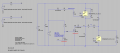
And this is the figure in question:
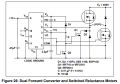
I am attempting to simulate this circuit in LTSpice. I am using GaN transistors for the power switching so that I can hopefully get a higher switching frequency above human hearing range for reduced audible noise. The issue that I have is: Q2 is obsolete, and I'm not sure about Q1's life expectancy. I would like to use newer transistors.
I messed around with many different options, even trying to find cross-referenced parts, but they all seem to introduce weird artifacts (large current and or voltage spikes, slower switching speed, reverse current on the main FETs etc). I've even tried newer power MOSFETs with a gate drive circuit.
The first thing I tried was just using two IRF710s. That seemed to work the best. Everything seemed to be okay except the current through the device was 8-14A peaks. The device is rated for around 2A continuous with 6A peak current.
I then tried newer power MOSFETs. The 10k resistor was too high to drive the gate high quickly, so I changed it to 1k in my schematic. That helped, but the previously mentioned issues/artifacts were still there. It needs to pull the source pin of the high-side fet high so that the bootstrap cap will charge. I will have three of these for the three motor windings, so I would rather not use isolated supplies unless I have to.
Also, the larger power transistors caused voltage spikes almost double the supply voltage (maybe due to the recovery time of the diodes, but I thought I'd point that out.) I also noticed some reverse current in the main power FETS with the newer MOSFETs in place.
So my question is, how can I choose the components for Q1 and Q2 for efficient operation? Should I use a different circuit design to do this? Also, how would you go about specifying the diodes so that I can ensure they have a fast enough recovery?
I have attached the LTSpice simulation along with the necessary components if you'd like to look at that yourself.
I found an application note (AN) that discussed how to create a bootstrap circuit when the circuit is in a dual forward converter configuration. This is the same configuration that is used in SRM motor drives. (According to my research)
The application note is here: https://www.farnell.com/datasheets/2254418.pdf
And this is the figure in question:
I am attempting to simulate this circuit in LTSpice. I am using GaN transistors for the power switching so that I can hopefully get a higher switching frequency above human hearing range for reduced audible noise. The issue that I have is: Q2 is obsolete, and I'm not sure about Q1's life expectancy. I would like to use newer transistors.
I messed around with many different options, even trying to find cross-referenced parts, but they all seem to introduce weird artifacts (large current and or voltage spikes, slower switching speed, reverse current on the main FETs etc). I've even tried newer power MOSFETs with a gate drive circuit.
The first thing I tried was just using two IRF710s. That seemed to work the best. Everything seemed to be okay except the current through the device was 8-14A peaks. The device is rated for around 2A continuous with 6A peak current.
I then tried newer power MOSFETs. The 10k resistor was too high to drive the gate high quickly, so I changed it to 1k in my schematic. That helped, but the previously mentioned issues/artifacts were still there. It needs to pull the source pin of the high-side fet high so that the bootstrap cap will charge. I will have three of these for the three motor windings, so I would rather not use isolated supplies unless I have to.
Also, the larger power transistors caused voltage spikes almost double the supply voltage (maybe due to the recovery time of the diodes, but I thought I'd point that out.) I also noticed some reverse current in the main power FETS with the newer MOSFETs in place.
So my question is, how can I choose the components for Q1 and Q2 for efficient operation? Should I use a different circuit design to do this? Also, how would you go about specifying the diodes so that I can ensure they have a fast enough recovery?
I have attached the LTSpice simulation along with the necessary components if you'd like to look at that yourself.
Attachments
-
922.4 KB Views: 1