Choosing an op amp for signal rectification

Thread Starter

PeteHL

Joined Dec 17, 2014
562
Which would be the better op amp to configure for half-wave or full-wave rectification in the audio frequency range, TL072 or CA3140? Would it make a big difference which one I choose? If it does make a significant difference, what characteristic(s) of an op amp would make it suitable or not for this purpose?

I haven't readily found any information about this, so thanks in advance if you know the answer.

-Pete
 

ronsimpson

Joined Oct 7, 2019
4,648
The CA3140 has an input that works to slightly below the low power supply voltage. That is important. The TL072, I think does not work well when the input gets within 2V of the negative supply.
I often use a "R-R input" and "R-R output" opamp in this position.
 

Thread Starter

PeteHL

Joined Dec 17, 2014
562
The CA3140 has an input that works to slightly below the low power supply voltage. That is important. The TL072, I think does not work well when the input gets within 2V of the negative supply.
I often use a "R-R input" and "R-R output" opamp in this position.
Thanks! My signal inputs will be line level such as from a CD player which I believe wouldn't exceed maybe 5V peak at most? I continue to use a +/- 15V power supply for the best possible performance. So I'm staying well away from getting close to the power supply voltages.
 

Thread Starter

PeteHL

Joined Dec 17, 2014
562
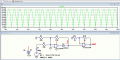
The output is a full-wave rectified signal.
Yes.
But with a single, positive supply voltage, it saturates at 0V, since the output can't go negative.
V2 is a (full-wave) sine wave source and the output of the circuit is half-wave. I would call that a half-wave rectifier.

I did miss that the power supply is single positive.
 

crutschow

Joined Mar 14, 2008
38,323
and the output of the circuit is half-wave. I would call that a half-wave rectifier.
Call it what you want, but to the rest of us, it's full-wave.

Look at the Vbuff output of the circuit in post #2 (green trace), which shows a full-wave rectified signal.

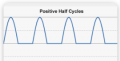
Below is an example of a half-wave rectified sinewave.
What does a full-wave rectified signal look like to you?

1759890130619.png
 

sparky 1

Joined Nov 3, 2018
1,218

Thread Starter

PeteHL

Joined Dec 17, 2014
562
Call it what you want, but to the rest of us, it's full-wave.

Look at the Vbuff output of the circuit in post #2 (green trace), which shows a full-wave rectified signal.

Below is an example of a half-wave rectified sinewave.
What does a full-wave rectified signal look like to you?

View attachment 356883
Okay yes I agree with you that it is full-wave rectification. However
Call it what you want, but to the rest of us, it's full-wave.

Look at the Vbuff output of the circuit in post #2 (green trace), which shows a full-wave rectified signal.

Below is an example of a half-wave rectified sinewave.
What does a full-wave rectified signal look like to you?

View attachment 356883
Okay I agree with you that it is doing full-wave rectification. However the positive half-wave of V2 is badly distorted. The feedback resistor network of the first inverting amplifier isn't to be found in textbooks, at least not in my textbooks.
 

Thread Starter

PeteHL

Joined Dec 17, 2014
562
I see no distortion in the output.
Why do you think it's distorted?
I'm sorry, I don't know what I'm thinking. You're right, of course, this is how full wave rectification normally looks.

So when the voltage of V2 is negative the first (inverting) amplifier attenuates V2 by one-half and the following non-inverting amplifier amplifies by 2 for unity gain by the circuit. When the voltage of V2 is positive, then the output of the first op amp saturates. V2 by voltage division of R1 and R5 is attenuated by one-half and is multiplied by two by operation of the second op amp. Thus the circuit full-wave rectifies. I think that maybe about this I'm correct.

Thanks for putting up with my initial idiocy, I don't know where that came from.

-Pete
 

schmitt trigger

Joined Jul 12, 2010
2,027
EDIT; The TL072 has a much faster slew rate, thus for audio frequencies it would be a better option.
It will require a split supply. Its common mode range is only a couple of volts above the negtive rail
 
Last edited:

Thread Starter

PeteHL

Joined Dec 17, 2014
562
In the FW rectifier of post # 2, when the AC voltage source V2 is positive, then there is a voltage drop at the inverting input terminal of the first op amp equal to 50mV. In other words, because diode D2 is reverse biased, it's impossible for the inverting input terminal to be a virtual ground. Also feedback resistor R3 is an inconsequential resistance in series with the impedance of the positive input terminal of the second op amp.
 
Top