Charging a supercapacitor

-live wire-

Joined Dec 22, 2017
959
And for maximum power dissipation, with resistive-like loads and an ESR, you can use the maximum value of P = (V*Rload)/(Rload+ESR)^2.
 

Thread Starter

cmartinez

Joined Jan 17, 2007
8,761
The first thing you should do is to figure out what exactly you are working with. Then design a circuit based on that.
Agreed ... then again, I'm currently preparing myself, trying to learn the available options, so I can later decide more quickly what I'm going to do.

Rest assured, I'll come back to this thread when I've done proper testing and have more specific information to share.
 

-live wire-

Joined Dec 22, 2017
959
What exactly is this for? Should it be portable/small, and how much of an issue is cost? Or do you just want to extract as much power as you can from a motor? This will also determine what options you have.
 

Thread Starter

cmartinez

Joined Jan 17, 2007
8,761
What exactly is this for? Should it be portable/small, and how much of an issue is cost? Or do you just want to extract as much power as you can from a motor? This will also determine what options you have.
I'm afraid I can't disclose the exact nature of the device, but I can tell you it's to generate power from a renewable source ... let's say it's a teeny-tiny windmill.
 

Thread Starter

cmartinez

Joined Jan 17, 2007
8,761
So size is an issue? What about cost? And is it possible to use a more powerful generator to get more energy?
Size is a constraint, and of course, so is also cost. I have to meet both specs (and so far I've been perfectly able to do just that). This is but a small part (although a very important one) of a much more complex system. And no, it is not possible to use a more powerful generator to get more energy.
 

ebp

Joined Feb 8, 2018
2,332
...
I noticed this sentence in the description: "The LTC3459 can be powered from a single lithium ion battery, a 2- to 3-cell stack of alkaline or nickel batteries, or any low impedance voltage source between 1.5V and 5.5V." What happens, I wonder, if the voltage source is NOT low impedance? And just how low is "low"? The data sheet doesn't say.
The input supply will be "collapsed." If a switcher does not have sufficient power available to allow regulation at its output, it will go to maximum duty cycle and with a source that isn't low impedance, this means it sort of latches into a state where even less power is available due to the source impedance. The behavior is rather similar to what you get with foldback current limiting.

For any such source, the only real solution is along the lines of maximum power point (MPP) operation. For something like a photovoltaic source, this is done by regulating the minimum input voltage - you allow loading that pulls the terminal voltage of the array down to the MPP but no lower as long as the load requirement cannot be met. If the system reaches a point where the load requires less than the power available at MPP (e.g. battery has been mostly charged), the normal output regulation loop takes over control.

With a PV source at a known combination of illumination and temperature there will be a single MPP since the source is "DC." With the generator operating at a known speed, there will be a maximum power curve where the instantaneous MPP will vary with the phase angle. It might turn out to be a nice neat relationship or it might not.
 

Thread Starter

cmartinez

Joined Jan 17, 2007
8,761
With the generator operating at a known speed, there will be a maximum power curve where the instantaneous MPP will vary with the phase angle.
Very interesting observations. Fortunately, since the source is AC (which is later rectified into DC) I can make the MCU detect the "pulses", and therefore have it calculate the speed at which the generator is runnig, and hence the acual power available. That way I could have it make whatever adjustments are needed for changing the supercap under optimal conditions. But I don't know how to do that.... that's what I'm trying here to figure out, and the reason why I opened this thread.
 

DickCappels

Joined Aug 21, 2008
10,661
(some text removed for clarity)

But I do need to simultaneously run an MCU, and I'm currently considering weather to either power it from the same supercap, or to power it from a separate circuit with a much smaller cap. So my choice right now is either to charge the supercap and then start the MCU when voltage reaches the minimum threshold, or to accumulate a little energy inside a separate, smaller cap that will feed the MCU, and then to start charging the supercap.
The test group at one place I worked had a battery powered test instrument that ran on a Ni-Cd battery that was charged by the on-board microcontroller. The irritating aspect of the design was that when the battery was discharged, as happens whether you use the instrument or not, the microcontroller cannot operate and thus cannot charge the battery. It seems like every time I went into their lab I'd see the instrument on the floor with the cover off, and a couple of clip leads connected to the battery so it could be charged by an external charger.
 

ebp

Joined Feb 8, 2018
2,332
You may find that the generator impedance is enough higher than the capacitor impedance that simply connecting the cap across the rectifier output works acceptably. All that is then required is something to end charging at 5 volts. If this isn't acceptable overall, it might still be OK for getting the cap up to the voltage required by the processor (about half the total charge, a quarter of the total energy). If you use a conventional boost converter, this is what you have with the switch kept turned off - the input connects to the output via the inductor and the diode - so it isn't a bad arrangement if you want to control the boost switch directly with PWM from the microcontroller.

If I were faced with trying to keep parts count to a minimum and found a conventional boost configuration to be useful, I would consider using the boost switch to short circuit the generator to end charging the capacitor.
 

Thread Starter

cmartinez

Joined Jan 17, 2007
8,761
You may find that the generator impedance is enough higher than the capacitor impedance that simply connecting the cap across the rectifier output works acceptably. All that is then required is something to end charging at 5 volts. If this isn't acceptable overall, it might still be OK for getting the cap up to the voltage required by the processor (about half the total charge, a quarter of the total energy). If you use a conventional boost converter, this is what you have with the switch kept turned off - the input connects to the output via the inductor and the diode - so it isn't a bad arrangement if you want to control the boost switch directly with PWM from the microcontroller.

If I were faced with trying to keep parts count to a minimum and found a conventional boost configuration to be useful, I would consider using the boost switch to short circuit the generator to end charging the capacitor.
As a matter of fact, the generator's impedance will end up being between 50 and 140 ohms, depending on the configuration that I choose to use. And, of course, I'll be testing both options to see which one performs better and delivers more power.

If what you're saying regarding "All that is then required is something to end charging at 5 volts" is true, then the solution offered by OB in post #2 is a perfect one.
 

OBW0549

Joined Mar 2, 2015
3,566
If what you're saying regarding "All that is then required is something to end charging at 5 volts" is true, then the solution offered by OB in post #2 is a perfect one.
That post addressed only developing a regulated 2.4V for your MCU's Vdd; it wasn't aimed at limiting the supercap's voltage at 5.0V.

For that, you could either use a second LP2951 (the 5V version) to series-regulate the supercap's voltage, or use a TL431 set to 5V as a shunt regulator.
 

Thread Starter

cmartinez

Joined Jan 17, 2007
8,761
That post addressed only developing a regulated 2.4V for your MCU's Vdd; it wasn't aimed at limiting the supercap's voltage at 5.0V.

For that, you could either use a second LP2951 (the 5V version) to series-regulate the supercap's voltage, or use a TL431 set to 5V as a shunt regulator.
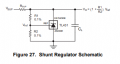
You mean like this?:
upload_2018-6-6_14-11-22.png

I'm guessing the \(C_L\) shown at the output might very well be the supercap I'm trying to charge?
 
Last edited:

OBW0549

Joined Mar 2, 2015
3,566
You mean like this?:
Yup.

I'm guessing the \(C_L\) shown at the output might very well be the supercap I'm trying to charge?
Sort of. Reading the data sheet is always better than guessing. :D Check out paragraph 10.2.2.2.3:

Untitled2.png
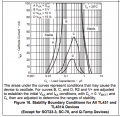
In other words, the TL431 is potentially unstable for certain values of capacitance, which the \(C_L\) in Fig. 27 is apparently intended to represent. Looking at Fig. 16, we see this:

Untitled.png
I interpret this to mean that when set for Vka=5V, load capacitances between 0.01 μF and about 2.2 μF should be avoided because of possible oscillation. Although your supercap certainly qualifies (and is connected across the TL431 as shown) because of its size, it might be a good idea to supplement it with a 4.7 μF 10V ceramic cap just to be safe unless you're sure of the supercap's high-frequency impedance characteristics.

That's my opinion, anyway.

EDIT: this application note gives additional info.
 
Last edited:

Thread Starter

cmartinez

Joined Jan 17, 2007
8,761
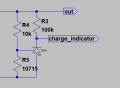
I've just simmed a TL431 configured as a shunt regulator, and it's behaving exactly the way I want it to :)

upload_2018-6-26_14-42-10.png


I have 10k and 715 ohm resistors available, so the value of R5 is not a problem.

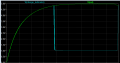
upload_2018-6-26_14-42-52.png

Everything's going as planned. :)
 
Top