Facebook
 Google
 GitHub
 Linkedin

I'm building a circuit in which a supercapacitor will be used as a battery. So far, all of my tests have been successful. However, the power source is very limited, and I need to build a circuit as efficient as possible.
A small generator will be producing an AC source of about 7 VAC (that would be 14V peak to peak). I have not yet tested the power source, since I'm in the building phase, but I don't expect it to be able to deliver more than a tenth of a Watt, if I'm lucky. My plan is to rectify that source using schottky diodes (which, although they normally cannot carry too much current, they have a very low forward voltage of about 0.4V) but after that things get a little confusing for me.
An MCU should be powered from the same rectified source while the supercapacitor is being charged. The MCU can run at voltages of between 2.4V and 5.5V, and I'd like it to start running at the rated minimum 2.4V and keep going until the supercapacitor has been fully charged to 5V. It's important that that voltage is never exceeded. I expect the supercap to take several minutes (up to 15 or 20) while it's being charged by the power source. The supercap I've chosen for this application is a 0.33 Farads one.
So here are the three conditions I'd like to meet:
The MCU I'll be using (an AT89LP4052) already has an internal comparator that I could use for that last condition. But since both the supercap and the MCU will be subject to the same voltage, I'm not sure how to go around it. Perhaps use a zener diode to that effect?
Also, how do I limit the voltage reaching the supercap, wasting as little energy as possible?
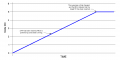
Here's a small graph of how I'd like things to behave:
Any ideas on where I should start?
A small generator will be producing an AC source of about 7 VAC (that would be 14V peak to peak). I have not yet tested the power source, since I'm in the building phase, but I don't expect it to be able to deliver more than a tenth of a Watt, if I'm lucky. My plan is to rectify that source using schottky diodes (which, although they normally cannot carry too much current, they have a very low forward voltage of about 0.4V) but after that things get a little confusing for me.
An MCU should be powered from the same rectified source while the supercapacitor is being charged. The MCU can run at voltages of between 2.4V and 5.5V, and I'd like it to start running at the rated minimum 2.4V and keep going until the supercapacitor has been fully charged to 5V. It's important that that voltage is never exceeded. I expect the supercap to take several minutes (up to 15 or 20) while it's being charged by the power source. The supercap I've chosen for this application is a 0.33 Farads one.
So here are the three conditions I'd like to meet:
- To run an MCU while the supercap is being charged. The MCU should start running at 2.4V, so maybe I need some sort of "snap on" circuit that will deliver the 2.4V to the MCU once the supercap has reached that level of charge, but not before.
- To charge the supercap to a maximum voltage of 5V, even while the MCU is still running
- To let the MCU know when the supercap has reached the desired 5V.
The MCU I'll be using (an AT89LP4052) already has an internal comparator that I could use for that last condition. But since both the supercap and the MCU will be subject to the same voltage, I'm not sure how to go around it. Perhaps use a zener diode to that effect?
Also, how do I limit the voltage reaching the supercap, wasting as little energy as possible?
Here's a small graph of how I'd like things to behave:
Any ideas on where I should start?


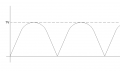
 I think it will work fine, especially since it is basically a boost converter.