Celsius versus Fahrenheit

Ian0

Joined Aug 7, 2020
13,243
There is one place where TAU do have a leg up is woodworking. This is because the divisions strongly favor halves and humans are strangely good at visually dividing things into two equal parts. Most woodworkers will agree it is easier to work in TAU (or in the UK and Commonwealth "Imperial").
My woodworking was building loudspeaker enclosures. The maths gives the box volume in litres, so the dimensions come out in millimetres.
Sheet sizes were always 8' x 4', which became 2440mm x 1220mm. Then recently, and very quietly, they changed to 2400mm x 1200mm, so if you cut 4' off the sheet you thought was 8' x4', you haven't got 4' left!
 

panic mode

Joined Oct 10, 2011
5,195
I ... knew people that could work in feet, yards, inches in their head, tell you almost instantly how many inches were in 9 yards, 2 feet, 7 inches.
that tells that such people do exist but they are selected few.
compare that with metric system where everyone can tell without any delay how many millimeter, centimeter, decimeter or kilometer is in 189.47m
 

WBahn

Joined Mar 31, 2012
33,094
that tells that such people do exist but they are selected few.
compare that with metric system where everyone can tell without any delay how many millimeter, centimeter, decimeter or kilometer is in 189.47m
Given that I increasingly encounter people that can't add 5 and 7 without using their fingers and speaking out loud (and still get it wrong) or that can't figure out that, 24 cents plus 1 penny is equivalent to a quarter, I wouldn't be to sure that "everyone" can tell you all of those things, despite the odds being stacked in their favor. In fact, just recently, I've been working with a sophomore computer science major that struggles to multiply and divide integer values by ten. It really has gotten this bad (and will only get worse).
 

Reloadron

Joined Jan 15, 2015
7,921
All my formative years were Degrees F and later years involved living in a few other countries beyond the US. This made me comfortable using either. While I prefer F I am also fine with C. While living in Italy my daughter was 2, 3, and 4 years old and she just naturally learned English and Italian. Here in the US we use F, my evening news and weather uses F so F it is.

Ron
 

atferrari

Joined Jan 6, 2004
5,022
Did you ever load bulk grain? Were the units used Bushels (a volume unit) and had to convert to MT?
Similarly to loading Barrels of crude oil, again a volume unit, but with different weights depending on the crude type.
For almost 7 years, as a Ch. Officer in bulk carriers, loading mostly grain / by products but also coal or fertilizers. The first two mainly from Argentina but also Uruguay or Brazil.

Freight is charged by weight: USD/MT.

To estimate the intake of a vessel you use the SF (stowage factor) given in cuft/LT in the past and in m3/MT nowadays. It depends of what grain and the year of harvest and humidity.

In voyage, dew point and temperature, regarding ventilation comes into play too.

In tankers (I was in that type also) whether crude, subproducts, chemicals, oils or God knows what, you ask in advance, tonnage, density and temperature.

Myself never been exposed to bushels/barrels.

In LPG carriers (been there too!) you add another component to the mix: pressure-temperature.

Reefers (not my game) use volume, temperatures and with certain specific cargoes (fruits/vegetables) they take care of CO2 tenor once stowed and hatch covers battened down.

Complex life with units out there...
 

camerart

Joined Feb 25, 2013
3,847
Hi,
I've been reminded of a Milli minute system (American) for timing work where I used a decimal stop watch.

And not forgetting a poke. (pig in a Poke)
C
 

Attachments

wayneh

Joined Sep 9, 2010
18,136
In our office, the women were always complaining about the temperature. It would go both ways: some of the hot flashers wanted it cooler, and the mousy ones wanted it warmer. The engineers of course could do nothing to actually fix this impossible situation but came up with a brilliant solution anyway.

They installed 3 thermostats spread over the area. The complaints stopped.

A couple years later after a few re-orgs and an acquisition or two, the office was being reconfigured. The electrical contractor became confused and came to my desk (I was one of the few survivors) with a question: "Why are there 3 thermostats in this space that aren't connected to anything?"

After telling him to keep his voice down, I explained the history and he got it immediately. The secret was safe.
 

wayneh

Joined Sep 9, 2010
18,136
You're right about Celsius being a bit too coarse for home thermostats. So yes, increments of 0.5C is the one most thermostats use. Even my Audi A4 2007 (it's an old car, but it's in perfect condition) has it set that way.
Interesting.

As the developer of an app that deals with temperature (and thermodynamics under the hood), I've had to handle a lot of issues around temperature units. My app can handle a user's preference for °F, °C, °R or K. This is all simple in principle - there is no ambiguity about how these are defined or how to convert from one to another.

Under the hood, for calculations, it's relatively simple to convert any input (from the user or a sensor) to a common unit, make the calculations, and convert back to whatever the user has chosen for display. Even this simple process can be a problem though, when converting one displayed value (one that has been rounded) to another scale and back. You have to keep the un-rounded value in memory and not re-use displayed values.

But it practice, for something as simple as the display of a temperature, you have to make choices about how many decimals to display. In °R or K, showing even one decimal means showing 4 significant figures. That implies a level of precision that may not be justified and certainly feels silly. Do you care if it's 300.2K instead of 300.3K? But if your user prefers °C, I personally think it's important to distinguish 19.5°C from 20.4°C. Showing 20°C, no decimals, is just too sloppy. In °F on the other hand, only an engineer like me cares about 69.5°F versus 70.4°F. Showing 70°F is better for most folks. Unless of course the temperature is near 0°F, in which case the user might care that it's -0.5°F instead of 0.4°F. Might.

I was unaware that others have chosen to break displayed Celsius values in 0.5°C increments instead of 0.1°C increments. I can definitely see the logic in that choice even though it's abhorrent for an engineer to display a significant figure that implies more precision than is really there.
 

WBahn

Joined Mar 31, 2012
33,094
Unless of course the temperature is near 0°F, in which case the user might care that it's -0.5°F instead of 0.4°F. Might.
Even if they might, there's no reason they should. There's absolutely nothing special about 0°F that would make wanting to know if you were slightly above it or below it any more relevant than knowing if you were slightly above or below -10°F or +10°F.

Now, if you are near 0°C and are concerned about freeze or not freeze, that could be a different matter. Over the usual range of air pressures that people experience, fresh water freezes within something like -0.2°C to 0°C, sea water being around -2°C.

I was unaware that others have chosen to break displayed Celsius values in 0.5°C increments instead of 0.1°C increments. I can definitely see the logic in that choice even though it's abhorrent for an engineer to display a significant figure that implies more precision than is really there.
But the marketing guys love it and they are clearly the one with the ear of the decision makers. I love these bathroom scales that read out in 0.01 lb increments, but if you step on them twice, the readings typically vary by two or three pounds.
 

joeyd999

Joined Jun 6, 2011
6,450
Even if they might, there's no reason they should. There's absolutely nothing special about 0°F that would make wanting to know if you were slightly above it or below it any more relevant than knowing if you were slightly above or below -10°F or +10°F.
If we're only talking about human experience, I agree.

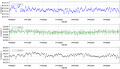
On the other hand, I market a technology that is actually highly dependent on the differences between hundredths of a degree across a 70C range, and simply would not function if it were not able to reliably distinguish those differences.

Selection_014.png
 
Last edited:

WBahn

Joined Mar 31, 2012
33,094
If we're only talking about human experience, I agree.

On the other hand, I market a technology that is actually highly dependent on the differences between hundredths of a degree across a 70C range, and simply would not function if it were not able to reliably distinguish those differences.

View attachment 370435
I was clearly responding in the context of a case where it had already been decided that displaying temperature to the nearest 1°F was adequate, except, for some reason, near 0°F when, for some reason, distinguishing between being half a degree above it or below might be important.

If you have an application that needs a resolution of hundreds of a degree, then that's what you need. And you need a measurement system that is capable of delivering it. But, even then, I doubt that you suddenly need more resolution when you are some arbitrary temperature just because we happen to label it with a zero on some scale.
 
Top