Voltage versus Current

Thread Starter

jethro99

Joined Oct 31, 2020
66
I have an electric motor turning a permanent magnet alternator. Constant RPM.

Open circuit voltage is as high as it can be I believe, with no current flow obviously.

With the DC output leads shorted, the current is what I believe to be the maximum that it can be. Can't get a voltage reading but it would have to be greater than zero given that power is being produced.

What I am getting from this is that as the load is increased the voltage drops and as the load is decreased the voltage goes up. If anyone disagrees please let me know.

Now to the heart of my desire to know and understand. If there was a zener diode within the rectifier that was shorting a bit of current to ground, or between the phases of the stator, in order to lower and control the output voltage of the rectifier, there would be heat build up within the rectifier. Correct or not?

And as the load is increased then there should be less heat build up with the rectifier given that the zener is shunting less to ground or between the AC phases?

Does this make sense?


Ian0

Joined Aug 7, 2020
13,097
I have an electric motor turning a permanent magnet alternator. Constant RPM.

Open circuit voltage is as high as it can be I believe, with no current flow obviously.

With the DC output leads shorted, the current is what I believe to be the maximum that it can be. Can't get a voltage reading but it would have to be greater than zero given that power is being produced.

What I am getting from this is that as the load is increased the voltage drops and as the load is decreased the voltage goes up. If anyone disagrees please let me know.

Now to the heart of my desire to know and understand. If there was a zener diode within the rectifier that was shorting a bit of current to ground, or between the phases of the stator, in order to lower and control the output voltage of the rectifier, there would be heat build up within the rectifier. Correct or not?

And as the load is increased then there should be less heat build up with the rectifier given that the zener is shunting less to ground or between the AC phases?

Does this make sense?

Yes correct, there would be heat in the rectifier, but most of the heat would be in the zener.
The open circuit voltage divided by the short-circuit current is the output impedance (not the best way of measuring it but a good start)
The difference between the open circuit voltage and the zener voltage divided by the output impedance would give the zener current.
The power dissipated in the zener would be the current multiplied by the zener voltage, and it might be quite a lot.
 

wayneh

Joined Sep 9, 2010
18,088
If you map out the current and voltage versus the load resistance, you'll find there's a point of maximum power produced in the load. This is where the load and alternator impedance are equal. Note that the alternator impedance will increase with frequency. So while the power will increase with rpm, the ideal load for peak power will move to higher impedance.
 

ThePanMan

Joined Mar 13, 2020
862
Remember; a dead short is not zero ohms. The wire has resistance. So you're not truly seeing zero volts, but real close to absolute zero.
 

sparky 1

Joined Nov 3, 2018
1,218
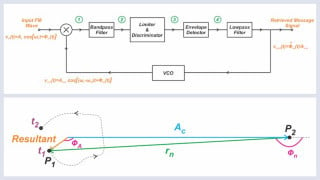
The principals of operation in a single phase AC motor reduces complexity. See figure 2.2 link below, identify the components of 3 Phase.
( applying torque from 3 points is smoother. The advancement of manufacturing technology has future opportunity )

Operation principals to keep in mind.
Alternating current flows through a moveable rotor producing a magnetic field.
The alternating current flows through a stationary stator having a separate rotating magnetic field.
The interaction of the two fields results in torque moving the rotor.

When the operation and the related electrical behavior have become familiar some will set them in respective layers.
We can reiterate in more detail and recall definition from DC that voltage is potential difference, and current is flow rate.
AC current is moving back and forth, we can use some help in our perception which is described below.

We can use a subset of terminology that better describes this in AC motors and it does not conflict with the general form.

Principles of AC Motor Operation

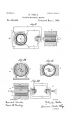
Historical record image, figure 10 L and Z coils, together with other figures they depict a brush / phase relationship.
Screenshot 2025-12-21 115120.png
 
Last edited:

MisterBill2

Joined Jan 23, 2018
27,186
I have an electric motor turning a permanent magnet alternator. Constant RPM.

Open circuit voltage is as high as it can be I believe, with no current flow obviously.

With the DC output leads shorted, the current is what I believe to be the maximum that it can be. Can't get a voltage reading but it would have to be greater than zero given that power is being produced.

What I am getting from this is that as the load is increased the voltage drops and as the load is decreased the voltage goes up. If anyone disagrees please let me know.

Now to the heart of my desire to know and understand. If there was a zener diode within the rectifier that was shorting a bit of current to ground, or between the phases of the stator, in order to lower and control the output voltage of the rectifier, there would be heat build up within the rectifier. Correct or not?

And as the load is increased then there should be less heat build up with the rectifier given that the zener is shunting less to ground or between the AC phases?

Does this make sense?

If a zener diode is connected between the output of the alternator and the return side (ground" then current would flow thru the diode and the voltage would not continue to rise. as the power input to the alternator increased.
This is called shunt regulation. It is simple and it works BUT IT IS QUITE INEFFICIENT. It converts a lot of power into a lot of heat.
There was, and possibly still is, a brand of motorcycle that uses that exact system to control the voltage for lighting and other functions. There is a serious flaw in such a system on a motorcycle, which is that the Zener diodes tend to eventually faiil due to excess heat and temperature rise. This additional voltage tends to damage (burn out) the lights on the motorcycle. This mostly happens while driving fast in the dark. This is often a problem.
 
Top