Cascade transistor and output resistance

Thread Starter

mondo90

Joined May 16, 2025
126
I think if only the author had said "this method is only for the sake of visualization, no actual current flows backwards when the input signal changes" instead of "left hand side current increases by i, right hand current also increases by i, but in the opposite direction, hence applying KCL we have i + i = 2i" it would have all been much easier to grasp.
Someone may say "isn't it obvious that the small signal current can't change the direction of the bias current" (I think you @WBahn have actually said that). Well, I don't see it this way because "small" is the input signal what we take at the output may not be, and will often not be, that small (that's in essence what we design amplifiers for).
Second argument is, maybe at higher frequencies, where the capacitances become a factor the current actually flows back and forth - this is what I started wondering when I first saw it..

As for your response to post #16
Once again, you insist on treating a small-signal variable as if it were the only thing in the actual circuit. A small-signal flowing out of the base of an NPN transistor means nothing more than that the total (actual) current going into the base is LESS than the quiescent current.
Why do you say it's a small signal? This time we don't deal with signals at all, here we are interested in calculating output resistance and for that author applies a voltage at the output.
Beside that, I am even more interested in, how can he write that emitter current is aprox. equal to base current?
 

WBahn

Joined Mar 31, 2012
32,925
I think if only the author had said "this method is only for the sake of visualization, no actual current flows backwards when the input signal changes" instead of "left hand side current increases by i, right hand current also increases by i, but in the opposite direction, hence applying KCL we have i + i = 2i" it would have all been much easier to grasp.
Someone may say "isn't it obvious that the small signal current can't change the direction of the bias current" (I think you @WBahn have actually said that).
I don't recall ever saying that it was "obvious". I tried repeatedly to explain that the small-signal voltages and currents are signals that are small enough such that the behavior of the circuit is acceptably linear about the operating point. If you can apply a signal that results in a deviation that takes the output nearly to the point of either cutoff or saturation but the deviation from linear is still small enough that ignoring it yields acceptable results, then it is still a small signal. If you insist on applying a signal that is so large that it results in a large enough deviation of any signal in the circuit away from its operating point such that the nonlinearities can't be ignored, then it is not a small signal and small-signal analysis and design techniques won't work.

Well, I don't see it this way because "small" is the input signal what we take at the output may not be, and will often not be, that small (that's in essence what we design amplifiers for).
Second argument is, maybe at higher frequencies, where the capacitances become a factor the current actually flows back and forth - this is what I started wondering when I first saw it..

As for your response to post #16

Why do you say it's a small signal? This time we don't deal with signals at all, here we are interested in calculating output resistance and for that author applies a voltage at the output.
As I a have stated a few times, the concept of "small" in small-signal analysis merely means that we are dealing with a component of the total signal that is small enough such that it can be treated as a linear deviation from the operating point of the overall signal in a non-linear system. There is nothing to say that "small" can't be a significant fraction of the overall signal or of the power supply voltage. If it's deviation from the quiescent point is such that a linear approximation yields acceptable results, it can be treated as a small signal.

If the word "small" is so troubling for you, then translate it to something else in your mind when you do your work. We are merely breaking the overall signals into two parts. Call them "Fred" and "Sue" if that helps. Or perhaps "bias" and "info". Or whatever you want.

In calculating the output resistance by applying a hypothetical voltage to the output (and the applied voltage is very much a signal -- a 'signal' is simply anything that is not part of the 'bias') and determining the change in current, we are still talking about the small signal output resistance, which is how much the output current changes when a small change is made to the output voltage. Because we are using a linear model as our approximation, scale doesn't matter. So, to calculate the output resistance, we can use whatever voltage we want. You can use 100,000 V if you want if it makes your life easier. That does not mean that you could actually apply 100,000 V to the output. It's best to not use any explicit voltage, but rather to use a symbolic voltage, which should then drop out of the result completely.

Beside that, I am even more interested in, how can he write that emitter current is aprox. equal to base current?
He's not saying that the emitter current is approximately equal to the base current. You aren't taking into account the presence of the output resistance, which provides another path.

Get rid of the transistor symbols from the small-signal circuit diagram and use the appropriate small-signal equivalent circuit.
 

WBahn

Joined Mar 31, 2012
32,925
Additional points:
1. author says "we have “pulled out” r_o of each transistor and shown it separately" but if that is the output resistance shouldn't it be in series with the transistor?
How were you introduced to the small-signal models?

Did you actually walk through the derivations of what they are and where they came from?

If so, you need to go back and revisit them. This is not uncommon. It's something very new and different for most people and they seldom absorb it all the first time. So go back to that section of the text and walk through the development of them one step at a time. Don't just read what the text says, actually take out a pencil and paper and walk through them step by step.

If not, then you were seriously short-changed -- so much so that you should be questioning the value of any degree you end up getting from the school you are attending. Hopefully, it's the former and you just need to revisit it.

2. author says "current i_2 flows into the base of Q3 and gives rise to a collector current B_3*i_2 and then in following calculations he also makes an assumption that B_3 (beta of Q3) is much bigger than 2 - both of these statements contradict what I see on the schematic.
It would be helpful if you could include the entire portion of the author's explanation related to the calculation of the output resistance.
 

LvW

Joined Jun 13, 2013
2,031
This strikes me as largely apples and oranges. Let's use a basic inductor as an example. Being able to work with the equation that govern it, namely V=L·di/dt, doesn't imply any understanding of how it really works. Similarly, having a good understanding of how it works doesn't imply an ability to understand, analyze, or design circuits that use inductors. These are largely separate things that, while they work best when they complement each other, are somewhat orthogonal.
I am afraid that your inductor example does not meet my point.
Therefore, let`s assume that there are no equivalent small-signal circuit diagrams at all.
For designing and/or analyzing BJT-based circuits it would be necessary to know about the fundamental propereties of the BJT (DC properties; ib=ic/beta; ic=gm*vbe). My personal view: I myself can only see advantages as far as education and understanding are concerned.

Yet I'll bet even you treat it that way much of the time.
Never! I know that the BJT is not current-controlled and I know that ALL design rules are derived from voltage-control.
Where would be the advantage to consider the BJT as current-controlled? To use the equation Ib=Ic/B (or ib=ic/beta) does not mean that the base current would have any control function.
In the past, have designed and anylyzed many BJT-based circuits - but in no case it was necessary or even advantageous to consider the BJT as current-controlled.
Please, can you show me one simple and real-world example where it makes sense (because of simplification or better understanding) to apply the current-control concept?

Let's say that I have a typical small-signal NPN transistor and a 12 V supply. I connect the emitter to the negative terminal, which I use as my common reference node, and the base and collector to the positive terminal via two resistors, a 1 kΩ resistor at the collector and a 220 kΩ resistor at the base. I measure the collector voltage and find it to be 3 V. What value should I change the resistor to in order to get the collector voltage to near 6 V?
No problem. But you know, of course, that such a configuration will never be used as an amplifier in practice.
When the collector voltage has to be reduced the collector current must be increased correspondingly. As consequence, the base current will increase too. That means: In order to still allow a Vbe of app. 0.7V (no better information is available) I have to redesign the voltage division between the base resistor (former RB=220k) and the B-E-path (with 0.7V). As a result - RB must be reduced.
The DC voltage at the base is always generated using voltage division - either with two external resistors or with only one (similar to the series connection of a pn-diode an a resistor).

Are you going to insist that the transistor cannot be treated as a current-controlled element and figure out what Vbe is and then figure out what the change in Vbe needs to be in order to result in the needed change in collector current, and then figure out what the value of the base resistor is that will result in that Vbe?
Or are you going to determine that you need the collector current to go from 9 mA to 6 mA (i.e., be 2/3 of the original amount) and, treating it as a current-controlled current source, conclude that the base resistor's current needs to be scaled by the same amount and, hence, needs the resistance to be scaled by a factor of about 3/2, making it about 330 kΩ?
No - I do not "insist that the transistor cannot be treated as a current-controlled" .
Of course, I know that for some calculations current-control works (mathematically).
But I think it is extremely important for engineers to know what they are doing and why it is permissible in a particular application (or not!).
And I realize that one can proceed in this way (as desribed by you).
And I don't see any problem with that if you know that it's a simplified approach that also gives the correct result.
Another simple example: In some calculations, I also act as if the current through the resistor R would “generate” a voltage V=I*R (simplified approach) - although this is physically incorrect. But it simplifies the analysis.

What I don't see is how using such diagrams implies or requires a poor understanding of the BJT physics.
Perhaps I have expressed myself not clear enough (I did not use the terms "implies" or "requires".)
I tried to use an example (my former post with the ratio beta/rbe) to show that using the small-signal equivalent circuit alone can lead to problems.

Finally (to come to an end) - It is, of course, no surprise that two people use two different methods to solve a technical problem.
Regards
LvW
 
Last edited:

Thread Starter

mondo90

Joined May 16, 2025
126
How were you introduced to the small-signal models?
I read Sedra & Smith microelectronic circuits edition 6. All the circuits presented in this thread are from this book.

Did you actually walk through the derivations of what they are and where they came from?
Yes, although it is a bit scattered around this bible so its easy to forget. Revisiting is always a good idea. I think for the most part this concept is clear for me. I was only surprised by those odd current directions + justification which claimed that one current from current mirror goes down, the other from current sink goes up so based on KCL we have to add them so we have 2i current for the output. But I think your explanations here helped. Just need to wrap my head around it.

He's not saying that the emitter current is approximately equal to the base current. You aren't taking into account the presence of the output resistance, which provides another path.
I am taking this resistance into account. What will an extra current path of current do to collector current? Only further increase it right? So we have i_2 ~= i_1 + i_x/r_0 while it should be rather i_2 << i_1 + i_x/r_0
However the point here is that this transistor is taken as a super node with r_o in parallel.

It would be helpful if you could include the entire portion of the author's explanation related to the calculation of the output resistance.
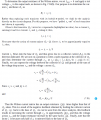
Here is a the output resistance derivation from the book:

1752210648882.png

So to wrap up:
1. This output resistance of a transistor is a small signal thing, so I revert my previous comment about v_x not being a small signal related.
2. The only thing I don't get is the fact that i_1 is equal or almost equal to i_2.
 

WBahn

Joined Mar 31, 2012
32,925
Let's essentially walk through the same development, but do it from a different angle.

First, let's make sure that we understand some of the finer points about BJT characteristics.

In the simplest model, the collector current is β·Ib and the emitter current is almost the same as the collector current. Thus, if you add a small amount of base current, the emitter current changes by essential β times that. Conversely, if you reduce the base current by a small amount, you would expect the emitter current to be reduced by β times that.

But, in this diagram, it is saying that reducing the base current by i2 corresponds to an increase in the emitter current by i1. This, alone, is inconsistent with this simple model before we ever talk about i2 and i1 being about the same size.

So what might explain it?

It's the fact that our transistor model isn't that of a simple current-controlled current source any longer. The presence of Early effect means that if we change the voltage across the collector-emitter junction that the current will change even if we make no change at all to either the base current or the base-emitter voltage. This effect is what the output resistance between the collector and emitter is modeling.

In a basic current mirror, if the output voltage changes, due to some external factor, be it a change in load resistance or noise or whatever, there will be a change in output current that corresponds to r_o -- that's what r_o models. But in a Wilson current mirror, an attempt to change the output voltage causes changes in the basic current mirror below the output transistor that results in the generation of signals that shift the operating point of the output transistor so as to greatly minimize the impact.

With this in mind, let's walk through the mechanism involved.

An external voltage is applied to the output (and, remember, this actually represents a small change in the actual output voltage).

Since we know that our current mirror is not ideal, we know that there will be some small increase in output current that results, namely i_x. Remember, the output current of a current mirror is the current going INTO the output transistor's collector, so i_x going into that same point represents an increase in current.

By KCL, that change in current has to be matched by changes in the current in the other two terminals of the transistor. In a basic current mirror, all of that additional collector current is routed through the output resistance, resulting in a one-for-one increase in emitter current while there would be no change in the base current. (i.e., i_1 = i_x, and i2 = 0). The additional collector-emitter current is completely accommodated by the transistor's Early effect.

Thus, we have established that, even in a basic current mirror, the notion that changes in the base current and changes in collector and/or emitter currents are always in a ratio of approximately β no longer holds. Other mechanisms (the Early effect) are at play.

So, with that in mind, let's push further.

We reasonably expect that the additional collector current, i_x, will result in some additional emitter current. So, we have defined that increase as our variable i_1 on the diagram.

But i_1 then goes to the input of a basic current mirror at the bottom. That results in the bottom mirror changing it's output current by a corresponding amount. So, we define that amount to be i_2.

However, the only place for i_2 to come from is from the base of the output transistor, Q3. Since it is coming out of the base, that means that the bottom current mirror is responding to the increase in it's programming current (i_1) by reducing the base current of the output transistor (i_2). But that's exactly what we want to have happen! Our external voltage is resulting in an increase in output current, but in response to that, the bottom mirror is telling the output transistor to reduce it's output current. If it could reduce it by an amount exactly equal to i_x, then there would be NO change in the actual output current and our Wilson mirror would be ideal. But, of course, if this were to happen, then we would lose i_1 (it would become zero) and so we would lose i_2 and the output transistor wouldn't respond at all, resulting in all of i_x going through the output transistor's r_o. So, in reality, we can't offset v_x completely, but we can offset most of it.

So, continuing on, we know that the bottom mirror makes it so that i_2 ≈ i_1 and, consequently, that each of these is about half of i_x.

The decrease in base current represented by i_2 results in a decrease in collector current in the output transistor of β·i_2. This decrease is combined with the total change in collector current, i_x, and flows through r_o, the voltage across which is approximately v_x.

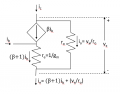
This is well-illustrated if we look at the tee-model of the transistor.

1752254803038.png

The output resistance we are trying to get at is (approximately) v_x/i_c under the conditions, imposed by the bottom mirror, that i_b ≈ -i_e.
 

Thread Starter

mondo90

Joined May 16, 2025
126
Great explanation, thanks a lot! Yes, it starts making sense but there are some loose ends still:
But, in this diagram, it is saying that reducing the base current by i2 corresponds to an increase in the emitter current by i1. This, alone, is inconsistent with this simple model before we ever talk about i2 and i1 being about the same size.
Just to clarify, you are saying that from the diagram we can see a small reduction of i_2 would increase i_1 because of KCL says that i_1 = i_x - i_2 and hence if the lower the i_2 the bigger i_1 would be, right? I haven't noticed that before but yes, it makes perfect sense.

However, the only place for i_2 to come from is from the base of the output transistor, Q3
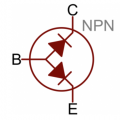
Sounds good but both junction of NPN BJT are reverse biased towards the base:
1752300461756.png
It seems to be again the confusion with the current direction in the small signal model. I think here the action of Q2 lowers its collector current, hence it looks like if the base current of Q3 is flowing out of it.
Note, in his statement about current beta*i_2 at the collector of Q3 he says "current flow in the direction indicated" - while we know that no real current really flow in this direction right? All that happened is a decrease of the output current by this amount.

The decrease in base current represented by i_2 results in a decrease in collector current in the output transistor of β·i_2.
Yes but that means we decreases by more than needed? In other words, we need to respond to an increase of i_x by an equal and opposite decrease but instead we decrease by i_x/2 * beta ~= 50i_x for a typical beta = 100.

I really wish they described it the way you did. I think author assumes that he introduced the concept of output resistance r_o in earlier chapters and now you are expected to correlate it with the actions on the diagram.
 

WBahn

Joined Mar 31, 2012
32,925
Great explanation, thanks a lot! Yes, it starts making sense but there are some loose ends still:

Just to clarify, you are saying that from the diagram we can see a small reduction of i_2 would increase i_1 because of KCL says that i_1 = i_x - i_2 and hence if the lower the i_2 the bigger i_1 would be, right? I haven't noticed that before but yes, it makes perfect sense.
You need to be very careful to describe what you are trying to say. The current i_2, when positive, IS a small reduction in the Q3 base current. So, a small reduction of i_2 would translate to an increase in the total base current (compared to what it was before i_2 was reduced). Was that what you meant to say?

Leaving that aside, you can't say that lowering i_2 results in a larger i_1 based on that KCL equation. You can only say that if you assume that i_x is a fixed, constant value. That most certainly is not the case here. We are applying v_x and then determining what i_x turns out to be (and then taking the ratio to find the output resistance). Compared to the basic current mirror, i_x in the Wilson mirror is smaller by a factor of about β/2.

Sounds good but both junction of NPN BJT are reverse biased towards the base:
View attachment 352538
No they are not!!

You REALLY need to get a handle on the fact that a small signal current coming out the anode of a PN junction is NOT a physical current that is physically flowing out of the anode. It is a REDUCTION in the FORWARD current flowing in the junction.

There are no PN junctions in the small-signal circuit. A PN junction is a highly nonlinear circuit element. The small-signal circuit describes LINEAR changes ABOUT the large-signal operating point.

It seems to be again the confusion with the current direction in the small signal model. I think here the action of Q2 lowers its collector current, hence it looks like if the base current of Q3 is flowing out of it.
Note, in his statement about current beta*i_2 at the collector of Q3 he says "current flow in the direction indicated" - while we know that no real current really flow in this direction right? All that happened is a decrease of the output current by this amount.
Correct. You are starting to catch yourself and make the necessary mental adjustments. That's good.

Yes but that means we decreases by more than needed? In other words, we need to respond to an increase of i_x by an equal and opposite decrease but instead we decrease by i_x/2 * beta ~= 50i_x for a typical beta = 100.
You are ignoring the output resistance again.

Remember, the output resistance of an ideal current source is infinite. We WANT a large increase in voltage to be required in order to get a small increase in current.

The collector current, β·i_2, flowing out of the collector adds to i_x and flows through the output resistor. Since it is roughly β/2 as large, it requires roughly β/2 times as much voltage to get that same i_x. Hence, the output resistance is about β/2 times as large as Q3 would exhibit by itself.

I really wish they described it the way you did. I think author assumes that he introduced the concept of output resistance r_o in earlier chapters and now you are expected to correlate it with the actions on the diagram.
They do -- and they really have little choice in that. The expectation is that you will go back and revisit those concepts as you need them in later chapters and discover you didn't get them down as well as you now need them. They really can't revisit them over and over each time they are needed in the text, otherwise the text would be many times as long as it is (and S&S is already a none-too-small text). Unfortunately, students are really resistant to doing that. They probably always have been (they certainly were when I was an undergrad forty years ago), but they seem even more so today. I was initially that way, but as a physics major you learn to get on very intimate terms with your textbooks early on, so by the time I was an sophomore I had learned to spend a LOT of time really understanding what the textbook was telling me. But what was amazing was that the result was far LESS time doing homework and studying for exams -- so much so that I typically had my weekends completely free and it was a rare course in which I studied for the final. Yet that change in habit took me from an A/B student to a nearly straight-A student (and removed a lot of stress).
 

Thread Starter

mondo90

Joined May 16, 2025
126
You need to be very careful to describe what you are trying to say. The current i_2, when positive, IS a small reduction in the Q3 base current. So, a small reduction of i_2 would translate to an increase in the total base current (compared to what it was before i_2 was reduced). Was that what you meant to say?
I think so. Let's put it this way, i_2 reduces base current of Q3 and as a result its collector/emitter currents are decreased as well, right? So if we decrease i_2 itself, then Q3 collector and emitter currents must increase. This is how I see it.

There are no PN junctions in the small-signal circuit. A PN junction is a highly nonlinear circuit element. The small-signal circuit describes LINEAR changes ABOUT the large-signal operating point.
Yes, good point about diodes being highly nom-linear and a reminder that small signal analysis is all about linear change.

The collector current, β·i_2, flowing out of the collector adds to i_x and flows through the output resistor. Since it is roughly β/2 as large, it requires roughly β/2 times as much voltage to get that same i_x. Hence, the output resistance is about β/2 times as large as Q3 would exhibit by itself.
Makes sense, this is a really good example which exploits a lot of things at once including negative feedback. I think a good exercise would be to analyze what would happen if we change the diagram so that now Q2 is diode connected instead of Q1.
In this case unfortunately we break the negative feedback loop and all the i_x flows through r_o3 and later r_o1 as the current through Q1 can not change and therefore the output resistance would be r_o3 + r_o1, am I right?

Also, they say on the diagram V_ce of Q1 is aprox. equal to i_1*r_e1. I think this is because the diode connected Q1 have r_o1 and r_e in parallel and since r_e1 is much lower than r_o this will be approximately the equivalent resistance.


The expectation is that you will go back and revisit those concepts as you need them in later chapters and discover you didn't get them down as well as you now need them.
Absolutely, plus it is really good to make notes as you go on the key points/concepts.

Yet that change in habit took me from an A/B student to a nearly straight-A student (and removed a lot of stress).
So, for subjects like this, fundamental electronics, transistor amplifiers, circuit analysis, what books would you recommend? :)
 

WBahn

Joined Mar 31, 2012
32,925
Makes sense, this is a really good example which exploits a lot of things at once including negative feedback. I think a good exercise would be to analyze what would happen if we change the diagram so that now Q2 is diode connected instead of Q1.
In this case unfortunately we break the negative feedback loop and all the i_x flows through r_o3 and later r_o1 as the current through Q1 can not change and therefore the output resistance would be r_o3 + r_o1, am I right?
Pretty sure the answer is no, but I can't tell what circuit you are picturing in your mind. If Q2 is diode connected, then it's output resistance is just r_e. It's a diode and diodes have very low incremental resistance. But I don't know what you are picturing for the rest of the circuit. Presumable, you are not diode-connecting Q1. But then how is the programming current, I_REF, being acted upon? Please sketch a circuit of what you have in mind so that we can discuss it.

Also, they say on the diagram V_ce of Q1 is aprox. equal to i_1*r_e1. I think this is because the diode connected Q1 have r_o1 and r_e in parallel and since r_e1 is much lower than r_o this will be approximately the equivalent resistance.
Correct. And since r_e1 is so much smaller than r_o2 (let along β·r_o2/2), it is negligible.

So, for subjects like this, fundamental electronics, transistor amplifiers, circuit analysis, what books would you recommend? :)
Mostly by default, I relied on the textbooks for the course. I was an undergrad back in the 1980s, so there was no Internet (to speak of) and the college bookstore only carried the texts for the courses being offered that semester (a few others, but not much). I could have (and probably should have) made better use of the resources in the library, but never really thought of that. Perhaps that was because, between the text for the current course, the texts I still had for all of the prior courses, a couple of fellow students, and the professors themselves, I had sufficient resources to learn the material pretty well (though there were certainly holes that I discovered later on).

In the years since, I became a real textbook whore. I peaked out at well over 1300 textbooks (still have ~1200). A lot of them I got for free as evaluation copies or from retiring professors, but many of them I paid full freight for. What I've discovered is that, with pretty rare exception, the books that I took the course with are the ones I refer back to, even when they were clearly not the best text and I know I have better ones sitting right next to them. There are really only two exceptions, and even in those cases I use the text for the follow-on course (one of which is the best text for any course I've ever come across, which coincidentally took the place of perhaps the worst text I've ever had to contend with). I think that the reason that I always fall back on the text for the course I took is because that text, with whatever warts it has, is familiar and carries with it the echoes all of the lectures and homework and exams and discussions with profs and fellow students. Any other text is a new and foreign journey.
 

Thread Starter

mondo90

Joined May 16, 2025
126
Pretty sure the answer is no, but I can't tell what circuit you are picturing in your mind. If Q2 is diode connected, then it's output resistance is just r_e. It's a diode and diodes have very low incremental resistance. But I don't know what you are picturing for the rest of the circuit. Presumable, you are not diode-connecting Q1. But then how is the programming current, I_REF, being acted upon? Please sketch a circuit of what you have in mind so that we can discuss it.
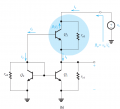
Yes I was thinking about something like this:
1752364770328.png


Now I've changed the mirroring system, so that the I_ref is controlled by the output - Q3s collector current instead. If that changes, as we analyze here by the presence of the v_x voltage, then Q2 is forced to reflect that change. However, I also see some negative feedback actions here. This is because if Q2 current increases (we can use the i_2 current to represent that increase) that means it will be taken away from the Q3s base right? That in turn should theoretically limit Q3s current as well therefore stabilizing the output current. Not sure if I got it right here, but the end result after my modification shown above seems to be the same huh?

One more thing which I forgot to ask about before - on the diagram they show the current i_1 flows completely thought the output resistance r_o1 skipping the Q1s collector all together - this can not be because part of this current must go to base of Q1 and Q2. That is the essence of negative feedback we utilize here right?

I think that the reason that I always fall back on the text for the course I took is because that text, with whatever warts it has, is familiar and carries with it the echoes all of the lectures and homework and exams and discussions with profs and fellow students. Any other text is a new and foreign journey.
Yes this makes sense because your mind is already used to the authors style, notation used etc. Plus you have already some "tags" in the head suggesting you where to look.
In the years since, I became a real textbook whore. I peaked out at well over 1300 textbooks (still have ~1200).
That is impressive, but I can tell you are passionate about this subject :)
I also bought my S&S book on FB marketplace for as much as $15! Perfect condition hardcover, price went down because this is edition 6th from 10 years ago, the latest is 8th I believe but the content is pretty much the same from what I can tell.
 

WBahn

Joined Mar 31, 2012
32,925
Yes I was thinking about something like this:
View attachment 352567


Now I've changed the mirroring system, so that the I_ref is controlled by the output - Q3s collector current instead. If that changes, as we analyze here by the presence of the v_x voltage, then Q2 is forced to reflect that change. However, I also see some negative feedback actions here. This is because if Q2 current increases (we can use the i_2 current to represent that increase) that means it will be taken away from the Q3s base right? That in turn should theoretically limit Q3s current as well therefore stabilizing the output current. Not sure if I got it right here, but the end result after my modification shown above seems to be the same huh?

One more thing which I forgot to ask about before - on the diagram they show the current i_1 flows completely thought the output resistance r_o1 skipping the Q1s collector all together - this can not be because part of this current must go to base of Q1 and Q2. That is the essence of negative feedback we utilize here right?


Yes this makes sense because your mind is already used to the authors style, notation used etc. Plus you have already some "tags" in the head suggesting you where to look.

That is impressive, but I can tell you are passionate about this subject :)
I also bought my S&S book on FB marketplace for as much as $15! Perfect condition hardcover, price went down because this is edition 6th from 10 years ago, the latest is 8th I believe but the content is pretty much the same from what I can tell.
You can't go changing the small-signal circuit without making the corresponding modifications to the actual circuit and seeing if it will work at all.

You have Q2 diode-connected, so what is the voltage at it's collector going to be?

What does this say about the voltage at the base of Q3?

Can all of the transistors be in their active regions at the same time with the modifications you've made?
 

Thread Starter

mondo90

Joined May 16, 2025
126
You have Q2 diode-connected, so what is the voltage at it's collector going to be?
It needs to be Q2 v_be, same as Q1s v_be.

What does this say about the voltage at the base of Q3?
ahh I see, Q3 base voltage will be negative in regards to it's emitter hence cut off.

And what do you think about this one:
One more thing which I forgot to ask about before - on the diagram they show the current i_1 flows completely thought the output resistance r_o1 skipping the Q1s collector all together - this can not be because part of this current must go to base of Q1 and Q2. That is the essence of negative feedback we utilize here right?
 

WBahn

Joined Mar 31, 2012
32,925
And what do you think about this one:
Q1 is diode-connected. Notice that they did not say that the incremental voltage across it is equal to i_1·r_e1, only that it is approximately equal to it. Some of i_1 goes to the base of Q1 and some goes to the base of Q2. Remember that r_e is the ratio of the change in the base-emitter voltage to the change in emitter current. For a diode-connected BJT, the base-emitter voltage is the same as the collector-emitter voltage.

But, yes, a tiny fraction of i_1 goes to the bases of Q1 (let's call that i_b1) and Q2 (let's call that i_b2), let's call that. i_b1 is just enough to result in an increase in Q1's collector current of i_1 - (i_b1+i_b2). Assuming Q1 and Q2 are perfectly matched, this is also i_2. Notice that i_2 is less than i_1 by the amount that is siphoned off to feed the bases. This is one of the things that makes it so that the effective output of the Wilson mirror isn't infinite.
 

WBahn

Joined Mar 31, 2012
32,925
But why a tiny fraction? In general R_be is lower than r_o hence I would expect more current flowing to the base than to the output resistor right?
Look at the small signal model -- or think of a small change in the full-up nonlinear device model.

In the small-signal model that includes r_o, there are THREE paths between the collector and emitter when the transistor is diode-connected. To the base and then to the emitter, through the current source that is controlled by the base-current (in the tee model) or the base-emitter voltage (in the hybrid-pi model), and through the output resistance.

A small portion goes through the base. That results in the majority going through the current source. The rest goes through r_o.
 

Thread Starter

mondo90

Joined May 16, 2025
126
Okay, I think that makes sense.
Thank you @WBahn for your help in this thread, I really feel like I made some solid progress in understanding this material.
 
Top