Facebook
 Google
 GitHub
 Linkedin
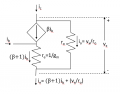
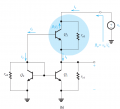
I think if only the author had said "this method is only for the sake of visualization, no actual current flows backwards when the input signal changes" instead of "left hand side current increases by i, right hand current also increases by i, but in the opposite direction, hence applying KCL we have i + i = 2i" it would have all been much easier to grasp.
Someone may say "isn't it obvious that the small signal current can't change the direction of the bias current" (I think you @WBahn have actually said that). Well, I don't see it this way because "small" is the input signal what we take at the output may not be, and will often not be, that small (that's in essence what we design amplifiers for).
Second argument is, maybe at higher frequencies, where the capacitances become a factor the current actually flows back and forth - this is what I started wondering when I first saw it..
As for your response to post #16
Beside that, I am even more interested in, how can he write that emitter current is aprox. equal to base current?
Someone may say "isn't it obvious that the small signal current can't change the direction of the bias current" (I think you @WBahn have actually said that). Well, I don't see it this way because "small" is the input signal what we take at the output may not be, and will often not be, that small (that's in essence what we design amplifiers for).
Second argument is, maybe at higher frequencies, where the capacitances become a factor the current actually flows back and forth - this is what I started wondering when I first saw it..
As for your response to post #16
Why do you say it's a small signal? This time we don't deal with signals at all, here we are interested in calculating output resistance and for that author applies a voltage at the output.Once again, you insist on treating a small-signal variable as if it were the only thing in the actual circuit. A small-signal flowing out of the base of an NPN transistor means nothing more than that the total (actual) current going into the base is LESS than the quiescent current.
Beside that, I am even more interested in, how can he write that emitter current is aprox. equal to base current?