I've been in contact which the IVA in the UK and been told I can do this mod, but once I've done this mod I need to take it to a MOT test which deals which one for cars for them to check it
Before you go doing this mod, are you using the old lens housing or did you get one specifically for projector lights? These two lighting systems have lenses that refract light in entirely different manners and you may be very disappointed if you are not using the proper lens design. Just a thought.
The projectors I've pulled apart have a baffle in them. They block the light from the lower portion of the reflector. This allows the upper portion of the reflector to project light out and down. Moving that baffle will allow the light to be directed upwards as well as the normal pathway.
If - and I've had some difficulty following your plan and statements, if you have a single filament bulb and a solenoid that moves the baffle for high beam operation then you need only the high beam signal from the lighting system to operate the solenoid. However, I suspect, and I don't know this for sure, I could go out to the garage and check, but when on high beam, the low beam element is shut down, therefore disabling the lamp. You'd have to splice the high beam into the H1 filament in order to keep it lit while the solenoid moves the baffle.
Actually, that sort of system would be pretty cool. I have HID lamps for low beam and secondary for high beam. You can't flash HID lights as they need to warm up. Having an HID lit and switching between low and high operation would mean you don't have to heat up a bulb.
I've made a spot light out of an old projector headlamp - removing the baffle in order to accomplish that. AND as a hand held unit - it's somewhat heavy.
The original bulbs in the car are H4 so dual filament, so it can be used for high and low beam, but the new projectors only take a H1, problem is on the original wiring only high or low can be selected not both
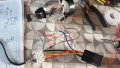
Doing a bit of googling I see that diodes are sometimes used in high-low systems, but since you already have an automotive relay I think this is how the wiring should go :- View attachment 199538
D1 is a back-emf suppressor. The example shown is a 3A Schottky diode, but is a tad OTT. Choice depends on the (unknown) solenoid current. Something in the 1N400x series should be adequate.
Assuming that you are talking about the circuit in post #18 if the feed is from the blue wire the relay coil and solenoid would be energised so the NO contact would be closed feeding power from the blue wire to the lamp. If the feed is from the white wire the light would get it's power via the NC contact on the relay.
That's exactly what I'd be worried about. The TS would have to wire the filament to the solenoid power through a diode so that when at low beam operation the solenoid doesn't activate.
I take this to mean that the solenoid needs to be energised when high beam is required.
In the post #18 schematic, 12V on the white wire (low beam) will energise the lamp (via the NC relay contact) but not the relay coil nor the solenoid. 12V on the blue wire (high beam) will energise the solenoid and relay coil. The lamp will then be energised via the NO relay contact. There is no need for a current-steering diode.
I take this to mean that the solenoid needs to be energised when high beam is required.
In the post #18 schematic, 12V on the white wire (low beam) will energise the lamp (via the NC relay contact) but not the relay coil nor the solenoid. 12V on the blue wire (high beam) will energise the solenoid and relay coil. The lamp will then be energised via the NO relay contact. There is no need for a current-steering diode.
Hey thanks for helping but can I ask a really dumb question as I'm a bit dim with electrics can the which colour wire goes to which number on the relay please as just got the diodes today and it doesnt seem to work, I know I'm doing something wrong lol
If it is the relay in the picture in post #1 and the schematic in post #18 then blue wire to relay 87, relay 86, top end of solenoid and D1 cathode. White wire to relay 87a. Brown wire to bottom end of solenoid, D1 anode, relay 85 and the bottom end of the lamp. tThe top end of the lamp to relay 30. (The bottom end of the diode in the schematic is the anode.) It is probably a good idea to show us how you had it wired as it is possible you have caused the diode to fail short circuit. If the diode has failed short circuit then the circuit will not work and it will blow fuses in the car even when it is wired correctly.
A 12 volt relay will probably not work with 6 volts on the coil. Also a better description of the fault than "it doesnt seem to work" would help us to understand what may be wrong.
A 12 volt relay will probably take around 9 volts to kick in. Once kicked in it may hold all the way down to 4 volts before it falls out. Don't take those voltages as hard numbers, I've run other relays on lower voltages and find that they typically take 75% of the rated voltage to pull them in and hold down to around 40% before they fall out.

 Facebook
 Google
 GitHub
 Linkedin



 How many threads here take on a life of their own after a solution?