Car battery cable puzzler

MisterBill2

Joined Jan 23, 2018
27,508
Consider the internal resistance of the 12 volt vehicle battery, which one in good condition the voltage may drop 2 volts at the first instant the starter is engaged, and the instant inrush is possibly 200Amps for a few milliseconds. Now with that kind of source resistance what sort of shunt current will need to flow to clamp the voltage??
Thus the part that absorbs the spikes is the battery itself. So the MOV with that skinny wire is having no effect except for boosting the price of the cable and the profits to the seller. Selling a fix for a problem that does not exist is easy money.
 

MrAl

Joined Jun 17, 2014
13,702
The photos were taken at my requests about one week apart. The request to open up the cable was made after this thread did not firmly answer the question. Not everybody is schemer.
Read my sig line about bad motives :)
I notice that given a bad report and a good report about the same thing, many people will readily believe the bad report more than the good report. I dont know why this is except maybe it's part of survival: assuming the worst means you will always be ready for the worst, assuming the best means you could get tricked or get into a very bad situation that could involve injury or death.
 

MisterBill2

Joined Jan 23, 2018
27,508
Read my sig line about bad motives :)
I notice that given a bad report and a good report about the same thing, many people will readily believe the bad report more than the good report. I dont know why this is except maybe it's part of survival: assuming the worst means you will always be ready for the worst, assuming the best means you could get tricked or get into a very bad situation that could involve injury or death.
Evidently none present believe that there is ever any misrepresentation done for the sole purpose of gaining profit. and in addition, none believe that the low source resistance of an automotive battery allow it to absorb voltage spikes from much higher impedance sources. And nobody sees an issue with a foot of # 20 wire being OK to shunt the spike current.
Do all of those folks believe that there is never any exaggeration in advertising claim????? Nor any just plain lies??
 

WBahn

Joined Mar 31, 2012
32,823
Evidently none present believe that there is ever any misrepresentation done for the sole purpose of gaining profit. and in addition, none believe that the low source resistance of an automotive battery allow it to absorb voltage spikes from much higher impedance sources. And nobody sees an issue with a foot of # 20 wire being OK to shunt the spike current.
Do all of those folks believe that there is never any exaggeration in advertising claim????? Nor any just plain lies??
Go back and read the comments in question -- they are not about any claim made by the cable manufacturer, but rather about the completely unrelated issue of the first post showing just the wire and the subsequent post revealing the MOV.

Also, if you read the posts in the thread, it's going to be pretty difficult to claim that none of the participants believe any of the things you mention, since virtually all of them emphasize how useless that MOV is. As just one example, how does someone saying, "But I can't help but wonder if it is either wishful thinking or was a marketing gimmick," lead to the conclusion that every one here believes that there is never any exaggeration in advertising claims?
 

k1ng 1337

Joined Sep 11, 2020
1,038
Go back and read the comments in question -- they are not about any claim made by the cable manufacturer, but rather about the completely unrelated issue of the first post showing just the wire and the subsequent post revealing the MOV.

Also, if you read the posts in the thread, it's going to be pretty difficult to claim that none of the participants believe any of the things you mention, since virtually all of them emphasize how useless that MOV is. As just one example, how does someone saying, "But I can't help but wonder if it is either wishful thinking or was a marketing gimmick," lead to the conclusion that every one here believes that there is never any exaggeration in advertising claims?
Instead of speculation, I would like to see a proof for or against the use a MOV in what appears to be a typical application of the cables eg. boosting a vehicle.

Claims have been made but WHERE IS THE PROOF?
 

WBahn

Joined Mar 31, 2012
32,823
Instead of speculation, I would like to see a proof for or against the use a MOV in what appears to be a typical application of the cables eg. boosting a vehicle.

Claims have been made but WHERE IS THE PROOF?
What kind of proof are you demanding? Do you expect people on an Internet forum in which people discuss their views on a bunch of topics to run out and set up a whole bunch of experiments to definitely prove or disprove everything that is discussed, particularly when the printing on the device can't even be clearly seen and we don't have the original packaging to even know what claim is being made?

By all means, feel free to go do that and report your findings.

What is it that you think this MOV is supposed to do in the typical application of boosting a vehicle?

It's not going to protect against the single most likely error, namely connecting the batteries backwards. MOVs are not polarized devices.

Where is the 20+ V overvoltage going to come from that the MOV is going to protect against? Accidentally using the cables on a 24 V battery in a semi? How is it going to help in that regard?
 

MisterBill2

Joined Jan 23, 2018
27,508
My take on several of the responses to my comments was that the responders were replying that "of course it is a benefit to have a MOV to protect against the inductive spikes." THOSE are the folks that I was responding to.
As for "proof", an adequate understanding of the effect of source resistance is all that it takes to understand that the MOV offers no benefit. The proof is in the numbers, experimenting will be a waste of time and resources.
 

Thread Starter

DickCappels

Joined Aug 21, 2008
10,661
It is a MOV with some impedance in series with it. It can help but to a limit. My friend was really curious about the wire and didn't really want to cut into the cable assembly to see what was going on.
 

MisterBill2

Joined Jan 23, 2018
27,508
It is a MOV with some impedance in series with it. It can help but to a limit. My friend was really curious about the wire and didn't really want to cut into the cable assembly to see what was going on.
A visual inspection of the undisturbed device under the heat shrink implies that it was a disk-shaped package, either a capacitor or a MOV. Based on previous experience, that would be the conclusion. Based on the size, it would be a fairly low power version of either kind.
Opening the covering reveals it to be a MOV device.
Consider that the resistance of the device and it's connection wire is in parallel with the resistance of the battery on each end. And then consider that both of the batteries are in parallel with the internal resistance of whatever may be producing the claimed high voltage transient.
Then consider that the internal resistance of a reasonably healthy 12 volt automotive size battery is less than 0.05 ohms. That is based on the observed voltage drop under known current draws, which are functionally "experiments."
 

k1ng 1337

Joined Sep 11, 2020
1,038
What kind of proof are you demanding? Do you expect people on an Internet forum in which people discuss their views on a bunch of topics to run out and set up a whole bunch of experiments to definitely prove or disprove everything that is discussed, particularly when the printing on the device can't even be clearly seen and we don't have the original packaging to even know what claim is being made?

By all means, feel free to go do that and report your findings.

What is it that you think this MOV is supposed to do in the typical application of boosting a vehicle?

It's not going to protect against the single most likely error, namely connecting the batteries backwards. MOVs are not polarized devices.

Where is the 20+ V overvoltage going to come from that the MOV is going to protect against? Accidentally using the cables on a 24 V battery in a semi? How is it going to help in that regard?
It was a challenge for anyone to present something other than their own words.

I feel like a lot of people on the internet want to show their skills without actually showing their skills if you know what I mean..
 

Thread Starter

DickCappels

Joined Aug 21, 2008
10,661
A visual inspection of the undisturbed device under the heat shrink implies that it was a disk-shaped package, either a capacitor or a MOV. Based on previous experience, that would be the conclusion. Based on the size, it would be a fairly low power version of either kind.
(some text removed for clarity)
Emphasis added to above quote for clarity.

The plastic handles had to be cut and removed in order to see the MOV. After he got that far he guess it might be a MOV. He was trying to avoid taking that step because now his jumper cables are "messed up", not that they were pretty when he started but at least they were intact.
 

ThePanMan

Joined Mar 13, 2020
918
Do all of those folks believe that there is never any exaggeration in advertising claim?
My A1C was "Here" and now it's "Here" {so says one commercial on TV}. In a lot of instances they make statements that either can not be quantified OR are absolutely true; like this one: {speaking of cell phone networks} "No one has a more powerful network." Which in regards cell phone carriers, yes, no one has a more powerful network. But you may assume that this means theirs is the most powerful, when that's not what they said. "No one has a more powerful network" means the FCC has regulated the maximum amount of power they can operate. ALL carriers are limited to that power level. So it's true, no one has a more powerful network. But the advertisement wants you to make blind assumptions.

For the life of me I can see no useful purpose of a MOV across the battery terminals. I don't know if it's a gimmick or not. I make no assumptions either. Perhaps there's something I don't know. I know everything I know and in some cases there are things I know I don't know. But the ultimate truth: I don't know what I don't know. So I choose skepticism because if a fool and his money are soon parted - at least I have mine. Still.
 

wraujr

Joined Jun 28, 2022
259
Thinking out loud.
12V is not high voltage so don't expect ionizing spark gap when connecting.
In other words, when connecting cable in perfect world, no bounce, no spark.
Now, if the car electrical system looks like a highly inductive load, then on break, with current flowing
you would get spark (just like switching inductive motor/relay off).
So you get contact bounce when attaching cable and Back Emf (seen as sparking) and the high spikes could damage electronics in car.
MOV reduces spikes.
Just a thought.
BTW, my brother a retired auto mechanics had many stories of people who destroyed engine ECU's during a jumping process but never had exact details of where things went wrong. Just cautioned me not to make it a habit if giving someone a jump....
 

MrAl

Joined Jun 17, 2014
13,702
My A1C was "Here" and now it's "Here" {so says one commercial on TV}. In a lot of instances they make statements that either can not be quantified OR are absolutely true; like this one: {speaking of cell phone networks} "No one has a more powerful network." Which in regards cell phone carriers, yes, no one has a more powerful network. But you may assume that this means theirs is the most powerful, when that's not what they said. "No one has a more powerful network" means the FCC has regulated the maximum amount of power they can operate. ALL carriers are limited to that power level. So it's true, no one has a more powerful network. But the advertisement wants you to make blind assumptions.

For the life of me I can see no useful purpose of a MOV across the battery terminals. I don't know if it's a gimmick or not. I make no assumptions either. Perhaps there's something I don't know. I know everything I know and in some cases there are things I know I don't know. But the ultimate truth: I don't know what I don't know. So I choose skepticism because if a fool and his money are soon parted - at least I have mine. Still.
I like that, that's a cute take on the advertising, taken out of context it translates to:
"No one has a more powerful network"
when the comparative is between them all, all at once, the meaning is
they all have the same power <chuckle>.
Of course they want to imply that theirs is "more powerful" whatever that means ha ha. It smells stronger than the others? :)
 

MisterBill2

Joined Jan 23, 2018
27,508
My A1C was "Here" and now it's "Here" {so says one commercial on TV}. In a lot of instances they make statements that either can not be quantified OR are absolutely true; like this one: {speaking of cell phone networks} "No one has a more powerful network." Which in regards cell phone carriers, yes, no one has a more powerful network. But you may assume that this means theirs is the most powerful, when that's not what they said. "No one has a more powerful network" means the FCC has regulated the maximum amount of power they can operate. ALL carriers are limited to that power level. So it's true, no one has a more powerful network. But the advertisement wants you to make blind assumptions.

For the life of me I can see no useful purpose of a MOV across the battery terminals. I don't know if it's a gimmick or not. I make no assumptions either. Perhaps there's something I don't know. I know everything I know and in some cases there are things I know I don't know. But the ultimate truth: I don't know what I don't know. So I choose skepticism because if a fool and his money are soon parted - at least I have mine. Still.
My last paragraph in post #31 provides an explanation of exactly why the MOV can not provide any benefit. Of course I did not go into a discussion about source resistance, nor about the theory of parallel resistances. Oh Well.
 

Tesla23

Joined May 10, 2009
560
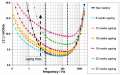
I have no idea, but I do know someone many years ago who had one of the early ECUs, and coming across someone with a flat battery he pulled over to give him a jump start. The car started happily and the good samaritan waved him away, but then tried to start his car - completely dead. Had to be towed back and have a new ECU fitted. After that I started seeing jumper cables with a little junction box in the middle that I assumed was some sort of surge suppressor. So, even noting the low impedance of the battery, I wondered what the impedance at higher frequencies was - maybe we were seeing some sort of inductive kick that the battery didn't suppress. Clearly the battery doesn't provide milliohm impedance though to MHz. A quick search yielded:

1663039239217.png
from: https://www.researchgate.net/figure...-procedure-The-graph-shows-the_fig1_322478231

So it's possible that it is providing some sort of sub-ms pulse protection (but as I said I don't know).

Hopefully now, though, there is an MOV fitted at the ECU, and anywhere else that needs protection.
 

MrAl

Joined Jun 17, 2014
13,702
I could also see a thermistor being used to sense temperature so that the wire or clip does not melt or just heat up too much, but that would have to have some associated electronics with it.

There are battery models you can look at to see what might be inside that can cause a problem. There is obviously some inductance in the wiring and with heavy current even a small inductance can hold a lot of energy for a short time (E=I^2*E/2).
 

Boggart

Joined Jan 31, 2022
82
I have no idea, but I do know someone many years ago who had one of the early ECUs, and coming across someone with a flat battery he pulled over to give him a jump start. The car started happily and the good samaritan waved him away, but then tried to start his car - completely dead. Had to be towed back and have a new ECU fitted. After that I started seeing jumper cables with a little junction box in the middle that I assumed was some sort of surge suppressor. So, even noting the low impedance of the battery, I wondered what the impedance at higher frequencies was - maybe we were seeing some sort of inductive kick that the battery didn't suppress. Clearly the battery doesn't provide milliohm impedance though to MHz. A quick search yielded:

View attachment 276142
from: https://www.researchgate.net/figure...-procedure-The-graph-shows-the_fig1_322478231

So it's possible that it is providing some sort of sub-ms pulse protection (but as I said I don't know).

Hopefully now, though, there is an MOV fitted at the ECU, and anywhere else that needs protection.
Yes, the usual sequence when jumpstarting another vehicle is that you connect the cables, get the other vehicle started, and then disconnect your cables. Now, what you have to realise is that, once the other vehicle starts, a large current will flow from its alternator to its rather flat battery, but a similar, somewhat smaller current (due to the jumper cable resistance) will also flow from the alternator of the car that provided the jump. When you disconnect the jumper cables, it does indeed produce a hefty spike from the very rapid load change on the alternator. This spike is what can kill the ECU.

This was never a problem before electronic controls, of course, but is definitely something to look at now.

The recommended method of jumpstarting a modern car is to connect both vehicles, start the car with the good battery and let it run 10 mins to charge the battery of the other vehicle somewhat, then stop the car providing the jump and remove the cables. The car with the flat battery should have enough charge to get started.
 

MisterBill2

Joined Jan 23, 2018
27,508
Unfortunately, in the past, some automotive companies did not adequately design their systems to survive the "Load Dump", which is that short term over-voltage that happens when an alternator delivering a high current suddenly has the load removed. At that point the rotating field current is still quite high, and the magnetization is very strong. So it takes a short bit of time for the output voltage to drop. Some systems did not include adequate protection against this.
A similar thing would happen when the alternator was powered during the engine cranking time, if the charging connections were not good enough. The system voltage would drop while the engine was cranking, and so the alternator would be working at maximum output. Not only did this add to the load the starter motor had to spin, it also assured a voltage surge when the driver released the start connection and the starter motor was disconnected. The result was not an inductive spike at all, it was the alternator at max output suddenly not having much load, and the regulation not being nearly fast enough.
It is also the reason that it is incredibly stupid to race the engine the instant it starts.
The best solution, adopted by many but not all, is to not enable the alternator until the engine has started running. That delay of just a few seconds solves the problem.
 
Top