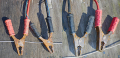
I like that answer, but personally I'd find it rather inconvenient to limit how far the cables can be separated since when jumping I always make the positive connection first on the battery then make the negative connection to bare metal, most commonly on the engine block if I can get a convenient spot. Having that "convenience" would be rather inconvenient.Keeps the clamps together for convenience?
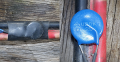
OK, so what is the purpose?I finally received a photo of what that blue wire is connected to. Looks like a Metal Oxide Varistor, which sounds like it could serve a purpose yet not have an effect on normal operation of the jumper cables.
View attachment 275677
Mystery solved (the hard way : -)
That doesn't really explain the existence of the MOV in the OP?I have seen a set of cables that had a red and green LED to let the user know if the polarity is correct. And I have come across, abandoned in a snowbank in a snowy parking lot, a set of aluminum wire jumper cables that appeared to have been melted through by having been connected backwards. The cables were about #10 aluminum wire so it must have been a few amps flowing to fuse it and open the circuit.
Good luck with that.The MOV could be provided to protect against the transient when the starter motor is switched off. That would raise the sell price while costing very little. And it would never fail because that spike is absorbed by the battery.
Either there must be a little blue varistor on the car as well or the varistor on the cable isn't needed.Good luck with that.
What happens when the starter motor switches off normally with regular starting, . i.e. with out boosting?