Car batteries that never seem to finish charging

recklessrog

Joined May 23, 2013
985
Don't pay attention to "shortbus". With him we don't get along, he is just trying to just find a reson to prove me being an idiot, because unlike him I don't believe what I am told and I can think by myself.
Hi Arakel. Did you quote the wrong post?......I can't see the connection between my post you quoted and anything to do with the difference of opinions between you and Shortbus.
 

ian field

Joined Oct 27, 2012
6,536
You should thank God for stopping them on time. If they catch fire or explode it will be very bad for these big batteries.

Your batteries are worthless. You might be able to recover them with the help of some chemistry/physics expert but maybe you should not risk your life again and just throw them!

Theoretically its possible that the charger is faulty also, but I do not believe it in this case.
Once or twice I've been desperate enough to flush out sludged cells - but its a serious PITA and you have to write desperate in LARGE upper case...…...
 

recklessrog

Joined May 23, 2013
985
Here in the U.K I have used "Bat aid" tablets (have a look on Google) in failing car batteries with varying degrees of success. We had an old Peugeot 406 diesel estate that was used for towing a large trailer when we went fishing etc. One year after several months of being left unused, the battery was dead and would not hold a charge for more than a couple of days.A new battery was probably worth more than the vehicle, so with nothing to lose, I popped two "Bat Aid tablets in each cell and slow charged it for a couple of days. from then on and for another year until I scrapped the car due to M.O.T failure, it would fire up with no problem even when left for weeks at a time.
My friend tried some in his newer car with absolutely no improvement.
 

ArakelTheDragon

Joined Nov 18, 2016
1,366
Here in the U.K I have used "Bat aid" tablets (have a look on Google) in failing car batteries with varying degrees of success. We had an old Peugeot 406 diesel estate that was used for towing a large trailer when we went fishing etc. One year after several months of being left unused, the battery was dead and would not hold a charge for more than a couple of days.A new battery was probably worth more than the vehicle, so with nothing to lose, I popped two "Bat Aid tablets in each cell and slow charged it for a couple of days. from then on and for another year until I scrapped the car due to M.O.T failure, it would fire up with no problem even when left for weeks at a time.
My friend tried some in his newer car with absolutely no improvement.
The new batteries are capsulated. I am not experienced in chemistry but I am guessing it depends on the technology of the battery. As you know old batteries had cells with acid in between them and metal. However different acid and metal might be used or the metal plates were already damaged too much or he did not use a proper charger for the first few cycles.

What I meant is that "shortbus" commented that because he was told that batteries don't explode so he tried to prove I am an idiot because we don't get along. But I can think by myself and I can make the estimation that a battery can explode.
 

ian field

Joined Oct 27, 2012
6,536
The new batteries are capsulated. I am not experienced in chemistry but I am guessing it depends on the technology of the battery. As you know old batteries had cells with acid in between them and metal. However different acid and metal might be used or the metal plates were already damaged too much or he did not use a proper charger for the first few cycles.

What I meant is that "shortbus" commented that because he was told that batteries don't explode so he tried to prove I am an idiot because we don't get along. But I can think by myself and I can make the estimation that a battery can explode.
SLA is still lead &H2SO4, but is some kind of gel in absorbent or glass fibre mats.

The explosion risk is from separated hydrogen and oxygen. Charge completion is marked by the end of chemical change and the start of elecrolysis. Most SLA manufacturers claim tech that recombines the evolved gasses. The battery aid tablets might be some calcium compound, and probably a preferential acceptor for lead sulphate.
 

shortbus

Joined Sep 30, 2009
10,049
The battery aid tablets might be some calcium compound, and probably a preferential acceptor for lead sulphate.
Don't know about tablets, but in my youth they sold a powder that was put in the battery sells. I was just Epson salts, magnesium sulfate. Said so right on the package fine print.
 

shortbus

Joined Sep 30, 2009
10,049
You should thank God for stopping them on time. If they catch fire or explode it will be very bad for these big batteries.
What I meant is that "shortbus" commented that because he was told that batteries don't explode so he tried to prove I am an idiot because we don't get along. But I can think by myself and I can make the estimation that a battery can explode.
No, you don't get what I said. Batteries don't explode from overheating. They explode from the gas being ignited when they are charging. If they explode from getting hot, how can cars be used in a desert?
 

recklessrog

Joined May 23, 2013
985
No, you don't get what I said. Batteries don't explode from overheating. They explode from the gas being ignited when they are charging. If they explode from getting hot, how can cars be used in a desert?
During some attempts at recovering some old sla batteries we had been given, (I posted a series some time ago showing what we were doing) I had one 17Ah get so hot at one end that the plastic softened and the internal pressure caused it to bulge out into a 6" diameter balloon. I dropped it into a bowl of water to cool down. If I hadn't, it would have burst at some point. I was driving it with very short 250 amp pulses of 3.1 mHz.
 

shortbus

Joined Sep 30, 2009
10,049
During some attempts at recovering some old sla batteries we had been given, (I posted a series some time ago showing what we were doing) I had one 17Ah get so hot at one end that the plastic softened and the internal pressure caused it to bulge out into a 6" diameter balloon. I dropped it into a bowl of water to cool down. If I hadn't, it would have burst at some point. I was driving it with very short 250 amp pulses of 3.1 mHz.
But yet it never exploded! That is the thing dragon can't seem to understand. Seen many melted batteries over the years in cars while working in my friends junk yard, most of them in cars that weren't in a fire, but some that were. And not one of them had a split case from an explosion.
 

recklessrog

Joined May 23, 2013
985
But yet it never exploded! That is the thing dragon can't seem to understand. Seen many melted batteries over the years in cars while working in my friends junk yard, most of them in cars that weren't in a fire, but some that were. And not one of them had a split case from an explosion.
So, had I not noticed the balloon I am certain it would have burst releasing the gasses and acid.
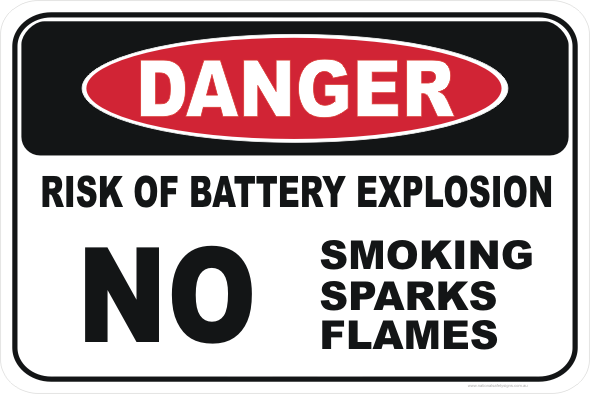
This sign was everywhere in a Naval submarine dockyard.


shortbus

Joined Sep 30, 2009
10,049
So, had I not noticed the balloon I am certain it would have burst releasing the gasses and acid.
I would say not. Unless there was a spark or other point of ignition available. You see m to for get that even sealed batteries have a vent for gasses to the outside, When they call a battery "sealed" they mean you just can't add water to it. It still has the vent to get rid of gases, when charging.

That is the same thing the warning sign was/is talking about. You and the dragon should notice that it says nothing about the batteries over heating. Smoking, Spark and Flame are all what? IGNITION sources. A 'balloning' battery from overheating, with no ignition source, is just a danger of possibly spilling its acid, but even that if it is sitting level is of little danger. Because the top is what come loose, it is put on the case after the internal parts of the cells are put in place.
 

recklessrog

Joined May 23, 2013
985
I would say not. Unless there was a spark or other point of ignition available. You see m to for get that even sealed batteries have a vent for gasses to the outside, When they call a battery "sealed" they mean you just can't add water to it. It still has the vent to get rid of gases, when charging.

That is the same thing the warning sign was/is talking about. You and the dragon should notice that it says nothing about the batteries over heating. Smoking, Spark and Flame are all what? IGNITION sources. A 'balloning' battery from overheating, with no ignition source, is just a danger of possibly spilling its acid, but even that if it is sitting level is of little danger. Because the top is what come loose, it is put on the case after the internal parts of the cells are put in place.
Yes i agree that it needs some source of ignition which is usually caused by the rupture causing a short that sparks the explosion.
All I can assume is that you have differently constructed batteries from the ones we have in the U.K, the sla battery i was referring to was a Yuasa and it was the end next to the + terminal that had swollen, the top was still firmly attached. The distortion caused by heating in those and normal car type lead acid batteries can and does lead to internal shorts which will ignite any hydrogen present.
Whilst I take your points onboard, I think that we will have to agree to disagree on the
subject as we seem to have had different experiences with batteries.
Whatever the answer is, for anyone dealing with batteries, take great care and wear appropriate safety clothing and goggles in case you are not as lucky as I was to get away without serious injury. See my photo in post # 18
 
Last edited:

Tonyr1084

Joined Sep 24, 2015
9,744
The charging circuit was acting up, and was overcharging the battery
Back in the 70's I drove a Ford Granada. Had a voltage regulator that was mounted on the inner fender. It was one of those relay types that had a few resistors on it to change the voltages going to the alternator, which in turn controlled the battery voltage. There were times driving at night I noticed that my headlights were working quite well. EXCEPTIONALLY well. In fact, the regulator (relay points welded) was producing an over voltage condition. Everyone thought I was "Fonzie" because a quick rap on the fender made the relay point break loose and return the charging system to normal. I suspect I was probably producing a lot of hydrogen outgassing.

There is a good reason to connect the Positive post first.
This has been my habit for many years. I learned early on that wrenching on a positive lead while the negative lead was still connected meant that if the wrench touched ground (metal) you'd get a good spark, and likely burn the tip of your tool. Have been fortunate enough to not have HHO gas present.

The explosion risk is from separated hydrogen and oxygen.
HHO - one of my favorite subjects. I messed with a HHO generator. A small one, about 2 inches in diameter. With some plates in the water and the application of some current, I managed to generate a quarter of an inch of foam. Using a long stem lighter I touched a flame to the foam wanting to see how long it would take to consume the gas bubbles. It let out an ear ringing pop. I then built a sealed reactor with a quarter inch tube connection. Bought 100 feet of drip irrigation tubing and connected it. I wanted to see how long it would take for the flame to propagate through 100 feet of 1/4 inch tube. After allowing enough time to evacuate ambient air I disconnected the tube from the reactor and promptly put flame to the opening. The entire 100 feet went poof, from end to end in a virtual instant. The tube was not deformed, nor was there any sign of heat damage, the flame traveled through the tube so quickly that it was imperceivable.

Hydrogen - well, first lets remember the fire triangle: Heat, Fuel, Oxygen. Hydrogen, in an absolute pure hydrogen atmosphere will not burn because there is no oxygen present. You can add all kinds of heat and it won't explode. But add a little oxygen and you get a hydrogen flame. Not an explosion - a flame. Add the proper amount of oxygen to the hydrogen and you get that wonderful battery opening explosion. So why do batteries seem to explode with such ferocity? Because there's not only present "Hydrogen" there's also the EXACT QUANTITY of "Oxygen". Water is two hydrogen molecules and one oxygen molecule. Which when in liquid form is inert. But when present in a gaseous form it is in the perfect region for an explosion.

Hot batteries can expand but not explode. Expanding batteries can explode if the internal plates make physical contact, causing heat and sparks. In the presence of this perfect gas blend - you get that explosion that showers everything. I think with my Ford I was probably lucky I noticed the problem and rectified it before it became an issue. I've never witnessed a battery explosion, nor have I seen the aftermath. But having messed with HHO generators I do know that what everyone calls "Hydrogen" around a battery is actually a concentration of both hydrogen AND oxygen, which is the root cause of battery explosions.

This has been an interesting read, watching banter go back and forth. I felt the need to include my experiences with hydrogen since I've messed with it (albeit foolishly).
 

Ylli

Joined Nov 13, 2015
1,092
HHO - one of my favorite subjects. I messed with a HHO generator.
Just one of my pet peeves... There is no such thing as HHO. You messed with a mixture of H2 and O2 gasses. Structurally, water is H-O-H, 2 hydrogen stuck to one oxygen with the oxygen in the middle. When you write "HHO", you are implying this is a structural configuration, and as such does not exist. (H has a valence of 1, O has a valence of 2).
 

Tonyr1084

Joined Sep 24, 2015
9,744
Just one of my pet peeves...
Two hydrogen molecules. one oxygen molecule. H2O2 is not water. I don't know what it is but it's not water. And there is no reason for two hydrogen molecules to stick together that I know of. But then again I'm not a molecular expert.

Hydrogen molecule (one free molecule), another Hydrogen molecule (a second free molecule), Oxygen molecule (ONE oxygen molecule liberated from the bonds of the hydrogen atoms) H H O.

Pet peeve or not, it's commonly referred to as HHO - as opposed to that fat guy with the beard and the red pajamas he never gets out of who goes Ho Ho Ho.

@crutschow HIJKLMNO - LOVE it! H to O for those who didn't get the reference.
 

ian field

Joined Oct 27, 2012
6,536
I have seen it once, a battery exploding. The only result was the acid burned winter coat and bad spots on the cars fender paint. But this was from trying to jump a frozen car battery. Not from charging one with a dead cell.
One time I was welding the centre stand on a motorcycle and forgot to move the breather pipe which hangs down there. another time I was going past Colchester barracks - a seriously loud bang made me wonder if someone was shooting at me. fortunately there was enough battery casing left to hang on to some electrolyte. Probably sparking at a loose terminal lug.
 

Tonyr1084

Joined Sep 24, 2015
9,744
Only by those trying to run a car on water or create an over-unity generator.
Again, I disagree. I DO have plans for my current hydrogen reactor (I am sure that's not the proper term - please don't beat me up). I also know that I can't get more energy out of the generator than I put in. And that's in a PERFECT world. 10 watts in - 10 watts out. Nothing is going to give you better gas mileage by simply reducing water into hydrogen and oxygen.

Actually the RIGHT way to run your car on hydrogen is to separate hydrogen in one cell while you separate the oxygen in a different cell. Since hydrogen won't burn without oxygen it's relatively safe to duct it into the throat of the carburetor. But even there it's being introduced to oxygen. Just not in the perfect amount, which is what causes batteries and other things to suddenly go bang when a spark is presented. By the way, I'm not trying to run any gasoline powered engine on hydrogen, though I have seen it powered by hydrogen from a tank. But what's the cost in a tank of hydrogen and how many miles are you going to go on that ? ? ?

It's OK to disagree with me, but lets try and stay on topic. Batteries that don't end charging.
 
Top