Makes you wonder if you lived somewhere in Paris from where you could see the Eiffel tower and owned some surveying instruments whether you could work out the temperature.
When I was working at NIST designing measurement systems, one of the things we always had to keep in mind is that everything is a thermometer, whether you want it to be or not.
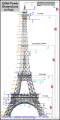
In that webcam photo, the height of the tower is about half the vertical height of the image, so let's call the image height, at the distance of the tower, about 650 m.
The coefficient of thermal expansion for steel is about 12e-6/°C.
The all-time record high and low temps for Paris are 41.9°C and -16.8°C, respectively, for a max all-time swing of 58.7°C, for which the tower would change height by about 23 cm.
For that to amount to a one-pixel change in height, the webcam would need a vertical resolution of about 2800 pixels.
My understanding is that most cityscape webcams are Full HD (1920x1080), but even Ultra HD (i.e., 4K) are just 3840x2160.
So, you would need something comparable to a 4K camera (at that location) to detect the difference from the all-time record extremes.
On paper, you could just zoom in on the top of the tower, but of course, the place where the camera is mounted is also moving because it is attached to something that is also expanding and contracting, which would make calibrating it for that kind of approach virtually impossible. You really need to see as much of the tower as possible so that you can actually measure the fractional change in height, which means a vertical resolution of about 80,000 pixels in order to see a difference of one pixel per degree celsius.
Of course, that wouldn't stop the screen writers for CSI or any similar show from being able to take a traffic cam's 1280x720 pixel image in which the tower is a distant object and using that to determine that the timestamp was altered by the bad guys by determining the exact time of day that the image was actually taken based on the thermal expansion of the tower.
The answer depends on the assumptions allowed. Nearly all "physics questions" require assumptions and the reasonableness of the assumptions depends on the required fidelity of the answer. For this case, it depends on what "the same time to fall" means? If the time of one is within 1% of the other, is it close enough to be considered "the same"? Or, does ANY difference, even a picosecond, qualify as being not "the same"?
Even if a criteria for "same" was given, the answer would likely depend on the actual size of the spheres, not just their relative sizes. As the spheres get larger, the effect of drag goes down and the fall times approach what they would in a vacuum, so they get closer and closer to each other. But if the smaller sphere is truly small, such as the size of a BB, then the difference would be huge because the smaller sphere would quickly reach a much slower terminal velocity.
But if we insist on a criterion of "any difference", no matter how small, then the answer is: No, not unless a lot of different factors are successfully tuned so as to cancel out the differential effects over the course of the drop.
There's quite a bit going on here. To a first approximation, there is the square-cube effect in which the drag force increases with the square of the sphere's radius, but the mass increases with the cube (assuming that we are talking about solid steel spheres, which is implied, but not stated). Thus the drag will result in a smaller decrease in acceleration for the large sphere than the small sphere.
But drag is a very complex phenomenon and is sensitive to the Reynold's numbers involved as well as the surface roughness of the sphere. If you can get the small sphere into drag crisis while keeping the large sphere out of it, you might be able to get them to take the same total time. I don't know how difficult that would be over practical sizes of spheres and degrees of surface roughness to get them "close enough" to be considered the "same" for a reasonably tight criterion, but they would not be exactly the same, even for two nominally identical spheres dropped at the same time because of non-deterministic effects, though measuring the differences in the times might be challenging.

 Facebook
 Google
 GitHub
 Linkedin