Capping off 50mL solution bottles

oz93666

Joined Sep 7, 2010
742
Go back to the uncapped bottle of ammonium hydroxide, even a full bottle with very little/no headspace of air to be affected by atmospheric pressure changes to push the air in and out. The vapor does leave the bottle even without any delta between inside and outside pressure. Molecules travel in a straight line until they strike another object and they travel from an area of greater to lesser concentration. That is diffusion. And that is why it doesn't take long for an uncapped bottle of ammonia water to stink up a large room without any aid from any form of induced air circulation. Even if I use a needle applicator bottle if I put fluid in it with a high vapor pressure such as anhydrous ether that bottle will magically become empty due to diffusion. The rate of diffusion depends on the "volatility" of the fluid and the environmental temperature and pressure. High volatility = high vapor pressure = rapid evaporation = more diffusion = empty bottle. Higher temp = faster evaporation. Lower pressure = faster evaporation. It's basic laws of physics. If I fill that needle dispenser bottle with a low vapor pressure fluid such a high-density oil with a very low vapor pressure my grandkids and their grandkids will probably still be waiting for it to evaporate, diffuse and magically disappear but it will eventually do so. And then there are hygroscopic fluids which left open to the atmosphere will absorb water molecules and increase in volume albeit due to water contamination of the fluid which will change it from it's original chemical properties.
I don't disagree with that ....except the part highlighted , they very soon strike another gas molecule .....

As you point out , escape of fluid will depend on Vapor Pressure of the fluid , the length and fineness of the needle , and most importantly the volume of airspace above the fluid ....

I'd be willing to bet if temperature does not vary more than 5C in a day , and the bottle is 2/3 full of alcohol , you wouldn't loose more than 1% a month
 

Thread Starter

SamR

Joined Mar 19, 2019
5,499
Sounds about right for the liquid flux and as I said earlier I have no interest in doing the calculations to determine it. Kinda like arguing about how many angels will fit on the head of a pin. And if my house varied 5°C a day I'd be replacing the HVAC system.
 

djsfantasi

Joined Apr 11, 2010
9,237
I used bottles with needle dispensers very similar to these. I used them in model railroading, to remove factory applied screen printing and as a wetting agent for gluing scenery bases (dust or powders) or for fine painting.

I had a bottle of alcohol for years without any noticeable loss of the liquid without sealing the tip.

I’m sure some was lost but a normal person couldn’t tell any was gone.
 

Thread Starter

SamR

Joined Mar 19, 2019
5,499
I’m sure some was lost but a normal person couldn’t tell any was gone.
Thanks for the info. Somewhere back there I mentioned it was just my nature based on my past life as an analytical chemist that it HAD to be capped to prevent loss and contamination. I also have to deal with a wife who is very sensitive to odors and will fuss if she smells anything but such is life and after 40 plus years of it, I'm used to it by now. I tease her that she must have a brain tumor because I can't smell anything when she does. After 70+ years in the same location, my Project Engineering group had to ditch our ammonia develop blueprint machine because the Plant Managers Executive Assistant (apparently secretary is now sexist and demeaning) complained about the odor every time we had to run off a batch of prints to secure bids from.
 

shortbus

Joined Sep 30, 2009
10,049
Oil has such a low vapor pressure it does not evaporate like most liquids and sticks around making a big mess. A thread fit to contain it would not be possible to finger start the bolt being probably either a press or shrink fit to be tight enough to prevent seepage.
Wouldn't the low vapor pressure make oil less likely to seep up a threaded joint? Not trying to argue just understand.
 

Thread Starter

SamR

Joined Mar 19, 2019
5,499
The vapor pressure has nothing to do with the capillary action of the oil or any fluid? The actual fluid density and its surface tension maybe. Why it is so noticeable is due to its lack of evaporation because of its low vapor pressure. Other fluids, such as cooling water, would have evaporated from engine heat leaving no residue behind except maybe some lime scaling or discoloration from antifreeze additives. So oil seepage becomes more noticeable. Oil seepage from the valve cover gasket usually ends up on the exhaust manifold and evaporates as "smoke". And it's seepage from the main crankshaft seal and oil sump pan gasket ends up on the driveway and parkway. With higher temps it becomes less dense and it's capillary action increases? It's been too long since I took material science and my mind ain't what it used to be. If you take a glass capillary tube and touch the surface of the fluid breaking its surface tension the material will flow up the tube based on its physical properties. The warmer the fluid the less dense it is and it will flow/wick higher up the tube. I want to say based on density with mercury not much at all, oil more so but less than water and water less than alcohol. There was something else about the capillary tube's materials physical properties that I can't remember. Might have been surface smoothness I think.
 

Danko

Joined Nov 22, 2017
2,179
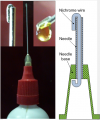
It is how I keep my rosin flux.
Advantages:
1. No evaporation.
2. No massive flow, well controlled droplets only.
3. If / when flux in tip becomes consolidated,
slightly turn nichrome wire by fingers.
upload_2019-7-4_18-4-37.png
 
Last edited:

Danko

Joined Nov 22, 2017
2,179
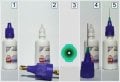
Second life of medicine bottle:

1. Bottle.
2. Hole 5 mm diameter drilled in cap.
3. Ledges on the bottom of needle base ground away
by file, up to dashed line on the picture.
4. Needle firmly pushed to cap hole.
5. Dispenser assembled.

Drawing3_.jpg
 
Last edited:
Top