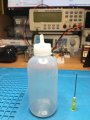
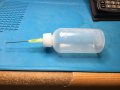
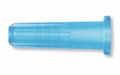
I bought these off fleaBay since I needed them for liquid flux, alcohol and such. They look great except for one problem. How to cap them off?!?! I guess I could put some Saran Wrap under the needle base? Any good ideas out there?
Yup it's a Luer needle so a Luer cap or a small used Luer needle cut off and sealed to make a cap should work. I used to use Grainger and McMaster Carr and some other catalogs at work for ideas. Never bought from them as they are on the expensive side but when you are in the middle of nowhere on a job they can provide what you need ASAP. I probably have some small gauge syringes around here somewhere so it's time to look and see if I threw them out. The new ones have the needle built in but should still have a cap that might work.
Not the perfect solution but a bit of both pieces of advice albeit far more than I wanted to spend... Not exactly something you can buy onesies or twosies of.
Re. Syringes:
Most medicinal syringes and the ones in that link have rubber-tipped plungers. Most also are greased with a silicone like grease. I prefer syringes that do not have those "features" and have been using AirTite syringes where the plunger tip is made of the same material as the rest of the syringe. No worries about contamination and dissolving the rubber with aggressive solvents that I may use. AirTite used to sell directly, but the illicit drug industry may have put an end to that. They are sold through Amazon and probably other distributors: https://www.amazon.com/AIRTITE-Norm...+syringes&qid=1561798324&s=arts-crafts&sr=1-1
Re. Caps:
When you say "used"needle, I hope you don't mean one found on the sidewalk.
Gasses diffuse very slowly though narrow capillaries. In fact, old analytical glassware used spiral capillaries to cap vessels for volatile chemicals and gases. If you are stuck using needles, I would simply crimp the needle, then break it off above the crimp. A fine needle, presumably blunt pointed, will work well for short term storage. That is, you do not need to remove the needle and cap the syringe after every use. Another useful product is fine bore capillary Teflon tubing. I use that to cap my small (1/2 to 1 oz. ) bottles of cyanoacrylic adhesive. Diffusion is so slow that there is no need to do anything else. If it does plug, that is always at the very tip, which is easily cut off. You can also buy flexible plastic hypodermic needles with Luer connections.
Plastic syringes with lubricated rubber/plastic plungers might be good for oil or grease but definitely not much else without some contamination. I do have one that came preloaded with flux paste and it does have a long plastic cap over the needle. At one time I had some glass barrel syringes with Luer lock needles circa the early 1900s before the use once and throw away plastic ones arrived. They were close tolerance ground glass barrel and plunger without lubricating oil and simply using the injectant for lubrication. No idea where they are now and may have tossed them during one of my clutter removal binges. I was thinking to cut down, bend over and crimp a throwaway aluminum needle for a cap but didn't find one. The silicone needle caps seem like a good solution since you don't have to remove and store a dirty dispensing needle to cap the bottle and should seal better than a snap-on plastic cap over the needle. We shall see. I'm disappointed the bottles came without a cap but that was an oversight on my part and I ended up paying more for the caps than I did for the dispenser bottles.
Let's try some off the reservation thinking and ask .... " Why cap them off???"
You have a plastic bottle , let's say filled with alcohol , and a syringe fitted ...
Nothing can get in , dust or anything , down that tiny metal tube ...
And the alcohol cannot get out ...
If you left the plastic bottle with the plastic lid off the alcohol would slowly defuse and evaporate away . But with the syringe in place the only way out is up a very long and very very narrow tube .... it will not defuse out in 100 years , as long as the temperature is below 79C the BPt of alcohol ...
Diffusion is only possible with a wide mouth opening that allows for movement of air in , which then allows some alcohol vapor to be absorbed in it , and then that air has to escape , this air movement is effectively non existent with a syringe attached
Even if the bottle was knocked over only a few drops might escape ....
Here's my quick and dirty solution with things I have laying around the bench. Hot melt glue and shrink sleeving. It's even possible you could use a find shrink tube, heat the end and fold it over on itself and compress it while still hot. It should seal itself up.
One thing I know for sure, an uncapped liquid can escape when flying in an airplane. Pressure differences and a bottle laying sideways (or upside down) will create quite the mess (1984). Also, I saw a guy make a thermometer out of a plastic hot sauce bottle and an empty pen tube (ball point type, cleaned of all ink). When temperature dropped the liquid (red die) would rise up the tube. Frustrated to understand how it was doing just the opposite, I explained the plastic bottle is contracting with the cold, squeezing fluid up the tube. But he insisted it's supposed to go down when it cools. "Yes" I explained, "the water WILL drop. But not as much as the plastic will contract. And the fluid will squeeze up the tube when cold. It will drop when the plastic bottle warms and expands. It has to do with volume.
Why did I bring that up? Because your plastic bottles will shrink and grow. If the bottle is full then when it cools you'll have a mess. But for the sake of simply closing off the bottle, shrink sleeve. Maybe some hot melt glue to close up the top end. OR you could just make a hot melt ball and poke the syringe into it, creating a custom cap. Then carefully pull it off and you now have a cover for your syringes.
a
Oil has such a low vapor pressure it does not evaporate like most liquids and sticks around making a big mess. A thread fit to contain it would not be possible to finger start the bolt being probably either a press or shrink fit to be tight enough to prevent seepage. The design of explosion proof electrical fittings is not to hermetically seal but instead produce a long path along the screw threads to cool the gases from an internal explosion so as not to ignite the surrounding explosive atmosphere. Actually got to see one demonstrated at an Instrument Society meeting. Explosion proof box with an electrical igniter and methane gas mixture inside. You could hear the pop when it ignited inside but the box remained intact and not enough heat leaked out of the screw-on lid to ignite the outside explosive atmosphere. Those are only a finger tight fit. And then we had things like Carbon Disulfide and Hydrogen which would self-ignite just by leaking out of containment to an atmosphere containing oxygen.
Threaded and flanged piping has only one advantage. The ability to easily disassemble it. As one old Engineer used to say pipe joints are to allow it to leak and rebar is to allow concrete to fracture. Especially on oil piping welded fittings were preferred, but terrible for renovations. That's why the Sawzall was invented.
The only way vapor could escape from a syringed bottle is by changes in air pressure and temperature , each time this happens the air inside expands or contracts and since the bottle is not sealed air moves through the syringe and carries off vapor .... but most bottles with tops on are not sealed from pressure changes.
Putting saran wrap (cling film) on the top will not pressure seal and stop very slight air exchange due to pressure change ... but still, the loss of alcohol would be very small.
it's called diffusion and is the basic gas law of physics. Molecules (in particular gases) move from an area of greater concentration to an area of lesser concentration unless they are in a closed container or acted on by other forces such as in osmosis. It's basic evaporation driven by the materials vapor pressure, atmospheric pressure, and temperature, albeit the opening is only ~0.8mm in diameter the vapor does leave the open container even under standard temperature and pressure conditions until the temperature is reduced or pressure increased or a combination thereof to the point that the vapor pressure becomes 0 and evaporation ceases or to 0°K where molecular motion even of gases ceases. And the outside atmosphere enters the container contaminating it. Uncap a bottle of ammonium hydroxide (household ammonia solution) and see how long it takes before everyone starts complaining about the smell. We had to blanket tanks with nitrogen to prevent oxygen contamination of organic fluids caused by the oxygen in atmospheric air oxidizing the organics molecules of the contents. I guess it is my analytical chemistry and physics background that makes my basic nature INSIST the container be closed to prevent evaporation and outside contamination even though for practical purposes it is almost a nil effect and obviously 99% isopropyl alcohol is relatively cheap. Call me an anal retentive perfectionist I guess.
it's called diffusion and is the basic gas law of physics. Molecules (in particular gases) move from an area of greater concentration to an area of lesser concentration unless they are in a closed container or acted on by other forces such as in osmosis. It's basic evaporation driven by the materials vapor pressure, atmospheric pressure, and temperature, albeit the opening is only ~0.8mm in diameter the vapor does leave the open container even under standard temperature and pressure conditions until the temperature is reduced or pressure increased or a combination thereof to the point that the vapor pressure becomes 0 and evaporation ceases or to 0°K where molecular motion even of gases ceases. And the outside atmosphere enters the container contaminating it. Uncap a bottle of ammonium hydroxide (household ammonia solution) and see how long it takes before everyone starts complaining about the smell. We had to blanket tanks with nitrogen to prevent oxygen contamination of organic fluids caused by the oxygen in atmospheric air oxidizing the organics molecules of the contents. I guess it is my analytical chemistry and physics background that makes my basic nature INSIST the container be closed to prevent evaporation and outside contamination even though for practical purposes it is almost a nil effect and obviously 99% isopropyl alcohol is relatively cheap. Call me an anal retentive perfectionist I guess.
No Sam ... what I have described is not diffusion , it's pushing the air in and out , like in a bellows ... the air moves ....and carries the vapor...
Diffusion occurs with no measurable air movement , but the movement of molecules (brownian motion) means things move around and get mixed up and the alcohol vapour would slowly move ...but with syringe hardly any of this ocours
Go back to the uncapped bottle of ammonium hydroxide, even a full bottle with very little/no headspace of air to be affected by atmospheric pressure changes to push the air in and out. The vapor does leave the bottle even without any delta between inside and outside pressure. Molecules travel in a straight line until they strike another object and they travel from an area of greater to lesser concentration. That is diffusion. And that is why it doesn't take long for an uncapped bottle of ammonia water to stink up a large room without any aid from any form of induced air circulation. Even if I use a needle applicator bottle if I put fluid in it with a high vapor pressure such as anhydrous ether that bottle will magically become empty due to diffusion. The rate of diffusion depends on the "volatility" of the fluid and the environmental temperature and pressure. High volatility = high vapor pressure = rapid evaporation = more diffusion = empty bottle. Higher temp = faster evaporation. Lower pressure = faster evaporation. It's basic laws of physics. If I fill that needle dispenser bottle with a low vapor pressure fluid such a high-density oil with a very low vapor pressure my grandkids and their grandkids will probably still be waiting for it to evaporate, diffuse and magically disappear but it will eventually do so. And then there are hygroscopic fluids which left open to the atmosphere will absorb water molecules and increase in volume albeit due to water contamination of the fluid which will change it from it's original chemical properties.

 Facebook
 Google
 GitHub
 Linkedin