Capacitors how to read markings

Thread Starter

AAE John

Joined Oct 20, 2018
2
DBF66E9A-499B-4E87-A3B8-8662176A9757.jpeg

CCF1BE89-C92C-465E-87CD-40C3975DA53B.jpeg
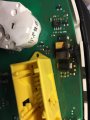
Hi all, I’m tring to identify the markings on what I think is a smd tantalum capacitor but from what I’ve been reading I can’t be sure what I think is right, I think it is a 10 volt 100uf capacitor

This is some of what I have been reading

Often SMD electrolytic capacitors are marked with the value and working voltage. There are two basic methods used. One is to include their value in microfarads, µF, and another is to use a code. Using the first method a marking of 33 6V would indicate a 33 µF capacitor with a working voltage of 6 volts. An alternative code system employs a letter followed by three figures. The letter indicates the working voltage as defined in the table below and the three figures indicate the capacitance on pico-farads. As with many other marking systems the first two figures give the significant figures and the third, the multiplier. In this case a marking of G106 would indicate a working voltage of 4 volts and a capacitance 0f 10 times 10^6 pico-farads. This works out to be 10µF

Some other capacitors I have been looking at I have been able to identify using the info above but I’m not sure on this one if anyone is able to lend a hand,

I am relatively new to this side of things and if any one can help it would be appreciated
Thanks John
 

ebp

Joined Feb 8, 2018
2,332
It is 10 x 10^7 picofarads = 100 microfarads; rated at 10 VDC, The K probably means it is made by Kemet.

It will be a solid tantalum type, but there are numerous series with differing properties. I'd check Kemet data for clues to identifying the series. It looks like there are bars above and below the K, and these may actually have meaning, as may the bar beside the 7. Some of the other characters will be a date code, but you really do need a datasheet to be able to decipher them. Manufacturers are known to change the way they mark their parts from time to time, which makes it an extra pain.
 

Thread Starter

AAE John

Joined Oct 20, 2018
2
Thanks for the reply, I wasn’t able to find a data sheet but I replaced the capacitors with 10v 100 and the fault was fixed (instrument cluster from car) do capacitors normally fail in this way or Is there useualy a reason?
Thanks John
 

ebp

Joined Feb 8, 2018
2,332
Solid tantalum capacitors are quite reliable but there are certain things they don't like. Fast-rising current can cause them to fail. They are the only capacitor type I know of that is widely used that usually "requires" voltage derating - using them at some significant amount below their nominal voltage rating. They also a tendency to fail in a way that might be described a partially short-circuit - a fairly low resistance between the terminals. I suspect that is what happened in your case, followed be gross overheating as DC current flowed when it shouldn't have. What might have caused it to fail initially is hard to say. Because of the voltage and capacitance I suspect it is in a DC-DC converter to provide something probably in the range of 3 to 5 volts for digital circuity. Usually in that application it would be fairly well protected from things go on in cars like "load dump" voltage spikes. My experience diagnosing failed automotive electronics is very limited.
 

MrChips

Joined Oct 2, 2009
34,630
Yes, failure of tantalum capacitors is a common occurrence. I have also repaired a number of PC mother boards with faulty aluminum capacitors.

I have repaired a number of electronic equipment where the remedy was to replace a blown tantalum electrolytic capacitor. My guess is that the effort is to maximize the capacitance/size ratio (or to minimize the size/capacitance ratio) i.e. to make the capacitor as physically small as possible.

This means that they have to reduce the maximum operating voltage or cut the operating voltage margin. I will generally try to substitute a capacitor with one with higher voltage rating to avoid a repeat failure.
 
Top