Capacitor Inductor Resonating

Thread Starter

Calloutman

Joined Jan 31, 2016
3
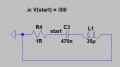
I have a circuit where a capacitor discharges through a resistor to ground. An inductor is connected to the other side of the capacitor and to ground, as shown in the LTSpice simulation schematic.
upload_2017-7-27_16-53-15.png

When I start the simulation, the capacitor discharges through the resistor, and I get a voltage/current oscillation between the capacitor and the inductor.
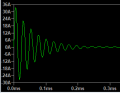
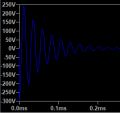
upload_2017-7-27_16-55-2.pngupload_2017-7-27_16-56-56.png

I know about LC resonators, but normally they involve dumping charge onto one side of the capacitor, which then discharges through the inductor, which sets up an oscillation. In this case, the one side of the capacitor is already at 0V, and both sides of the inductor are at 0V. Why does discharging the other side of the capacitor at 300v causes the oscillation?

Thanks.
 

Thread Starter

Calloutman

Joined Jan 31, 2016
3
EDIT: I suppose in this case the inductor doesn't matter too much. The key thing is why does the voltage drop to -300V on the L1 side of the capacitor to begin with.

Thanks.
 

crutschow

Joined Mar 14, 2008
38,503
The capacitor is charged to 300V at the start of the simulation with energy 1/2 CV^2 and the current from that energy discharge must go through the inductor, which cause the resonant oscillations.
Monitor the current through the capacitor/inductor and you will see what is happening.
It makes no difference which side of the capacitor is charged at the beginning (other than the initial direction of the current).

Make sense?
 

BR-549

Joined Sep 22, 2013
4,931
What happened to the inductor side of the cap plate.....when the start side was charged to 300 volts?

Isn't there an equal, but inverted potential on the inductor plate?
 

crutschow

Joined Mar 14, 2008
38,503
What happened to the inductor side of the cap plate.....when the start side was charged to 300 volts?

Isn't there an equal, but inverted potential on the inductor plate?
No.
Spice does a DC bias calculation before a transient simulation and all inductors are simulated as a short for that.
 

Thread Starter

Calloutman

Joined Jan 31, 2016
3
The capacitor is charged to 300V at the start of the simulation with energy 1/2 CV^2 and the current from that energy discharge must go through the inductor, which cause the resonant oscillations.
Monitor the current through the capacitor/inductor and you will see what is happening.
It makes no difference which side of the capacitor is charged at the beginning (other than the initial direction of the current).

Make sense?
Okay. That does make sense. Thanks very much.
 
Top