Capacitive and Inductive Impedance

Thread Starter

Abhinavrajan

Joined Aug 7, 2016
83
In a circuit with Capacitance and Inductance with an AC source, I see that when we calculate the value for the impedance of the capacitor and Inductor
there is a complex component "j".

What is the complex term and why is the complex term "j" included in the expression ?
 

crutschow

Joined Mar 14, 2008
38,503
The j is the imaginary part of the complex impedance number which represents the L and C reactances.
It allows relatively easy computation of the impedances and phase shift in RLC circuits.
Read this for more info.
 

MrAl

Joined Jun 17, 2014
13,703
In a circuit with Capacitance and Inductance with an AC source, I see that when we calculate the value for the impedance of the capacitor and Inductor
there is a complex component "j".

What is the complex term and why is the complex term "j" included in the expression ?
Hi,

Another view is that the 'j' operator shows that the impedance is such that the current through the element is out of phase with the voltage across the element.
For a resistor, the current is in phase with the voltage, but for caps and inductors it is out of phase by 90 degrees.

Other representations;
0-1/jwC a complex number
0+jw*L a complex number
(0,1/wC) a vector
(0,wL) a vector
1/wC@90 degrees current leading the voltage
wL@90 degrees current lagging the voltage

Note all these assume sinusoidal waveshapes only.
There are ways around that, but that's another story for later :)
 

MrChips

Joined Oct 2, 2009
34,809
Think of j as an operator, just like + and -.

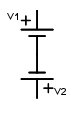
1)

upload_2016-8-9_8-1-48.png
If we have two DC voltage sources V1 and V2, the sum of the voltages is V1 + V2.

2)

upload_2016-8-9_8-4-26.png
Here the sum is V1 + (-)V2. That is, the operator (-) indicates that the voltage source is flipped by 180°.

3)

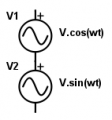
We can do the same with AC voltages.

upload_2016-8-9_8-11-53.png

The total voltage is

Vtotal = V.cos(ωt) + V.sin(ωt)

One way of solving this is to recognize that a sin wave is a cosine wave delayed by 90° or π/2.

Vtotal = Vcos(ωt) + Vcos(ωt - π/2)

We use the j-operator to represent a phase shift of -π/2.

Thus
Vtotal = V.cos(ωt) + j.V.cos(ωt )

4)

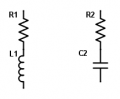
upload_2016-8-9_8-24-39.png

When applied to inductors and capacitors in AC circuit analysis, we use the impedance of the components.

ZR = R
ZL = jωL
ZC = 1/jωC

The total impedance of R1 and L1 in series is
Ztotal = ZR + ZL = R1 + jωL1

The total impedance of R2 and C2 in series is
Ztotal = ZR + ZC = R2 + 1/jωC2 = R2 - j/ωC2

Thus observe that the current in L will lag the applied voltage by 90° whereas the current in C will lead the voltage by 90°.

Remember this phrase:

ELI the ICE man

This will help you to recall that the voltage (or EMF) leads the current (I) in an inductor (L) whereas
the current (I) leads the voltage (E) in a capacitor (C).
 

Attachments

MrChips

Joined Oct 2, 2009
34,809
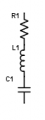
Let us combine R, L and C altogether in series:

upload_2016-8-9_9-54-50.png

Ztotal = ZR + ZL + ZC = R + jωL + 1/jωC = R + jωL - j/ωC

At decreasing values of ω, the capacitance term dominates, and the current leads by π/2.
At increasing values of ω, the inductance term dominates and the current lags by π/2.

Thus Ztotal has a minimum impedance at a certain ω. At what value of ω is Ztotal at the minimum?

The phase shift from L and C cancel at a certain ω.
At what value of ω is the phase shift zero?

Is this a band-pass filter or a notch filter?
 

Thread Starter

Abhinavrajan

Joined Aug 7, 2016
83
Think of j as an operator, just like + and -.

1)

View attachment 110172
If we have two DC voltage sources V1 and V2, the sum of the voltages is V1 + V2.

2)

View attachment 110173
Here the sum is V1 + (-)V2. That is, the operator (-) indicates that the voltage source is flipped by 180°.

3)

We can do the same with AC voltages.

View attachment 110174

The total voltage is

Vtotal = V.cos(ωt) + V.sin(ωt)

One way of solving this is to recognize that a sin wave is a cosine wave delayed by 90° or π/2.

Vtotal = Vcos(ωt) + Vcos(ωt - π/2)

We use the j-operator to represent a phase shift of -π/2.

Thus
Vtotal = V.cos(ωt) + j.V.cos(ωt )

4)

View attachment 110176

When applied to inductors and capacitors in AC circuit analysis, we use the impedance of the components.

ZR = R
ZL = jωL
ZC = 1/jωC

The total impedance of R1 and L1 in series is
Ztotal = ZR + ZL = R1 + jωL1

The total impedance of R2 and C2 in series is
Ztotal = ZR + ZC = R2 + 1/jωC2 = R2 - j/ωC2

Thus observe that the current in L will lag the applied voltage by 90° whereas the current in C will lead the voltage by 90°.

Remember this phrase:

ELI the ICE man

This will help you to recall that the voltage (or EMF) leads the current (I) in an inductor (L) whereas
the current (I) leads the voltage (E) in a capacitor (C).

Understood. But how does the complex term help while solving some circuit problems. Suppose I have an AC circuit with R,L,C having 20k , 20mH and 0.1uF respectively and I need to find the total impedance of the AC circuit, How am I supposed to solve with the complex term involved. So, the final answer will also have a complex term,right ?
 
Top