Check the bias with no input. The bias resistors may need to be adjusted a bit. I designed for a collector voltage of 15V. If it is far off from that, it will cause distortion. 14.5 to 15.5V should be close enough.
There is nothing extraordinarily wrong with observing distortion at the output. There are two simple ways to remedy this. Reduce the amplitude of the input signal. Adjust the values of the base bias resistors.
I assembled BobTPH's circuit after reading, and mostly understanding, what he said.
I'm still getting distortion on the output but it looks closer to a sine wave than prior efforts. I checked my oscilloscope input impedance to make sure it was not low enough to affect the circuit; the manual says "1MΩ±2% in parallel with 20pF±3pF"
so I'm thinking I'm okay there.
I fed the siggen to the base through a 1uF cap (instead of the .1uF I used previously), giving an Xc of 1 / (2piF(1uF)) = 0.16 ohms of Xc because I'm using 1Mhz. Checking the input at the base after it passes through the cap looks like a sine wave; the output is not there yet.
Why is your circuit producing distortion but Bob's and my simulations show NO distortion?
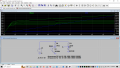
A photo of the distortion shown on your oscilloscope will be explanatory but a description like "the top (or bottom) is clipping".
Edited to add: The clipping point is about 8V p-p, so again, adding the extra voltage to the supply voltage and bias point worked out very well. Always be conservative in you designs.
I've been studying the circuit on the left to understand the transconductance of a BJT. It is called a Diode Connected Transistor and is electrically equivalent to the circuit on the right. It works because the base and collector are shorted together forcing the same voltage at that node. The remaining voltage is imposed on the resistor sourcing both Ibe and Ice. I took an average of the simulation and confirmed the following parameters from the Fairchild 2n3904 datasheet:
1) The base-emitter junction promptly enters saturation as Vbe > 0.65V
2) The collector-emitter junction does not enter saturation as Vce > 0.3V
3) The BJT begins in cutoff but enters active mode as Ibe must be > 50uA before Ice starts to flow.
4) The current gain is around 250 as gain = Ice / Ibe.
This information helped me understand there is both a forward voltage and forward current required to turn on (bias) a BJT.
I've been studying the circuit on the left to understand the transconductance of a BJT...
:::::::::::::::::::::::::::::::::::::::::::
This information helped me understand there is both a forward voltage and forward current required to turn on (bias) a BJT.
What do you mean with "both....required"?
Would you agree to the following sentence ?
Only one quantity is required (to be applied) for biasing a BJT in active mode - and that is the base-emitter voltage Vbe (in the range 0.6-0.7 volts).
The corresponding base current adjusts itself automatically,
What do you mean with "both....required"?
Would you agree to the following sentence ?
Only one quantity is required (to be applied) for biasing a BJT in active mode - and that is the base-emitter voltage Vbe (in the range 0.6-0.7 volts).
The corresponding base current adjusts itself automatically,
I'd like input from the pros but I solved the circuit using KVL and KCL. Since transconductance is the relationship between voltage and current, I think it reasonable to say one can approach the circuit with either currents or voltages in mind with respect to inputs and outputs. Depending on how you look at it, we need to provide either a bias voltage of ~0.7V or a bias current of ~50uA from base to emitter. Ultimately we are interested in the transfer of charge so both quantities represent the same result as one affects the other in known proportion if Ohm's law holds.
I also think this is why BJTs are called Current Controlled Devices because unlike FETs, a fairly large and continuous current is required to enter and remain in active mode.
.................................
Since transconductance is the relationship between voltage and current,
.........................
I also think this is why BJTs are called Current Controlled Devices because unlike FETs, a fairly large and continuous current is required to enter and remain in active mode.
With other words: The transconductance (Current out and voltage in) with gm=d(Ic)(d(Vbe) describes the relationship between input and output - and therefore the BJTs are "called Current Controlled Devices".
To me, this sounds a bit contradictory.
With other words: The transconductance (Current out and voltage in) with gm=d(Ic)(d(Vbe) describes the relationship between input and output - and therefore the BJTs are "called Current Controlled Devices".
To me, this sounds a bit contradictory.
I think it is more natural to bias transistors in terms of voltage because voltage sources are easier to deal with than current sources. We can use a cascade of BJTs to build the following topologies:
1) Voltage Controlled Voltage Source
2) Voltage Controlled Current Source
3) Current Controlled Voltage Source
4) Current Controlled Current Source
The topology which most accurately describes your circuit depends on what you are trying to do with the output and which input parameter offers you the most control. So, while you can control a BJT with either a voltage or current (Power In = Power Out - Losses), the transfer characteristic of the current response is almost linear whereas the voltage is exponential. I think it then boils down to if you prefer to do calculations based on the sharp knee of the voltage response or the nice gentle slope of the current response. In any case, all roads lead to Rome.
FETs are voltage controlled devices because the transconductance is based on the charge at the gate terminal which quickly charges to the input voltage via the RC constant. Since the gate capacitor is a very low value with low leakage, a continuous current is not required to keep it turned on.
Another consideration is high impedance inputs may not be able to drive a BJT but will drive a FET because a high impendence node cannot supply large currents (the voltage drops). It doesn't need to for FETs because the capacitor charges almost instantly.
I'm trying to get a clean sine wave output from a very simple voltage divider biasing for an NPN 2n3904 BJT.
I set a Vcc = 10vdc. I selected the resistors (R1, R2, Re, Rc) to achieve a 5vdc midpoint bias at the collector, the 'Q' point when no AC signal is supplied to the base. So far so good, I verified with my DVM and with a scope that with no input to the base from my siggen, my collector is at about 5vdc, and the Vbe is about 0.7vdc. The transistor is on, and it is not saturated, it is at 5vdc on the collector, so the input sine wave (4vpp) should swing about a 5vdc level.
I turn on the siggen and get a clean sine wave at the base but a distorted (not clipped, just not a sine wave) output at the collector.
I am suspecting a bad 2N3904 NPN but before I buy new ones, was wondering if anyone knows of a fault of some kind that would lead a BJT to create a non-sine wave on the output. This is not a clipped output distortion at the collector - the signal looks like a positive 1/2 cycle with another, slightly higher voltage positive 1/2 cycle, then repeats that shape. Since the base is seeing a clean sine wave, and the collector Q point is 5vdc with 10v for Vcc, I'm not understanding why the midpoint biasing is failing to give me a clean sine wave output. I'm stumped.
My oscilloscope shows the correct frequency. I've tried frequencies from 1Khz to 1Mhz with no change: weird non-sine wave output.
I've tried more than one value for Vcc and for the set of biasing resistors and I cannot get this BJT to produce a clean sine wave output.
I've tried using a blocking capacitor between the siggen and base, and without a blocking cap, no difference. The sine wave from the
siggen is perfect at the base, in both cases.
I'd like input from the pros but I solved the circuit using KVL and KCL. Since transconductance is the relationship between voltage and current, I think it reasonable to say one can approach the circuit with either currents or voltages in mind with respect to inputs and outputs. Depending on how you look at it, we need to provide either a bias voltage of ~0.7V or a bias current of ~50uA from base to emitter. Ultimately we are interested in the transfer of charge so both quantities represent the same result as one affects the other in known proportion if Ohm's law holds.
I also think this is why BJTs are called Current Controlled Devices because unlike FETs, a fairly large and continuous current is required to enter and remain in active mode.
Depending on the circuit, you can either view a BJT as a current-controlled device or as a voltage controlled device, but when we view it as a current-controlled device it is generally because one of two things holds true -- the first is that we are making assumptions about the behavior of the current transfer ratio, usually that it is either a specific value or that it is at least constant. Neither of these is a very good assumption, so then we needs the second thing to be true -- it is in a circuit that has been designed specifically to make the fact that the first thing isn't a good assumption have a tolerably negligible impact on the results.
That it is much more properly looked at as a voltage-controlled device can be seen from just trying to explain the behavior of a current mirror from the perspective of a current-controlled model. It is basically impossible. But it is trivially easy to explain it from a voltage-controlled viewpoint.
Depending on the circuit, you can either view a BJT as a current-controlled device or as a voltage controlled device, but when we view it as a current-controlled device it is generally because one of two things holds true -- the first is that we are making assumptions about the behavior of the current transfer ratio, usually that it is either a specific value or that it is at least constant. Neither of these is a very good assumption, so then we needs the second thing to be true -- it is in a circuit that has been designed specifically to make the fact that the first thing isn't a good assumption have a tolerably negligible impact on the results.
That it is much more properly looked at as a voltage-controlled device can be seen from just trying to explain the behavior of a current mirror from the perspective of a current-controlled model. It is basically impossible. But it is trivially easy to explain it from a voltage-controlled viewpoint.
Ok but aren't these assumptions actually the values given by the datasheet? I choose the values in post #46 as to satisfy the test conditions and my results were in range.
I'm glad you mentioned current mirrors because this speaks to the semantics of the whole topic of biasing. In a simulation I added a load to the collector output of the Diode Connected Transistor. I found for loads >10k, the circuit operated as a Voltage Controlled Voltage Source aka Voltage Regulator from the perspective of the load. The regulation is primitive but effective for light loads at ~0.7 able to tolerate some voltage and temperate drift.
In another simulation, instead of the just the load at the collector, I added an npn buffer stage and a load to create a Current Mirror. Suddenly my VCVS operated as a Current Controlled Current Source from the perspective of the load. I guess one could call it a Voltage Controlled Current Source if they want but this doesn't make much sense to me with respect to downstream circuitry.
Putting this all together I came up with a crucial distinction between BJTs and FETs. There is a forward voltage and forward current associated with each but the forward current requirements of a FET are pretty much nil. Isn't this what forms the basis for Fan In / Out in TTL which is eliminated by CMOS?
The topology which most accurately describes your circuit depends on what you are trying to do with the output and which input parameter offers you the most control. So, while you can control a BJT with either a voltage or current (Power In = Power Out - Losses), the transfer characteristic of the current response is almost linear whereas the voltage is exponential. I think it then boils down to if you prefer to do calculations based on the sharp knee of the voltage response or the nice gentle slope of the current response. In any case, all roads lead to Rome.
To avoid misunderstandings here, I speak about the "naked" transistor only .
Therefore, we must not mix physical properties/working principles with models or calculation methods.
* The BJT is a voltage-controlled device according to Shockleys famous equation: Ic=Io[exp(Vbe/Vt)-1].
This is important to realize to get a full understanding how an existing circuit works and/or when you try to develop/design a novel circuit.
* However, there are two ways for creating an equivalent BJT small-signal model which can be used for calculating purposes:
VCCS and CCCS.
* When the BJT is used as an active device in a more complex circuit, the whole circuit can act as one of the four available sources: VCCS, CCCS, VCVS or CCVS.
Why is your circuit producing distortion but Bob's and my simulations show NO distortion?
A photo of the distortion shown on your oscilloscope will be explanatory but a description like "the top (or bottom) is clipping".
The 2N3904 with a 24V supply, a 7V peak output and LOTS of negative feedback produces low distortion up to radio frequencies.
Please attach a photo of your scope's distorted waveform.

 Facebook
 Google
 GitHub
 Linkedin