Facebook
 Google
 GitHub
 Linkedin
Ok guys, (and Gals), why the heck can I not get this circuit to work ??!!...seems easy enough.
Have built and rebuilt it several times, am I missing something????!!....is there a possibility that the original design is faulty?
Thank you very much in advance for any help.
Upon reading a description of how the original Sinitsa works, I've come up with a new approach. The original Sinitsa used a diode up front to modulate any RF signals, basically gating them on and off. Then, after band-select filtering, an ordinary diode detector produced an audio signal from the now-modulated RF. I had originally thought that harmonics from the edges of the square wave were mixing with the RF signal directly in the first stage. I came up with a somewhat different approach that I think is functionally similar but doesn't require any "handling" of the RF:
Note the snazzy way I made the CD4053 toggle itself. That might have some interesting applications for lock-in projects. It's basically a DPDT self-toggling switch.
I used the 5082-2835 but any RF Schottky diode should work including the common 1N5711. Here's a fun application: The Bug Duster. The transistor amplifier could be replaced with an LM386. It turns out that not much gain is needed. If you try the LM386, add a switch to disconnect the capacitor between pins 1 and 8 to lower the gain for "bug sweeping." Otherwise it will simply be too sensitive.
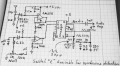
Have built and rebuilt it several times, am I missing something????!!....is there a possibility that the original design is faulty?
Thank you very much in advance for any help.
Upon reading a description of how the original Sinitsa works, I've come up with a new approach. The original Sinitsa used a diode up front to modulate any RF signals, basically gating them on and off. Then, after band-select filtering, an ordinary diode detector produced an audio signal from the now-modulated RF. I had originally thought that harmonics from the edges of the square wave were mixing with the RF signal directly in the first stage. I came up with a somewhat different approach that I think is functionally similar but doesn't require any "handling" of the RF:
In my version, the analog switch toggles between the DC from the detector diode and a reference diode. To the extent that the reference diode tracks the detector diode (mostly thermally) this should produce about the same result as turning the RF on and off to the detector diode. (In other words, when the RF is off, both diodes should produce the same voltage.) I don't "touch" the RF before the detector and I can null out a steady background RF level. The oscillation can be stopped by grounding pin 11 of the CD4053 with a toggle switch and the circuit will then behave like original All Band Receiver. The details of the audio amplifier haven't been worked out but a simple LM386 is probably sufficient. I might use an op-amp stage of some sort as a preamplifier if I want to synchronously detect the signal for driving a meter (using switch "C").
Note the snazzy way I made the CD4053 toggle itself. That might have some interesting applications for lock-in projects. It's basically a DPDT self-toggling switch.
I used the 5082-2835 but any RF Schottky diode should work including the common 1N5711. Here's a fun application: The Bug Duster. The transistor amplifier could be replaced with an LM386. It turns out that not much gain is needed. If you try the LM386, add a switch to disconnect the capacitor between pins 1 and 8 to lower the gain for "bug sweeping." Otherwise it will simply be too sensitive.