Can you amplify a signal with only resistors?

Status
Not open for further replies.

MisterBill2

Joined Jan 23, 2018
28,031
The real problem here is the large number of DIFFERENT uses and meanings attached to a single word. A QUICK FIX IS TO ADD descriptors to the word. So then we have "a MICROPHONE signal amplifier feeding an AUDIO POWER amplifier, delivering power to the speakers load.
 

ElectricSpidey

Joined Dec 2, 2017
3,356
@wayneh
I don't get it, do you think posting an image of energy transmission lines somehow proves something?

Without looking it up...give me the definition of 'power' and its expression, then maybe we can have a debate.
 
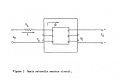
would it be possible to amplify a signal with this resistor circuit?


i put 'signal in/out' because i mean, if any works.

the theory question is basically, this circuit would present a voltage divider, so if a signal comes in at v2/v1, would this voltage result in a change in the voltage at v1/v2 , and in this configuration (or an alternate resistor organization) would it be possible to result in an amplification of the signal?
No the picture that you shared is not of an amplifier. Amplifier needs at least one transistor in the circuit.
 

MisterBill2

Joined Jan 23, 2018
28,031
Really, actually amplifying requires an actual source of additional energy. AND, therfore, an active device, which is often a transistor, but could easily be a tunel diode, and used to be a vacuum tube of some type. BUT, in all cases of amplification, a device controlling the addition of external power.
"Wishing or wanting it to be different does not make it real," no matter what J.M. wants. ( J.M. was a sales person at a company where I was the engineer. )
 

LvW

Joined Jun 13, 2013
2,035
Really, actually amplifying requires an actual source of additional energy. AND, therfore, an active device, which is often a transistor, but could easily be a tunel diode, and used to be a vacuum tube of some type. BUT, in all cases of amplification, a device controlling the addition of external power.
"Wishing or wanting it to be different does not make it real," no matter what J.M. wants. ( J.M. was a sales person at a company where I was the engineer. )
What about the following?
The input voltage Vin is converted to light (LED) which lights up a light sensitive resistor (LDR) which is part of a grounded resistor chain (at least two parts in total) which is connected to a "DC supply voltage".
Is it possible that the voltage across the LDR is larger than Vin?
 

MisterBill2

Joined Jan 23, 2018
28,031
What about the following?
The input voltage Vin is converted to light (LED) which lights up a light sensitive resistor (LDR) which is part of a grounded resistor chain (at least two parts in total) which is connected to a "DC supply voltage".
Is it possible that the voltage across the LDR is larger than Vin?
CERTAINLY the combination of an LED andan LSR constitutes "an active device", although not what I had been considering.
 

ElectricSpidey

Joined Dec 2, 2017
3,356
They're literally called "power lines". Dividing by time to get the rate of energy transfer doesn't change anything.
It does change something because power and energy are two entirely different things.

Energy is the ability to do work, and power is the rate at which work is done by energy.
 

PhilTilson

Joined Nov 29, 2009
155
What about the following?
The input voltage Vin is converted to light (LED) which lights up a light sensitive resistor (LDR) which is part of a grounded resistor chain (at least two parts in total) which is connected to a "DC supply voltage".
Is it possible that the voltage across the LDR is larger than Vin?
That is a very interesting thought! I can't actually see a reason why this should not work, though no doubt someone will come in to puncture my bubble!

And I'm not sure I would agree with Mister Bill that this constitutes an 'active device'. How is such a thing correctly defined? Ah, philosophy... :cool:
 

LvW

Joined Jun 13, 2013
2,035
................
And I'm not sure I would agree with Mister Bill that this constitutes an 'active device'. How is such a thing correctly defined? Ah, philosophy... :cool:
Yes, that is a good question - how to disriminate between passive and active parts.
I think,there is no doubt that a BJT must be considered as "active".
On the other hand - a BJT is not more than a specific combination of two pn junctions.
Hence, why shouldn´t we treat an LED/LDR combination also not as an active device?
 

AnalogKid

Joined Aug 1, 2013
12,238
There needs to be an understanding that "negative resistance", as it has been described here, IS ALWAYS INTENTIONAL. It is not accidental, except in some cases of insulation breakdown.
Maybe not accidental, but certainly *not* intentional.
Another example is the input of a switching regulator with a constant load.
As the regulator input voltage increases, the input current goes down (since the power output and thus the power input stay essentially constant).
As many young power system designers discover (the hard way), switching regulators in series can produce *interesting* effects. Turns out that many control loops are not compensated for a negative-resistance load.

ak
 
Status
Not open for further replies.
Top