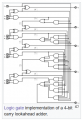
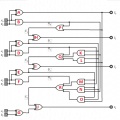
Can't we use this gate to build bigger 4 bit adders by using it as a base for the first 4 bit adder?Yeah, we ******* There are xor gates in there.
Well, now that you've disclosed it publicly you won't be able to get a valid patent in most jurisdictions.Besides, I don't have the money to patent it with the office right now.
There is such thing as an automatic patent.Well, now that you've disclosed it publicly you won't be able to get a valid patent in most jurisdictions.
Not sure if this is aimed at me or not.So you are comparing yours to one that has input and output buffers, when yours doesn’t?
No, at the TS (if it were aimed at you it would quote you or start with @WBahn). The TS says that the example in stackexchange has 6 gate delays, but it has an input non-inverting buffer and and output non-inverting buffer, and his has no buffers.Not sure if this is aimed at me or not.
If you implement this using discrete SSI logic chips, then the prop delay is largely independent of the logic implementation because that is dominated by the I/O circuits. But the notion of commercializing a discrete implementation of a four-bit carry-lookahead adder is pretty preposterous, so the discussion only makes sense in the context of an integrated implementation.
Not without incorporating carry-in and carry-out logic. The carry-out logic will almost double the size of the design.Can't we use this gate to build bigger 4 bit adders by using it as a base for the first 4 bit adder?
Hold on.Okay, I'll admit I don't know how useful my adder is. I just found it in some archive and it seemed really useful maybe. My main project right now is in biological engineering and it's called CVAX/CAX.
My understanding of the term "automatic patent" is merely the use of generative AI to produce patent documents.There is such thing as an automatic patent.
That is the way I read it. Sorry, it doesn’t work that way. You either stole it, or it is in the public domain. In either case, you have no more right to it than anyone else. If it is patented, and you try to sell it, you are committing a crime, or at least a tort.Hold on.
You are claiming to own the intellectual properly rights to a design that you found in some archive????
It's MY ARCHIVE!Hold on.
You are claiming to own the intellectual properly rights to a design that you found in some archive????
Or, I designed it myself at the UC of Santa Barbara on a homework assignment. Which, by the way, is what actually happened.That is the way I read it. Sorry, it doesn’t work that way. You either stole it, or it is in the public domain. In either case, you have no more right to it than anyone else. If it is patented, and you try to sell it, you are committing a crime, or at least a tort.
Okay.. Thanks for the additional info.It's MY ARCHIVE!
Very few (as in, vanishingly few, but not zero) homework assignments are going to yield new things. It's largely baked into the nature of the beast. Good ones lead you to discover and invent things that are new to you, and thus seem revolutionary, but in actuality you have been lead down a path of rediscovering and reinventing things that have been well-known for decades, centuries, or even millennia.Or, I designed it myself at the UC of Santa Barbara on a homework assignment. Which, by the way, is what actually happened.


Hmmm, reminds me of that time I invented bead-sort and it appeared on Wikipedia right after.Very few (as in, vanishingly few, but not zero) homework assignments are going to yield new things. It's largely baked into the nature of the beast. Good ones lead you to discover and invent things that are new to you, and thus seem revolutionary, but in actuality you have been lead down a path of rediscovering and reinventing things that have been well-known for decades, centuries, or even millennia.
If you look at the Wikipedia page on carry-lookahead adders, you'll find the following circuit.
View attachment 354224
Notice that this circuit supports both carry-in and carry-out. Also note that the carry-out logic is nearly half of the gates. If we trim out the carry-in and carry-out logic, we get the following simplified version.
View attachment 354228
I've added letter identifiers to each gate to make it easier to compare it to your schematic.
View attachment 354229
As you can see, your circuit is identical to the stripped down one, except that yours has redundant 3-input XOR gates (which will add a significant number of transistors to the circuit).
This is really something that you should have done, as the person thinking that you might have something with commercial potential.
On a side note, I certainly hope you have learned to produce much cleaner work-product than this represents. Had you turned this in for grading in one of my classes, it would have received little or no credit. It is in your best interest to present your work in a clear and well-organized manner so that your audience wants to engage with it, whether that audience is your supervisor, your customer, or the grader. I always told my graders (when I had them) that they were not to spend any more time and effort trying to decipher someone's sloppy work than that work represented in terms of effort to make it presentable. If the student didn't care enough about getting a good grade to put in the effort to make it easy to follow, then move on to the work of someone that did.
Just in case the TS attempts to edit his post.Okay, I only see and and or gates in my diagram. I just realized that all of you may just be idiots.
In belated answer to your question, I spent most of my career as a full-custom mixed-signal ASIC designer. One of the chips I worked on is currently in orbit about Mars. I also helped develop one of the early low-noise logic libraries for a small company called TSMC so that digital logic on mixed-signal chips didn't inject so much noise into nearby sensitive analog circuits. I've implemented and characterized these libraries on well over a dozen processes from several fabs.What kind of engineer are you? Gate delays for gate delays? You obviously have a different definition of gate than us.
| Thread starter | Similar threads | Forum | Replies | Date |
|---|---|---|---|---|
|
|
adder/subtractor | Homework Help | 6 | |
| U | 8 bit adder | Homework Help | 14 | |
|
|
Issue with 2-Digit BCD Adder-Subtractor Circuit Using 74LS83 | General Electronics Chat | 1 | |
| M | Anyone knows how to automatically generate an n-bit carry lookahead adder in verilog? | Digital Design | 0 | |
|
|
Binary adder that can add up to 30 | Homework Help | 9 |