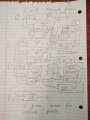
I wonder if I can get any money for this circuit design.
Attachments
-
1.7 MB Views: 71
The straight and simple answer: No.I wonder if I can get any money for this circuit design.
Why do you think that you can get money for it? What is new and useful about it? What is the comparison between it and other four-bit adders that reveals that it brings something worthwhile to the table?I wonder if I can get any money for this circuit design.
Good luck with trying to enforce them. The people using adders have deeper pockets and better lawyers -- fer shure!Mmmmmmh well I do own the intellctual property rights.
You own the intellectual property rights to a lookahead adder?Mmmmmmh well I do own the intellctual property rights.
What kind of engineer are you? Gate delays for gate delays? You obviously have a different definition of gate than us.Why do you think that you can get money for it? What is new and useful about it? What is the comparison between it and other four-bit adders that reveals that it brings something worthwhile to the table?
You claim that it has four gate delays for it's critical path. What is that critical path? If I understand your (very sloppy) logic diagram, your critical path is XOR->AND->OR->XOR. But how many gate delays is each of those gates? Depending on how they are implemented, they each have at least two gate delays (a gate delay is generally the propagation delay for a two-input NAND gate in a given technology, though there is no exact and universally-agreed upon definition).
Just take a look at the adder. It uses or and and gates. It only has basic gate delays. Its critical path is 4 gates, better than the leading competitor we found on StackExchange.Why do you think that you can get money for it? What is new and useful about it? What is the comparison between it and other four-bit adders that reveals that it brings something worthwhile to the table?
You claim that it has four gate delays for it's critical path. What is that critical path? If I understand your (very sloppy) logic diagram, your critical path is XOR->AND->OR->XOR. But how many gate delays is each of those gates? Depending on how they are implemented, they each have at least two gate delays (a gate delay is generally the propagation delay for a two-input NAND gate in a given technology, though there is no exact and universally-agreed upon definition).
I see several XOR gates in there. If you really only have OR and AND gates, then your circuit is not a valid binary adder since you are showing that the lsb of the output is then the OR of the lsbs of the two inputs, which is not correct.Just take a look at the adder. It uses or and and gates. It only has basic gate delays. Its critical path is 4 gates, better than the leading competitor we found on StackExchange.
So, you are basing your claim that your design is so much better based on comparing it to one student's homework problem on Stack Exchange?https://electronics.stackexchange.c...d-gate-delay-for-4-bit-look-ahead-carry-adder
Mine only has 4 gate delay, next leading has 6.
Yeah, we <Mod: deleted obscenity >. There are xor gates in there.I see several XOR gates in there. If you really only have OR and AND gates, then your circuit is not a valid binary adder since you are showing that the lsb of the output is then the OR of the lsbs of the two inputs, which is not correct.
You also seem to think that all gates have equal delay, which they don't. Why do we even bother with "gate delays"? Because it is a simple proxy for signal propagation delay. The only reason we care about propagation delay is because we want our circuits to be fast, which means that we need our gate delay proxy to reasonably relate to the actual propagation delay.
But in most (not all) logic families, and in particular in CMOS logic, which dominates current logic implementations, the AND and OR gates have about twice the propagation delay of the NOT, NAND, and NOR gates, hence they count as two gate delays each.
The XOR gate is a lot more variable because there are several ways to implement it. The direct implementation of the logic function has a propagation delay that is five times that of a NAND gate, Implemented using four NAND gates, it has three gate delays. Implemented directly in transistor-level CMOS, it still has two gate delays.
Your circuit is also not very useful because it is 4-bit only. It doesn't support carry-in or carry-out so that it can be used to create wider adders. There aren't that many applications these days that only need a four-bit adder and few of those really benefit from the speedup of a carry-lookahead approach compared to ripple-carry approach. The ripple-carry penalty becomes pronounced as the adder gets wider.
If you only want to look at propagation delay, then it is pretty trivial to design a 4-bit adder that has approximately the same delay as a single AND or OR gate. But speed isn't everything. You also need to look at size (number of transistors is the crude proxy for that) and power, particularly in today's battery-centric economy.
Usually, those IP rights are self enforced. IP theft can always be prosecuted. Besides, I don't have the money to patent it with the office right now.anything can be commercialized if someone will buy it. the only companies that would use something like this are IC manufacturers. logic ICs families and CPU/MCU are the only products that could use this.
but suppose this is a novel circuit and now that is shared online anyone can see it an try to use it. the question is how do you enforce intellectual rights? how do you find if anyone is using this design in their products? do you plan on buying any new MCU or CPU that enters the market, decap it, use electron microscope to inspect the die? or do you plan to use some backdoor to gain access to microcode? what if the user is some company in China? huge part of IC manufacturing is there and enforcing rights may be difficult. just saying...
It is a 4 bit only adder, but you can run wires from the carry variables to get their values.I see several XOR gates in there. If you really only have OR and AND gates, then your circuit is not a valid binary adder since you are showing that the lsb of the output is then the OR of the lsbs of the two inputs, which is not correct.
You also seem to think that all gates have equal delay, which they don't. Why do we even bother with "gate delays"? Because it is a simple proxy for signal propagation delay. The only reason we care about propagation delay is because we want our circuits to be fast, which means that we need our gate delay proxy to reasonably relate to the actual propagation delay.
But in most (not all) logic families, and in particular in CMOS logic, which dominates current logic implementations, the AND and OR gates have about twice the propagation delay of the NOT, NAND, and NOR gates, hence they count as two gate delays each.
The XOR gate is a lot more variable because there are several ways to implement it. The direct implementation of the logic function has a propagation delay that is five times that of a NAND gate, Implemented using four NAND gates, it has three gate delays. Implemented directly in transistor-level CMOS, it still has two gate delays.
Your circuit is also not very useful because it is 4-bit only. It doesn't support carry-in or carry-out so that it can be used to create wider adders. There aren't that many applications these days that only need a four-bit adder and few of those really benefit from the speedup of a carry-lookahead approach compared to ripple-carry approach. The ripple-carry penalty becomes pronounced as the adder gets wider.
If you only want to look at propagation delay, then it is pretty trivial to design a 4-bit adder that has approximately the same delay as a single AND or OR gate. But speed isn't everything. You also need to look at size (number of transistors is the crude proxy for that) and power, particularly in today's battery-centric economy.
| Thread starter | Similar threads | Forum | Replies | Date |
|---|---|---|---|---|
|
|
adder/subtractor | Homework Help | 6 | |
| U | 8 bit adder | Homework Help | 14 | |
|
|
Issue with 2-Digit BCD Adder-Subtractor Circuit Using 74LS83 | General Electronics Chat | 1 | |
| M | Anyone knows how to automatically generate an n-bit carry lookahead adder in verilog? | Digital Design | 0 | |
|
|
Binary adder that can add up to 30 | Homework Help | 9 |