Facebook
 Google
 GitHub
 Linkedin

Not simple but I hope it does the job.

25m of wiring is looking for trouble. D1 and D2 are input protection diodes to clamp the input voltage to between +V and GND. Any general purpose diode will do, such as 1N914, 1N4148 or 1N4001.
C1 filters out noise and switch bounce.
C2 filters out high frequency noise.
R1 is the current limiting resistor to the reed switch. A lower resistance would be preferred but then current consumption increases. With a 9V battery, 100kΩ will draw 90μA.
When the gate is opened, S1 sends a low-to-high signal. U1A inverts the signal producing a high-to-low transition.
R2 and C3 is a simple differentiator. It takes the signal from the reed switch to produce a pulse only when the gate opens. The input to U1B is simply a short high-to-low pulse about 1ms wide which is used to trigger the 555 monostable.
U1B and U1C are not required but since we have them we may as well use them. They are used to buffer the signal before applying to pin-2 of the 555 timer.
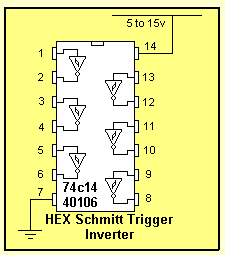
All unused inputs of the hex inverting Schmitt trigger are connected to GND to prevent excessive current draw caused by floating inputs. Leave the output pins unconnected. Any CMOS inverter will work. The Schmitt trigger feature helps to clean up the transitions.
Your NE555 timer chip is not CMOS. You can try whatever you have at hand. However, if they are not CMOS you can expect the current draw to be higher than what is desirable.
25m of wiring is looking for trouble. D1 and D2 are input protection diodes to clamp the input voltage to between +V and GND. Any general purpose diode will do, such as 1N914, 1N4148 or 1N4001.
C1 filters out noise and switch bounce.
C2 filters out high frequency noise.
R1 is the current limiting resistor to the reed switch. A lower resistance would be preferred but then current consumption increases. With a 9V battery, 100kΩ will draw 90μA.
When the gate is opened, S1 sends a low-to-high signal. U1A inverts the signal producing a high-to-low transition.
R2 and C3 is a simple differentiator. It takes the signal from the reed switch to produce a pulse only when the gate opens. The input to U1B is simply a short high-to-low pulse about 1ms wide which is used to trigger the 555 monostable.
U1B and U1C are not required but since we have them we may as well use them. They are used to buffer the signal before applying to pin-2 of the 555 timer.
All unused inputs of the hex inverting Schmitt trigger are connected to GND to prevent excessive current draw caused by floating inputs. Leave the output pins unconnected. Any CMOS inverter will work. The Schmitt trigger feature helps to clean up the transitions.
Your NE555 timer chip is not CMOS. You can try whatever you have at hand. However, if they are not CMOS you can expect the current draw to be higher than what is desirable.
Last edited: