Buzzer vodoo

MrChips

Joined Oct 2, 2009
34,810
Not simple but I hope it does the job.


25m of wiring is looking for trouble. D1 and D2 are input protection diodes to clamp the input voltage to between +V and GND. Any general purpose diode will do, such as 1N914, 1N4148 or 1N4001.

C1 filters out noise and switch bounce.
C2 filters out high frequency noise.
R1 is the current limiting resistor to the reed switch. A lower resistance would be preferred but then current consumption increases. With a 9V battery, 100kΩ will draw 90μA.

When the gate is opened, S1 sends a low-to-high signal. U1A inverts the signal producing a high-to-low transition.

R2 and C3 is a simple differentiator. It takes the signal from the reed switch to produce a pulse only when the gate opens. The input to U1B is simply a short high-to-low pulse about 1ms wide which is used to trigger the 555 monostable.

U1B and U1C are not required but since we have them we may as well use them. They are used to buffer the signal before applying to pin-2 of the 555 timer.

All unused inputs of the hex inverting Schmitt trigger are connected to GND to prevent excessive current draw caused by floating inputs. Leave the output pins unconnected. Any CMOS inverter will work. The Schmitt trigger feature helps to clean up the transitions.

Your NE555 timer chip is not CMOS. You can try whatever you have at hand. However, if they are not CMOS you can expect the current draw to be higher than what is desirable.
 
Last edited:

Thread Starter

Chillum

Joined Nov 13, 2014
546
@MrChips : LMC555 or TLC555. which one's the best I can get both (and they're very closely priced), and what would their dual timer product number be?
My buzzer8.3.pdf, how long should the battery last (175mAh 9v pp3): switch open and switch closed (as norm --- the specs says normally closed, but I'm not quite sure that it operates correctly)?
I appreciate the time you took to build that circuit, and I WILL build it eventually, but my transport is always a problem, so I don't know when I'll be able to get the parts for you're pretty cool, what is it, filter?
And if I can build it without 555, how would that look, might I remind you I'm self-'being tought"-noob
 

MrChips

Joined Oct 2, 2009
34,810
LMC555 is made by National Semiconductor while TLC555 is from Texas Instruments. As of September 2011, they are one company (TI).
The two chips are practically the same and either one would work. The dual version is LMC556 or TLC556.

A 450mAh 9V battery supplying 5mA (LM555) will last 450/5 = 90 hours. = 4 days approx.
while supplying 0.3mA (LMC555) will last 450/0.3 = 1500 hours = 2 months

If the battery is a 175mAh rechargeable, you're looking at 1.5 days and 24 days for the two scenarios as above.

As for a single hex inverter solution I will get back to you later after I get a chance to breadboard the circuit. This will use a piezo transducer and not a buzzer. How loud do you need the alarm to be?
 

Thread Starter

Chillum

Joined Nov 13, 2014
546
As an after thought, with the remaining three inverters in the one package, we can build a monostable and an oscillator and do away with the 555 altogether.
LMC555 is made by National Semiconductor while TLC555 is from Texas Instruments. As of September 2011, they are one company (TI).
The two chips are practically the same and either one would work. The dual version is LMC556 or TLC556.

A 450mAh 9V battery supplying 5mA (LM555) will last 450/5 = 90 hours. = 4 days approx.
while supplying 0.3mA (LMC555) will last 450/0.3 = 1500 hours = 2 months

If the battery is a 175mAh rechargeable, you're looking at 1.5 days and 24 days for the two scenarios as above.

As for a single hex inverter solution I will get back to you later after I get a chance to breadboard the circuit. This will use a piezo transducer and not a buzzer. How loud do you need the alarm to be?
what'sthe difference between piezo transducer and piezo buzzer, Loud, with 12vdc 101db at 1m, So I'm forced to use LMC555, I'll see when I can get a lift
 

Thread Starter

Chillum

Joined Nov 13, 2014
546
LMC555 is made by National Semiconductor while TLC555 is from Texas Instruments. As of September 2011, they are one company (TI).
The two chips are practically the same and either one would work. The dual version is LMC556 or TLC556.

A 450mAh 9V battery supplying 5mA (LM555) will last 450/5 = 90 hours. = 4 days approx.
while supplying 0.3mA (LMC555) will last 450/0.3 = 1500 hours = 2 months

If the battery is a 175mAh rechargeable, you're looking at 1.5 days and 24 days for the two scenarios as above.

As for a single hex inverter solution I will get back to you later after I get a chance to breadboard the circuit. This will use a piezo transducer and not a buzzer. How loud do you need the alarm to be?
Is these calculations with switch open or closed?
 

MrChips

Joined Oct 2, 2009
34,810
A buzzer emits a sound when DC voltage is applied. A transducer requires an oscillating signal to produce the sound.
The buzzer has a built-in oscillator.
 

MrChips

Joined Oct 2, 2009
34,810
The alarm circuit shown below is designed for lowest power consumption. The current drawn is almost entirely dependent on the current through the reed switch. This is determined by the value of R1.

With the gate open, the circuit takes 1μA from a 9V battery.
With the gate closed (reed switch closed), the current draw is 10μA when R1 = 1MΩ.


R1 sets the current through the reed switch when the switch is closed.
C1 filters out noise.
U1A and U1B buffers the signal and drives C2.
In the idle state, Q1 is off and C3 is charged to 9V through R3.
When the gate is opened, S1 opens sending a high pulse to the base of Q1. Q1 conducts and discharges C3.
The output of U1C goes high turning on Q2 and enabling the piezo buzzer BZ1.

Meanwhile, C3 charges through R3. When the voltage across C3 reaches V1/2 = 4.5V the buzzer turns off.
The length of time the buzzer is on depends on R3 and C3, now set for about 5 seconds. Change the value of C3 for desired time.

With a 450mAh 9V battery, run time is 450/0.01 = 45000 hours = 5 years.
 

Thread Starter

Chillum

Joined Nov 13, 2014
546
The alarm circuit shown below is designed for lowest power consumption. The current drawn is almost entirely dependent on the current through the reed switch. This is determined by the value of R1.

With the gate open, the circuit takes 1μA from a 9V battery.
With the gate closed (reed switch closed), the current draw is 10μA when R1 = 1MΩ.
With gate open reed switch closes and with gate close reed switch opens, atleast that's the specs on this little unit of mine...
http://www.fort777.co.za/index.php?...o&cPath=737_774_776_775_1160&products_id=4232

That'll alter the circuitry a bit wouldn't it?
No timer necessary?
 
Last edited:

MrChips

Joined Oct 2, 2009
34,810
Not a problem. You can wire the circuit for either case:


I have shown it as a switch selection S2. Just use a 2 x 2 pin header with a jumper to select open or close situation.
This also allows you to select alarm on gate open or gate close.

If you want alarm on both gate open and close I can add that as well. It will cost you a little extra.
 

Thread Starter

Chillum

Joined Nov 13, 2014
546
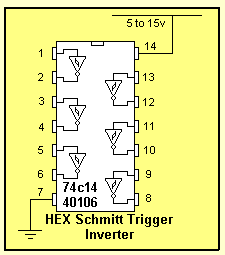
OK, any chance of gettting a circuit diagram that shows the pin out of the schmitt ic? I'm definitely building this, just a small matter of transportation to the suppliers (and of course designing my veroboard (strip board)). The suppliers only have the MC14584...
 

Thread Starter

Chillum

Joined Nov 13, 2014
546
LMC555 is made by National Semiconductor while TLC555 is from Texas Instruments. As of September 2011, they are one company (TI).
The two chips are practically the same and either one would work. The dual version is LMC556 or TLC556.

A 450mAh 9V battery supplying 5mA (LM555) will last 450/5 = 90 hours. = 4 days approx.
while supplying 0.3mA (LMC555) will last 450/0.3 = 1500 hours = 2 months

If the battery is a 175mAh rechargeable, you're looking at 1.5 days and 24 days for the two scenarios as above.

As for a single hex inverter solution I will get back to you later after I get a chance to breadboard the circuit. This will use a piezo transducer and not a buzzer. How loud do you need the alarm to be?
would the configuration of switch open when gate closed and closed when gate open alter these calculations any?
 

MrChips

Joined Oct 2, 2009
34,810
Here is revision #4:


This circuit will alarm on either gate open and gate closed. So it doesn't matter what type of switch you have.

You don't need switch S2 in the previous circuit. Simply hard wire the feature as needed.

In this latest circuit #4, install or remove D3 and/or D4 depending on which function you need, i.e. gate open/close or both.

D3, D4 and R4 function as a logic OR gate, i.e. it selects open or close signal from inverters U1D and U1E.
 
Last edited:

Thread Starter

Chillum

Joined Nov 13, 2014
546
Here is revision #4:


This circuit will alarm on either gate open and gate closed. So it doesn't matter what type of switch you have.

You don't need switch S2 in the previous circuit. Simply hard wire the feature you as needed.

In this latest circuit #4, install or remove D3 and/or D4 depending on which function you need, i.e. gate open/close or both.

D3, D4 and R4 function as a logic OR gate, i.e. it selects open or close signal from inverters U1D and U1E.
I can't thank you enough, I'll have to buy you a beer when I see you! The resistors, 0.25W would be overkill? This circuit was designed for low current, way lower than 1/4W... just checking the obvious ;-)
 

Thread Starter

Chillum

Joined Nov 13, 2014
546
Yes ¼W would be fine.
Everyone should be stocking ¼W resistors for general purpose use.
I do stock 1/4 wat resistors, bought starter pack with 68 different values, 10 each
Please answer the battery question about open switch where you had it closed
 

MrChips

Joined Oct 2, 2009
34,810
If the switch is open the circuit draws about 1μA.
When the switch is open, most of the current comes from resistor R1 which will draw about 9μA.
At those levels you don't have to worry about battery life. That is why I designed it that way.
 
Top