Buzzer vodoo

Reloadron

Joined Jan 15, 2015
7,889
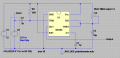
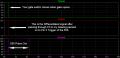
Here is what I was getting at:

555 Retrig 1.png

555 Retrig 2.png

In my drawing V2 is used to simulate your switch closing. The signal to your circuit goes low to ground when the gate opens. The problem is you don't want the constant low so we differentiate the low and just get a fast low spike to trigger the 555. The 555 generates an output pulse (One Shot) to turn on your buzzer for the duration set by the 555 R*C timing network. When your gate closes nothing happens and the circuit waits till the next gate open.

Ron
 

Thread Starter

Chillum

Joined Nov 13, 2014
546
Here is what I was getting at:

View attachment 79929

View attachment 79930

In my drawing V2 is used to simulate your switch closing. The signal to your circuit goes low to ground when the gate opens. The problem is you don't want the constant low so we differentiate the low and just get a fast low spike to trigger the 555. The 555 generates an output pulse (One Shot) to turn on your buzzer for the duration set by the 555 R*C timing network. When your gate closes nothing happens and the circuit waits till the next gate open.

Ron
Reloadron, It's exactly the same circuit as mine, the only difference is you use a ceramic for single shot and I use a electrolytic, I had to rebuild your circuit in TinyCAD, because it plays well with the next step: vero (strip) board layout. (VeeCAD), look at the difference, if I wired your diagram correctly, it seems to be exactly the same to me. My implementation however got post 15'd, thats buzzer 8.2.pdf

(your circuit is buzzer9.pdf, and my original circuit is buzzer8.pdf, and the changes made to the actual veroboard after post 15 is buzzer8.2.pdf)

Oh, and its not the power supply, its still spurious with a 9v battery
 

Attachments

Last edited:

Thread Starter

Chillum

Joined Nov 13, 2014
546
BTW, reed switches are quite sensitive to vibration. If your gate is not firmly anchored and the wind (or some other influence) makes it vibrate, then it might trigger false positives. You could replace the reed switch with a hall sensor and that would pretty much solve things, if that's what's happening.
Hall sensors produce voltage when gate is closed (with magnetic effect present)? How can I incorporate it so that it makes it go on with an open of the gate, ie removing the magnetic field
 

Reloadron

Joined Jan 15, 2015
7,889
A Hall Effect sensor is an option, they come in several "flavors" and I believe what you would want is latching rather than just an analog out based on field strength. Just wondering how long is the current wire run between the reed switch and your control circuit? Are you using shielded wire for the run? Your reed switch is normally open (as wired) correct and when the gate opens it closes? There is no reason for this not to work. The only reason I posted the drawing was to show the waveforms the 555 is seeing.

Ron
 

Thread Starter

Chillum

Joined Nov 13, 2014
546
A Hall Effect sensor is an option, they come in several "flavors" and I believe what you would want is latching rather than just an analog out based on field strength. Just wondering how long is the current wire run between the reed switch and your control circuit? Are you using shielded wire for the run? Your reed switch is normally open (as wired) correct and when the gate opens it closes? There is no reason for this not to work. The only reason I posted the drawing was to show the waveforms the 555 is seeing.

Ron
The wires are normal equipment wire (jumper wires) and its probably about 20-25 meters maybe even longer, can't remember from when we measured it...
 

cmartinez

Joined Jan 17, 2007
8,761
The wires are normal equipment wire (jumper wires) and its probably about 20-25 meters maybe even longer, can't remember from when we measured it...
Well that explains A LOT... Wires that long act like antennas and always pick up EMI... so you have two choices here.
Make the wires much shorter (say 1 m at most) or use a twisted-pair shielded cable. Personally, I'd use the former, placing the circuit close to the switch, and use long wires for the speaker. Shielded cable is no guarantee of perfect functionality.
 
Last edited:

Thread Starter

Chillum

Joined Nov 13, 2014
546
now, we've identified the voodoo, EMI

I have like a small lunch box I put the veroboard in, there's still space for a 9v, and it seals, don't imagine you can submerge it in water, but it should resist rain...

wouldn't be too difficult to re wire it
 

Thread Starter

Chillum

Joined Nov 13, 2014
546
Pretty long run for unshielded wire. However, this also fails to work correctly on the bench correct?

Ron
oops, yup... but haven't really tested it with post 15's change

edit: installed the breadboard outside where the production box used to get power from a 12V switching PSU, using the same PSU as the production box, cause I just finished installing the 9v clip, removing the 12v socket, damn, now I'm prolly going to have to redo the socket, that is IF the breadboard fails and we're back to voodoo hunting again...
 
Last edited:

Reloadron

Joined Jan 15, 2015
7,889
oops, yup... but haven't really tested it with post 15's change

edit: installed the breadboard outside where the production box used to get power from a 12V switching PSU, using the same PSU as the production box, cause I just finished installing the 9v clip, removing the 12v socket, damn, now I'm prolly going to have to redo the socket, that is IF the breadboard fails and we're back to voodoo hunting again...
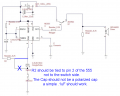
Looking back to post #15:

555 One Shot 3.png
I believe R2 should be tied to pin 2 of the 555. Also the cap just needs to be a .1uF and not a polarized cap as drawn. All you want on the trigger input is a differentiated spike, it should look like the signal I show in post #61 I believe. Additionally looking at my drawing in post #61 it would be a good idea to add a diode across R2 with the Anode side on Vcc. Any generic diode like a 1N4002 would work.The idea is to snub the positive spikes, The diode is shown in one of the earlier posted drawings.

Ron

Ron
 

cmartinez

Joined Jan 17, 2007
8,761
Looking back to post #15:

View attachment 79974
I believe R2 should be tied to pin 2 of the 555. Also the cap just needs to be a .1uF and not a polarized cap as drawn. All you want on the trigger input is a differentiated spike, it should look like the signal I show in post #61 I believe. Additionally looking at my drawing in post #61 it would be a good idea to add a diode across R2 with the Anode side on Vcc. Any generic diode like a 1N4002 would work.The idea is to snub the positive spikes, The diode is shown in one of the earlier posted drawings.

Ron

Ron
You're right about the cap being a non-polarized 0.1µF as being the right component. Not sure about the way you're suggesting R2 should be connected though, that's the way it was initially placed and it wasn't working... though it wouldn't hurt to try again, especially when adding a snub diode, which is an excellent idea.
 

Thread Starter

Chillum

Joined Nov 13, 2014
546
You're right about the cap being a non-polarized 0.1µF as being the right component. Not sure about the way you're suggesting R2 should be connected though, that's the way it was initially placed and it wasn't working... though it wouldn't hurt to try again, especially when adding a snub diode, which is an excellent idea.
Well guys, it's plugged in and under observation, nothing yet!
 

Reloadron

Joined Jan 15, 2015
7,889
You know what... if this works out I'm blaming the freaking polarized cap...
Well, you can't use a polarized cap in a circuit where the cap will see changing polarity. I think that is in a rule book somewhere. As to the Differentiation thing? This is a good read on the subject and how we want and get that negative spike and why we use the R and C component values we do. Let's just hope the thing works which it should. Well, it looks good on paper anyway. :)

Ron
 

cmartinez

Joined Jan 17, 2007
8,761
Well, you can't use a polarized cap in a circuit where the cap will see changing polarity. I think that is in a rule book somewhere. As to the Differentiation thing? This is a good read on the subject and how we want and get that negative spike and why we use the R and C component values we do. Let's just hope the thing works which it should. Well, it looks good on paper anyway. :)

Ron
I once connected an electrolytic in the wrong polarity, and it gave me horrible headaches until I realized my mistake. So yes, I can see why a polarized capacitor would be wrong for this application. On the other hand... electrolytics are bad for suppressing very quick transients, for that, small ceramic ones should be used... so maybe that's another reason for the circuit's behavior.
 
Top