Burning up a resistor

vanderghast

Joined Jun 14, 2018
70
It is ON because when I replace a resistor with leads to a mmeter I get all 9.34V across the headers where the R goes.
View attachment 166887
That is not a proof that the transistor is ON. What is the voltage drop between the Drain and the Source pins of the transistor, when you use the 1 Ohm resistance plugged into the circuit? If the transistor is ON, that voltage drop should be low. If the voltage drop is moderately low (or too high so not enough voltage is left through the 1 Ohm resistor), it may be that the polarity is reversed and the transistor somehow allow a current through the "built-in" Zener diode, but not enough.

It may be something else, but anyhow, for a MOSFET to be (fully) turned on it is NECESSARY that the voltage drop across the D and S pins is almost zero. (Not sufficient, but necessary.)
 

Thread Starter

quique123

Joined May 15, 2015
405
OK all of a sudden now I'm not even getting 9V across the leads on the meter.

I tried continuity and everything checks out. I tried 2 other fqp fets and they all behave the same.

There are many things I could try but I don't want to just try everything. So from the recent post by vanderghast I should measure the V between D and S to be zero when 5v are applied?
 

vanderghast

Joined Jun 14, 2018
70
So from the recent post by vanderghast I should measure the V between D and S to be zero when 5v are applied?
If the circuit loop is completed, you should get something close to zero. If the transistor is not totally open, its own resistance can be a couple of Ohms or more. Assume it is a two Ohm, then the total resistance would be 3 Ohms ( 1 for the resistor, and the hypothetical 2 for Rds ). That is letting one third of the voltage across the resistor of 1 Ohm and two-third across the transistor's pins D and S, in such a case. If even less open, its RDS can be, say, 100 Ohm (instead of 2), so the total is now 101 Ohm, and you would see only 1/101 of the voltage across the 1 Ohm resistor!

You can have MOSFET with very low resistance RDS(ON) though ( 0.1 Ohm, or less ), and it that case, you can get 10/11 of the voltage ( around the close loop) across the resistor of 1 Ohm ( that is, 1 Ohm / (1Ohm + 0.1 Ohm) = 10/11 ) and leaving only 1/11 of the voltage across the D and S pins of such a fully open MOSFET (with that very low RDS(on) or 0.1 Ohm ). It is not absolutely ZERO, but it should be CLOSE to.
 
If the intent is to make a resistor burn, do your Math AND Chemistry. You want the lowest wattage available with the smallest amount of ohms. You also want a resistor made of Carbon (Chemistry).

Remember the formula P =V²/R.
If you have a 9 volt battery and a 1 Ω Resistor, P= 9*9/1 = 81 watts. For a ¼ Watt Resistor, this is Overkill by a factor of 324 .
 

Thread Starter

quique123

Joined May 15, 2015
405
Ok so far I can ensure the following:

1. At some point this very same setup on this protoboard worked with a 9V battery and an fqp fet. I have video proof of it but I cant find it (although the video will most likely not show the fet I was using). It may have also been an IRF510, IRL540 or IRL8721 since those are the only 4 kinds of fets I have ever owned.

2. I just tried an IRF510, IRL540 & IRL8721 and I got the same result, when sending D5-FetGate HIGH, voltage slightly varied. With FQP the change is from 0.7 to 1.2V and with IRF510 and others it went from 0.8 to 1.8 and even 2.1V at one time.

3. Last night I did get the 9V across the leads on the multimeter WITH the FQP, but for some reason its not working anymore. I believe this happened to me once before a few months back, I mean that it worked, stopped working for a while as I researched the issue and a few weeks later after I got back to the project it all of a sudden worked. This leads me to believe the fets may work at a threshold and somehow they get 'charged' or otherwise modified which makes them 'not work' until some time later for some reason.

4. I tried the voltage difference (FQP) between D and S with the 1 ohm R in place and it does indeed go from about 3V to 0V.
 

vanderghast

Joined Jun 14, 2018
70
Ok so far I can ensure the following:

1. At some point this very same setup on this protoboard worked with a 9V battery and an fqp fet. I have video proof of it but I cant find it (although the video will most likely not show the fet I was using). It may have also been an IRF510, IRL540 or IRL8721 since those are the only 4 kinds of fets I have ever owned..
Have you check the Arduino pin to see if it is still able to supply enough volt and current? Does it perform as it should to light up a red LED with a 220 Ohm resistor (can check the voltage across the 220 Ohm resistor to check the current) ? It is possible that some manipulation fried part of the Arduino at some point in time, after all.
 

Thread Starter

quique123

Joined May 15, 2015
405
OK I just swapped the nano power source from a usb port to a phone charger battery pack and it worked with the fqp.I'm only getting 8.5V or so but I know the battery pack is not fully charged so it might be a current issue or voltage, I didn't check to see if the pin is now properly at 5v.

Im surprised the laptop's usb port doesn't supply as much power as a phone charger although I guess it makes sense.
 

vanderghast

Joined Jun 14, 2018
70
The voltage it puts out is 4.82V at D5.
I would stay away of the IRF510: Its Vgs can be as high as 4.0V, at 25 C. And Vgs is not the voltage at the gate (with respect to the source) to fully turn on the transistor, but the voltage required to allow Ids (current through the canal drain-source) of at least 250 microamp. To that, adding temperature, possible low voltage from the Arduino, and other effects, the IRF510 may be just too 'limit" to be reliable. (Ref for Vgs.: Vishay's IRF510 datasheet)
 

vanderghast

Joined Jun 14, 2018
70
You are absolutely sure this breadboard is known good and reliable? All good solid connections right?

Ron
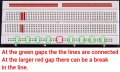
Good point. Some breadboard have DISCONTINUOUS power rails (the red and blue tracks on the side) so while we may think that we have, say, 9.0V all along, we only have 9.0V on the first "columns", and nothing on the last ones. Silly possible bugs when it happens to you for the first time, but then, you remember to check it when something weird happens.
 

Norfindel

Joined Mar 6, 2008
326
With the IRL540 and a Vgs of 5v, you should get a Rds of only 0.077 ohm and about 8.36v over the 1 ohm resistor: https://www.vishay.com/docs/91300/91300.pdf
Then, the current thru the resistor would be 8.36 A (if the batter could supply it, and most certainly it won't), with a theoretical power of 70 watts.
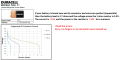
It seems like a 9v alkaline battery has 1 to 2 ohms resistance (when NEW), so that the current at most will be 4.5A, and maybe 3A, but likely not for very long, as the battery will heat internally at the same rate or faster than the resistance, and that will likely have some nasty effect: http://www.learningaboutelectronics.com/Articles/Battery-internal-resistance
Probably not the best battery for the job, judging by the use cases here: http://data.energizer.com/pdfs/522.pdf
No way to know what's the effect of practically shorting them with a 1 ohm resistor. They could show any kind of failures.
 

Thread Starter

quique123

Joined May 15, 2015
405
OK wait just to clear things up;

The 9v is the one used for the mosfet-switched-resistor-'burning' bit.

The one I switched was the USB-port-powered nano to a mobile charger battery pack. This takes the nano's d5 pin voltage from 4.82v to 4.91v when active.

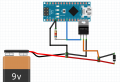
Im moving the project back to a breadboard and I want to double check the connections:Screen Shot 2019-01-05 at 3.16.49 PM.png
 

Norfindel

Joined Mar 6, 2008
326
Just make this simple check: remove the battery. Now, put the 1 ohm resistor across the battery. Does it burn?
I don't get what are those black rectangles on the drawing.
You say you used a "mobile charger battery pack", you mean a cellphone battery? That's should be a li-ion cell with around 4v fully charged voltage, and very low internal resistance, and it should have no problem supplying the current to burn the resistor.
Whatever battery you use, just remember to begin with the easiest test first: just connect the resistor to the battery directly, to see if it burns. If it does, then you can add complexity afterwards.
 

Thread Starter

quique123

Joined May 15, 2015
405
The black rectangles are header pins. One where the 9v battery connects and the other where I put in the 1 ohm resistor or the multimeter leads.

I know they burn because I've done it before.
 

Thread Starter

quique123

Joined May 15, 2015
405
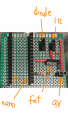
On I just tried the breadboard setup and our works flawlessly. So I've decided to rebuild my through hole board by un soldering and resoldering in the following order :

1. Diode (and give it header pins)
2. Header pins for mosfet, 9v and 1 ohm resistor
3. 6.2kR (and give it header pins)
4. The nano if necessary & connecting wires

EF04FF81-8DEE-4DA6-AF10-32E8BC0CF8B6.png
 

Audioguru

Joined Dec 20, 2007
11,248
Are you still using a Mosfet that needs 10V on its gate to properly turn on? What is its part number?
What is the part number of the diode?

Why do you have a diode? In case the battery is connected backwards? It won't fit backwards.

Each time the battery burns a resistor then a lot of its strength will be gone because it is too small.
 
Top