And when I first joined the NRA ~1966, this was one of their primary missions, teaching gun safety. Their magazine (American Rifleman) had stories every month on gun safety. But since la Pierre's coup of the NRA, the NRA focuses on tactical shooting, government lobbying, etc. Not so much a
And when I first joined the NRA ~1966, this was one of their primary missions, teaching gun safety. Their magazine (American Rifleman) had stories every month on gun safety. But since la Pierre's coup of the NRA, the NRA focuses on tactical shooting, government lobbying, etc. Not so much a
"
“Bullet buttons” are devices that allow gun owners to remove empty magazines from their AR-15 rifles so a fully loaded magazine can be put in their place. AR-15s are typically made with a magazine release that makes switching out magazines a breeze, but Democrat lawmakers in California passed legislation barring such releases. That prohibition, in turn, gave rise to the invention of the “bullet button” as a way to continue using AR-15s with detachable mags.
On July 1, Governor Jerry Brown signed a ban on “bullet buttons.” That ban, effective January 1, 2017, will make the AR-15 a fixed-magazine rifle until someone figures out a new way to outsmart the Democrats who work so hard to legislate law-abiding citizens into a gun-free existence. (At least one company is trying.)
For now, California’s gun owners are trying to get in front of the implementation of the new controls by racing to their favorite stores to buy up every AR-15 with a “bullet button.” Sacramento’s Last Stand Readiness & Tactical has seen a deluge of customers wanting the rifles. Operations manager Christopher Lapinski told Fox News, “The whole anti-gun movement, taking guns from citizens, literally has everyone and their grandmother buying firearms before they can’t get them anymore because they want to be able to be protected.
It's the firing pin that gets damaged. With a bullet in the chamber, the soft metal of the primer cushions the blow of the firing pin. Without a round in the chamber, the hardened metal on hardened metal contact can cause the pin to shatter or break. It's never a good idea to dry fire any weapon because the firing pin can peen the surface over time where the pin goes into the chamber and damage it. Even the newer titanium pins can damage the firing pin tunnel.
It's the firing pin that gets damaged. With a bullet in the chamber, the soft metal of the primer cushions the blow of the firing pin. Without a round in the chamber, the hardened metal on hardened metal contact can cause the pin to shatter or break. It's never a good idea to dry fire any weapon because the firing pin can peen the surface over time where the pin goes into the chamber and damage it. Even the newer titanium pins can damage the firing pin tunnel.
It's never a good idea to carry a weapon of which one does not possess intimate knowledge of its trigger action.
90% of shooting well comes from developing "muscle" memory, i.e. being able to draw, aim, and shoot without thinking. The last part -- pulling the trigger through the break without moving the muzzle off target -- is the hardest. You only gain proficiency through many repetitions of actually pulling the trigger. I can't afford so much ammo, so I carry a gun I can dry-fire. Which I do. Often.
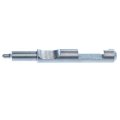
Here's a pic of a Beretta 92 firing pin. Without a round in the chamber, the large part just above the actual primer striking part will slam into the slide. The primer acts as a deceleration cushion.
It's never a good idea to carry a weapon of which one does not possess intimate knowledge of its trigger action.
90% of shooting well comes from developing "muscle" memory, i.e. being able to draw, aim, and shoot without thinking. The last part -- pulling the trigger through the break without moving the muzzle off target -- is the hardest. You only gain proficiency through many repetitions of actually pulling the trigger. I can't afford so much ammo, so I carry a gun I can dry-fire. Which I do. Often.
Don't know how I missed this when first posted. Reread my original post. I said the American Rifleman magazine, NOT the NRA website. When was the last article in the magazine? It's been quite a few years.
From the Glock website. "Can I dry fire my Glock pistol?
It is ok to dry fire your Glock pistol, but in situations where the pistol will be subjected to continuous sessions of dry firing, the use of a snap cap or dummy round is recommended." https://us.glock.com/customer-service/faq
Don't know how I missed this when first posted. Reread my original post. I said the American Rifleman magazine, NOT the NRA website. When was the last article in the magazine? It's been quite a few years.
I am not much of gun person. Could be that I actually never got to touch one.
But I did enjoy the " KILL A VOLT" part.
Too bad killivolt did not enjoyed that.
I am not much of gun person. Could be that I actually never got to touch one.
But I did enjoy the " KILL A VOLT" part.
Too bad killivolt did not enjoyed that.
If you're ever in town, let me know. I'll take you to the range.
I'll start you off with an 8 shot 22lr revolver. Less kick than a bb gun.
Then we'll move to the 9mm Glock. Comfortable to shoot.
Next, a few rounds on the 44 magnum snub nose. It'll rattle your metacarpals a bit.
Finally, we'll end with the 12 gauge shotgun with 00 buckshot. It'll break your shoulder if you're not careful.

 Facebook
 Google
 GitHub
 Linkedin