Building a off road mobility chair!

Thread Starter

monkeymagic75

Joined Mar 25, 2025
8
Hi,
I'm thinking about building a new off road mobility chair but I can't find any component lists or wiring diagrams that are helpful.
This is what I hope to emulate.
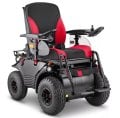
Screenshot_20250325_173313_eBay.jpgI've nearly built my CNC mill/router so that I can produce aluminium parts etc. But the electronics needed, allude me thus far.

Any help would be most welcome. @Irving maybe?

i currently have this that i use and can maybe rip parts from.
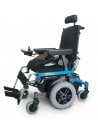
Atigra-Powerchair.jpgI have already adapted this one by welding a flip up footplate and swaping the seat for a fold down one from a pride gogo. All so I can fit it in the car with my hoist.
I'm somewhat ambulatory but not much. I'm just sick of not being able to get to areas that i could with the one above. Price of it is not in Range for me but building it at lower cost is maybe.
also, is the speed limiter inside the joystick on these?
What say you good people?
Thanks,
Darren.
 

MrChips

Joined Oct 2, 2009
34,626
Welcome to AAC!

May I suggest a different approach.

Firstly, search what is already available on the commercial market. Look for a model and pricing to see what features you would desire. This will give you an idea of the design should you decide to DIY your own.

Next, now that you have an idea of the cost, I would suggest that you investigate various means of funding this. Depending on where you are, there are institutions, councils, charities, government grants, etc. which you might be able to tap into. Also, you might want to investigate a GoFundMe campaign to raise funds for this.

Good luck on this.
 

Irving

Joined Jan 30, 2016
4,995
You called?

90% of powered mobility vehicles have proprietary semi-open controllers, most commonly VR2 and R-Net, both now from Curtiss-Wright. Both use a form of CANBus to communicate between modules, typically the joystick/screen, the motor controller/battery manager, lighting and auxiliary (eg seat, leg actuators) modules. Semi-open because you can build and integrate your own devices into them if you pay for the developer kits (£££) though some aspects have been reverse engineered. Even if you re-purpose an existing controller setup you will need the programmer dongle to adjust parameters such as speed limits, current limits, interlocks, etc. R-Net for example, maintains the current config in the joystick module, but dowloads it to the motor controller on power up. Standard messages on the bus broadcast info like battery volts, brake status, motor rpm, wheel speed, etc. as well as control commands like required motor state (speed/direction), lighting, etc.

The alternative is to roll your own using off-the-shelf DC motor controllers (one each side and/or wheel), something programmable to convert joystick position into left and right forward/backward speed plus brake control and so on (so called tank steering). Safety is paramount - both for yourself and for those around you. Modern wheelchair controllers have a number of interlocks to protect from errant operation, and failsafe hardware to prevent, for example, a faulty controller running a motor at full speed should something fail short circuit.

An offroad chariot is something I've considered my self as well, ignoring the difficulty of transporting both and transferring between them (and the impracticable nature of a fully offroad device indoors). Standard motor controllers are not truely waterproof and normal wheelchair motors are not suited to heavy loads such as wading through mud or sand, nor climbing any serious gradient, they just overheat. Battery capacity is another issue - a typical wheelchair setup will struggle to give more than a couple of miles over rough/hilly terrain. Current commercial offerings are, IMHO, massively expensive yet rather limited in what they actually offer (despite the marketing hype) especially if you need specialist seating as I do. A lightweight frame with lots of ground clearance, large diameter wheels with high-torque bldc hub motors, LIFEPO4 batteries, and so on is the way I would go.
 

Thread Starter

monkeymagic75

Joined Mar 25, 2025
8
Welcome to AAC!

May I suggest a different approach.

Firstly, search what is already available on the commercial market. Look for a model and pricing to see what features you would desire. This will give you an idea of the design should you decide to DIY your own.

Next, now that you have an idea of the cost, I would suggest that you investigate various means of funding this. Depending on where you are, there are institutions, councils, charities, government grants, etc. which you might be able to tap into. Also, you might want to investigate a GoFundMe campaign to raise funds for this.

Good luck on this.
Hi,
Thank you for your kind reply. Unfortunately funding is a no go as I've already had my manual chair funded and I have my adapted car as part of my disability award so that disqualified me for that type of funding.

I must confess though, that I am a tinkerer, so the thought of building my version of it is just too tantalising

I could,in theory, just use my chair as a donor to the new frame and it would probably work. There are other tech that I'd like to include also,like a rear and forward facing camera. The rear, so I can see cyclists coming up from behind when I turn off of a cycle path. The forward camera for my own safety as I've encountered 'situations' before so having a recording would be helpful in a police scenario.

Everything I'm going to add will be fed to a mounted tablet.

I have a degree in Software Engineering, so coding anapp to use with it would be fun too

Great advice though, much appreciated.

Darren.
 

Thread Starter

monkeymagic75

Joined Mar 25, 2025
8
You called?

90% of powered mobility vehicles have proprietary semi-open controllers, most commonly VR2 and R-Net, both now from Curtiss-Wright. Both use a form of CANBus to communicate between modules, typically the joystick/screen, the motor controller/battery manager, lighting and auxiliary (eg seat, leg actuators) modules. Semi-open because you can build and integrate your own devices into them if you pay for the developer kits (£££) though some aspects have been reverse engineered. Even if you re-purpose an existing controller setup you will need the programmer dongle to adjust parameters such as speed limits, current limits, interlocks, etc. R-Net for example, maintains the current config in the joystick module, but dowloads it to the motor controller on power up. Standard messages on the bus broadcast info like battery volts, brake status, motor rpm, wheel speed, etc. as well as control commands like required motor state (speed/direction), lighting, etc.

The alternative is to roll your own using off-the-shelf DC motor controllers (one each side and/or wheel), something programmable to convert joystick position into left and right forward/backward speed plus brake control and so on (so called tank steering). Safety is paramount - both for yourself and for those around you. Modern wheelchair controllers have a number of interlocks to protect from errant operation, and failsafe hardware to prevent, for example, a faulty controller running a motor at full speed should something fail short circuit.

An offroad chariot is something I've considered my self as well, ignoring the difficulty of transporting both and transferring between them (and the impracticable nature of a fully offroad device indoors). Standard motor controllers are not truely waterproof and normal wheelchair motors are not suited to heavy loads such as wading through mud or sand, nor climbing any serious gradient, they just overheat. Battery capacity is another issue - a typical wheelchair setup will struggle to give more than a couple of miles over rough/hilly terrain. Current commercial offerings are, IMHO, massively expensive yet rather limited in what they actually offer (despite the marketing hype) especially if you need specialist seating as I do. A lightweight frame with lots of ground clearance, large diameter wheels with high-torque bldc hub motors, LIFEPO4 batteries, and so on is the way I would go.
Call him and he shall come! Lol

I read aprevious thread that you contributed to, so I though you would be very informative on this.

What you just said is exactly my views too! I really like those tracked vehicles :) totally impractical but such fun!

Do you mean nema type motors with an electronic brake and gearbox?

Thanks.
 

wayneh

Joined Sep 9, 2010
18,085
This is what I hope to emulate.
Are you sure? Going “off road” around here in that would land you trapped in a ditch. If it meets your needs, perfect. But maybe you could adapt features from elsewhere, such as several of the available “off road recumbent electrical vehicles“. Here’s a link to one (not an endorsement, just an example).
 

Irving

Joined Jan 30, 2016
4,995
Are you sure? Going “off road” around here in that would land you trapped in a ditch. If it meets your needs, perfect. But maybe you could adapt features from elsewhere, such as several of the available “off road recumbent electrical vehicles“. Here’s a link to one (not an endorsement, just an example).
That's more the starting point I had in mind, though that design has it limitations for me at least.
 

crutschow

Joined Mar 14, 2008
38,316
I like the idea of the fat-tire quad vehicle wayneh posted.
Large diameter tires are better at going over large depressions or rocks than smaller wheels, even if the smaller wheels are fat.
that design has it limitations for me at least.
What are those?
 
Last edited:

Irving

Joined Jan 30, 2016
4,995
I like the idea of the fat-tire quad vehicle wayneh posted.
Large diameter tires are better at going over large grooves or depressions, than smaller wheels, even if the smaller wheels are fat.
What are those?
Specialist seating. Could be added, but not easily into that recumbent frame.
 

wayneh

Joined Sep 9, 2010
18,085
I'd hoped to find an example that includes shock absorbers and a suspension that allows articulation at each wheel but maybe that's asking too much. A lunar rover, basically.

Another idea: In coastal areas you can find wheelchairs with huge tires suitable for cruising the beaches. They're not so big that you'd float, but meant to easily handle loose sand. I think they have a wider wheelbase than the "scooter" type design in #1. Here's an example, albeit not an electric one:
https://www.sandcruiser.com.au/
 
Last edited:

Irving

Joined Jan 30, 2016
4,995
I'd hoped to find an example that includes shock absorbers and a suspension that allows articulation at each wheel but maybe that's asking too much. A lunar rover, basically.
There is a hand-pedalled quadri-cycle that uses all independent suspension, but I cant find a link to it right now. But, yes, that's what I had in mind.

If he's able to built his own frame, then perhaps the seating could be altered to his needs.
Anything can be done, if important enough.
 

Thread Starter

monkeymagic75

Joined Mar 25, 2025
8
I designed an awesome semi recumbent trike, kinda like that. It had full suspension AND I made it so the rear wheel folded in by using a hinge from those old folding bikes! I've got everything for the build. Gearbox (stormy archer hub gears) 110mm fat alloys. All I needed was the electric crank motor kit (pedal assist and full power). I had to stop due to worsening health condition. Still got it All in the workshop lol
 

MisterBill2

Joined Jan 23, 2018
27,159
Certainly the last few posts have some very good concepts. The wider longer stance will certainly be much more stable, and certainly the larger diameter wheels will have both better traction and better control. I suggest the addition of all-wheel drive as well. AND, what has not been mentioned yet, communications capability for when you get stuck in "a more interesting place."
A very old saying: "Jeeps do get stuck, but in much more interesting places."
 

MisterBill2

Joined Jan 23, 2018
27,159
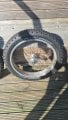
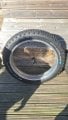
OK, although it is not clear to me about how they will be driven. Is there a sprocket that we are not shown?? Also, I question the load and drive power capability of the spokes. Wheels that width and diameter will be OK for hard paths and lighter loads, but they may not last long supporting a heavy adult load.
 

Thread Starter

monkeymagic75

Joined Mar 25, 2025
8
OK, although it is not clear to me about how they will be driven. Is there a sprocket that we are not shown?? Also, I question the load and drive power capability of the spokes. Wheels that width and diameter will be OK for hard paths and lighter loads, but they may not last long supporting a heavy adult load.
There is a unit that has the pedals and a motor built in to the crank! The sprocket attaches on the rear geared hub.

https://www.icetrikes.co/products/full-fat
 
Top